
Listen to this article
Checking audio support
By Day 3 of our Coorg trip, rain had stopped being a weather condition and become a permanent member of the group. Day 1 had welcomed us with a rainy arrival, a hidden hotel, warm tea and coffee, and a full day indoors. Day 2 had thrown us into river rafting, Bamboo Forest memories, reels, snacks, wet clothes, and nonstop friendship energy. So by the time Day 3 arrived, we were already fully trained in the art of getting wet and continuing anyway.
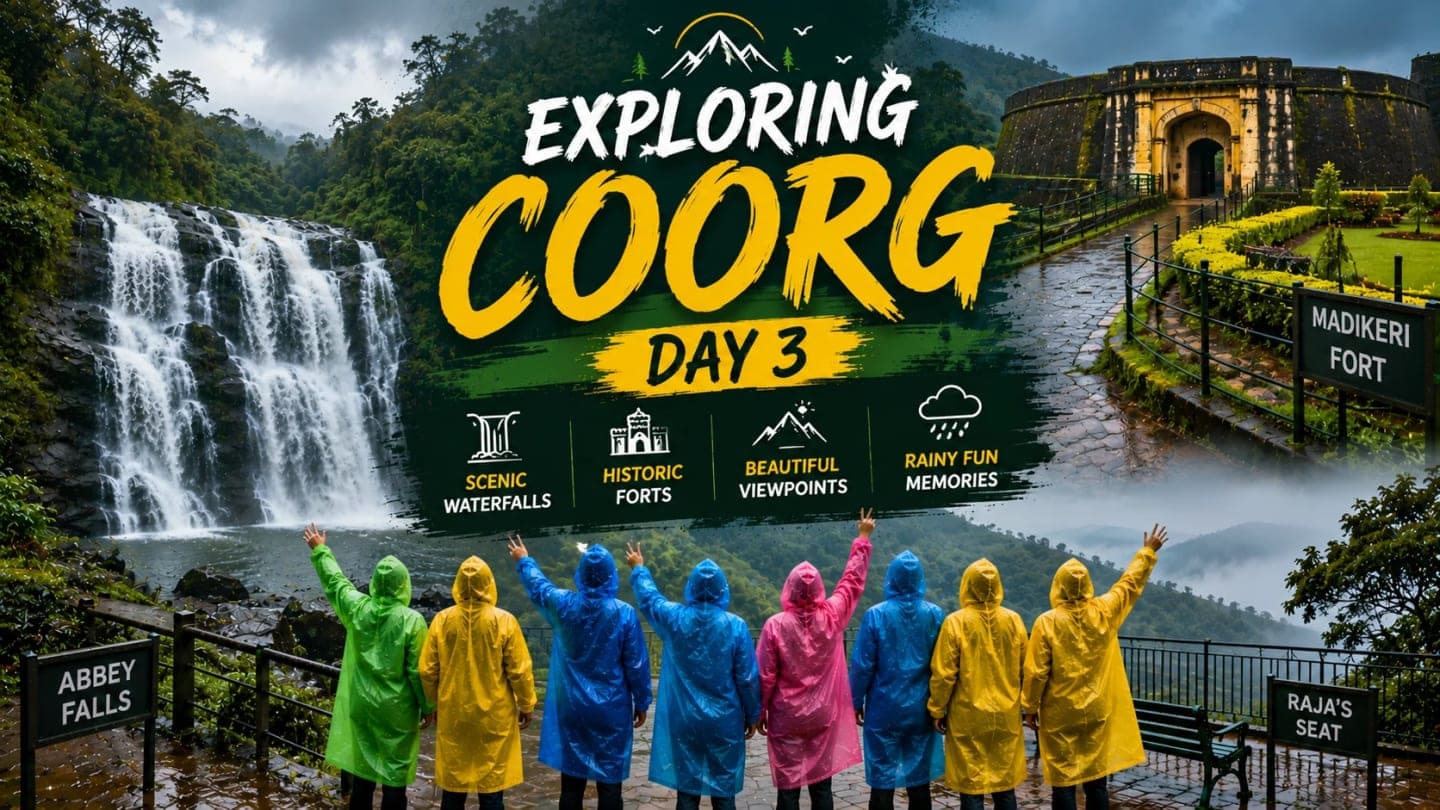
The same taxi wale bhaiya we had booked for the full three-day trip was waiting for us again, and that itself made the morning feel easier. The plan for the day was Abbey Falls first, then Madikeri Fort, then Raja’s Seat, and finally Raja’s Tomb, also known as Gaddige. The mood was simple: colourful raincoats, wet roads, cold weather, waterfall spray, Maggi, tea, coffee, reels, photos, and lots of masti.
And honestly, that is exactly what the day became.
Day 3 Started With the Same Taxi Wale Bhaiya
One very practical thing that helped our Coorg trip run smoothly was that we had booked the same taxi wale bhaiya for the full three days. So on the third day too, he was there waiting for us. We did not have to search again, bargain again, or explain our hotel location all over again. When you are travelling with friends in a rainy hill station, small conveniences like that matter more than they sound.
It was still raining, of course. By then we had fully accepted that Coorg and rain were a package deal. Nobody was shocked anymore. Nobody was asking whether it would stop.
All of us were ready, and all of us were in colourful raincoats. That visual itself became such a Day 3 memory. We looked like a cheerful moving rainbow walking into another wet day of sightseeing.
First Stop: Abbey Falls in the Rain
Our first stop was Abbey Falls. It kept raining that day too, and somehow that felt perfectly right for a place like this. Abbey Falls, also written as Abbi Falls, is one of the popular waterfalls near Madikeri and one of the best-known waterfall stops in Kodagu. Official sources differ slightly on the exact distance, with Karnataka Tourism placing it around 6 km from Madikeri and Kodagu district information placing it around 9 km away, but both agree on the main point: it is one of the major attractions near town and especially dramatic in rainy weather.
We reached Abbey Falls and all of us started walking toward the waterfall. There were a lot of people on the way, which was not surprising. A strong waterfall in monsoon is exactly the kind of thing everyone wants to see.
Walking Toward the Waterfall in Colourful Raincoats
The path was full of people, umbrellas, chatter, wet footsteps, and that growing sound of water you hear before a waterfall properly appears in front of you. And in the middle of all that, there we were in our colourful raincoats, turning the whole walk into something almost cartoonishly cheerful.
When the Waterfall Felt Aggressive
As we reached the viewpoint, the waterfall looked strong. Very strong. Karnataka Tourism describes the Kaveri dropping about 70 feet over wide rocks there, with a hanging bridge or viewing area giving a good look at the falls. In rainy season, that whole scene becomes more intense, and we felt that immediately.
How is it so far?
Vote with other readers
The water was not just falling in front of us. The spray was coming toward us too. It felt like the waterfall was reaching back at everyone who had come to stare at it. Beautiful, yes. But also aggressive. That is the word that stayed in my mind.
We made reels there and clicked a lot of pictures, but the combination of rain, spray, wind, and cold weather made us freeze properly. It was one of those moments where you are shivering and smiling at the same time.
Maggi, Tea, Coffee and One Very Bad Toilet Experience
After returning from the waterfall, we sat at a shop nearby to warm ourselves up with Maggi, tea, and coffee. That part felt so good because we were cold and wet and tired in exactly the way hot tea can fix, at least emotionally.
But there was also one very real and not-at-all-glamorous travel moment there: the toilet was extremely dirty. I do not want to make a big dramatic issue out of it or turn it into shop-shaming, but yes, it was bad enough to become part of the memory.
If there is one practical lesson there, it is this: always carry tissues, sanitizer, and wet wipes during hill-station sightseeing. Tourist-point facilities are not always well maintained, and sometimes the less photogenic travel advice is the most useful one.
Next Stop: Madikeri Fort
After Abbey Falls, we sat back in the taxi and moved toward Madikeri Fort. This stop changed the mood of the day. The waterfall had been wild, noisy, and full of spray. The fort brought in a heritage feeling instead.
Madikeri Fort is one of the important landmarks in the town. Official Kodagu district information says it was built by Mudduraja in 1681. The original earthen structure was later rebuilt in granite by Tipu Sultan. The palace inside was renovated by Lingarajendra II in 1814, and the British added features such as the clock tower and portico in 1933. That is a lot of history for one place, but thankfully the fort does not feel like a textbook. It feels like a lived-in historic stop.
And of course, we did what friends on a trip always do: we roamed around, clicked pictures, and had fun. Raincoats were still on. We were still wet. We were still enjoying.
That is what I love about these group trip memories. The place matters, but the people around you change the texture of the memory completely.
Raja’s Seat Garden: Coorg Views With Rain Around Us
Next, we went to Raja’s Seat Garden. Raja’s Seat is one of the most popular viewpoints near Madikeri. Official Kodagu district information says popular lore connects it to Kodava kings and their consorts, who are said to have spent their evenings there enjoying the scenery. Looking at the surrounding hills and valleys, it is not hard to understand why that story survived.
The rain was still with us. The view had clouds, mist, greenery, and that monsoon softness that makes even distance look dreamy. Rain can sometimes reduce visibility, and maybe it hides some of the big dramatic look people expect from viewpoints. But it also creates a different charm. The place feels more alive, more cinematic, and somehow more emotional.
So we clicked more pictures, walked around, and kept enjoying ourselves. By Day 3, our trip logic had become very simple: if rain comes, keep going.
Raja’s Tomb / Gaddige: A Quiet Heritage Stop
Lastly, we went to Raja’s Tomb, also called Gaddige. This stop felt quieter than the others, and that gave it its own charm. Gaddige is a royal tomb complex near Madikeri associated with Kodagu rulers such as Lingarajendra and Veerarajendra. Official district information notes the prominent domes and minaret-like turrets, which make the structure visually different from what many people expect in a hill-station outing.
We roamed around, took pictures, and enjoyed the place in our same colourful raincoats. By then those raincoats had practically become characters in the trip. Gaddige felt like a softer ending to the sightseeing sequence of the day. Not loud like the waterfall, not as central-town textured as the fort, but reflective in a nice way.
Rain Did Not Stop Us
It rained at Abbey Falls. It rained near the fort. It rained around Raja’s Seat and Gaddige. We kept getting wet. We kept feeling cold. And still, no one really wanted to stop enjoying.
By Day 3, colourful raincoats had become our uniform. We were no longer ordinary tourists. We were walking raincoat advertisements with cameras, reels, and too much group energy.
That is the thing about friendship and the right travel mood. Rain stops feeling like a problem and starts feeling like part of the memory. Wet sleeves, cold fingers, fogged-up photos, hot tea, extra laughter, and random poses in plastic raincoats somehow become the exact reason the day stays fresh.
Lock in the takeaway
Coorg Travel Stories
Frequently asked questions
Is Abbey Falls worth visiting in Coorg?
Yes, Abbey Falls is one of the popular waterfalls near Madikeri and is especially dramatic during the rainy season. Visitors should stay in permitted areas and follow safety rules.
How far is Abbey Falls from Madikeri?
Official sources differ slightly. Karnataka Tourism places Abbey Falls at around 6 km from Madikeri, while Kodagu district information lists it around 9 km away. Actual travel time can vary with traffic and weather.
Can we swim at Abbey Falls?
No. Karnataka Tourism clearly says bathing or swimming at Abbey Falls is not allowed.
Is Abbey Falls crowded?
It can get crowded, especially during tourist season, weekends, and holidays. We saw a lot of people on the way during our visit.
Who built Madikeri Fort?
Madikeri Fort was built by Mudduraja in 1681. It was later rebuilt in granite by Tipu Sultan and further renovated during later periods including Lingarajendra II and the British.
What is Raja’s Seat in Coorg?
Raja’s Seat is a popular viewpoint and garden near Madikeri. Local lore says Kodava kings and their consorts used to spend evenings there enjoying the surrounding views.
What is Raja’s Tomb or Gaddige?
Raja’s Tomb, also called Gaddige, is a royal tomb complex near Madikeri associated with Kodagu rulers such as Lingarajendra and Veerarajendra.
Can Abbey Falls, Madikeri Fort, Raja’s Seat and Gaddige be covered in one day?
Yes, they can usually be planned as part of one Madikeri sightseeing day, but rain, crowd, traffic, and energy levels can affect the pace.
What should I carry for Coorg sightseeing in monsoon?
Carry a raincoat or umbrella, waterproof phone protection, extra clothes, good footwear, sanitizer, tissues, water, and light snacks.
Is Coorg fun during rainy season?
Yes, Coorg feels very green and beautiful during rainy season, but travel plans need flexibility because rain can affect roads, visibility, and outdoor comfort.