
Listen to this article
Checking audio support
SnackNow Gets Many Orders at Once
At 7 PM, the kitchen receives twelve orders in the time it takes Meera to say 'one masala chai.' The backend faces the same shape of pressure: menu requests, cart updates, payment calls, inventory changes, and delivery lookups arrive together.
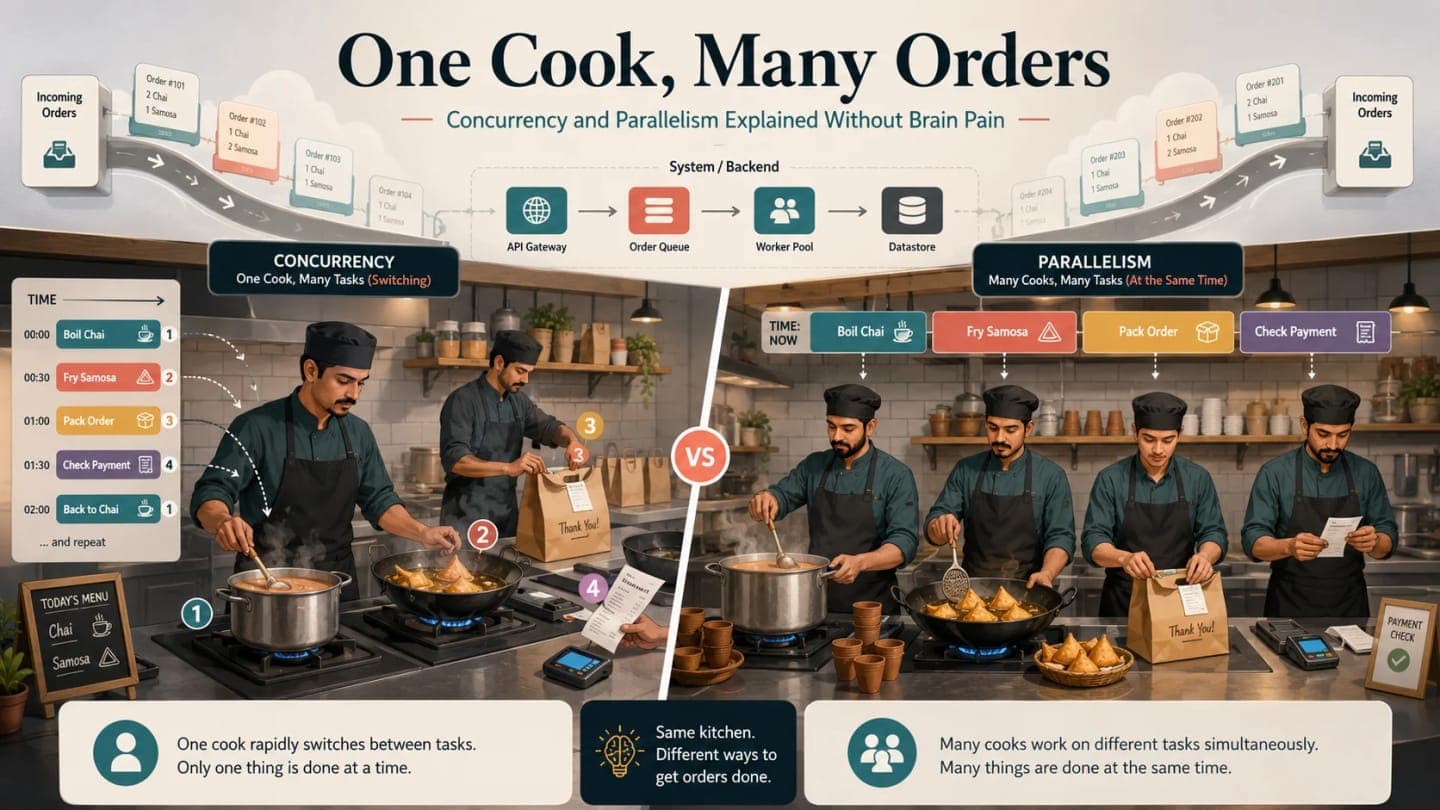
SnackNow's first kitchen has one cook. He puts water on the stove, checks a payment slip while it boils, drops samosas into oil, packs a finished order, then returns to the chai. Several orders are in progress, but the cook is still one person.
Later Meera adds more cooks. One handles chai, one fries samosas, one packs, and one manages delivery slips. Now separate tasks truly execute at the same time.
Aman: 'Many tasks in progress is not always the same as many tasks executing at the same instant.'
That distinction is the foundation for concurrency and parallelism. Both help systems handle work, but they solve different parts of the problem.
Concurrency is about coordinating overlapping tasks. Parallelism is about executing tasks simultaneously.
Concurrency: Managing Many Tasks
Concurrency means multiple tasks make progress during overlapping periods. The system can pause one task while it waits, work on another, and return later. The tasks do not need to execute in the same CPU instant.
The single cook is concurrent because chai, samosa, packing, and payment checking overlap as jobs. Whenever one task waits for water, oil, or a response, he advances another task. On a single CPU core, a scheduler can create the same pattern by interleaving tasks.
Concurrency improves responsiveness when work contains waiting. A web request that waits for a database or payment provider does not need to own a worker doing nothing throughout the entire wait, if the runtime and application use non-blocking I/O.
Concurrency does not promise that every task finishes faster. It helps the system remain productive and responsive while several tasks are active.
Memory hook: one cook juggling several orders by switching at useful moments is concurrency.
Parallelism: Doing Many Tasks at the Same Time
Parallelism means tasks execute simultaneously. Four cooks can physically prepare chai, samosa, packing, and delivery work at the same moment. In computing, this normally requires multiple CPU cores, processes, threads, workers, machines, or accelerators that can run at once.
Parallelism is valuable for CPU-heavy work that can be split into independent pieces. SnackNow might resize many restaurant images, calculate report partitions, compress exports, or transform large datasets across several workers.
Adding workers does not guarantee linear speedup. Some work cannot be divided, workers may compete for memory or locks, coordination has cost, and one slow shared dependency can become the new limit. Four cooks sharing one tiny stove do not create a four-times-faster kitchen.
Memory hook: several cooks actually working at the same time is parallelism.
Concurrency vs Parallelism
Visual purpose: This visual helps you understand the questions that distinguish overlapping task management from simultaneous execution.
Question | Concurrency | Parallelism | SnackNow hook |
|---|---|---|---|
Core idea | Manage several active tasks | Execute several tasks at once | One cook switches vs many cooks work |
Needs multiple cores? | No | For true CPU execution, usually yes | One cook can still juggle |
Primary goal | Responsiveness and utilization | Speed and throughput | Avoid idle waiting vs add cooking capacity |
Strong fit | I/O-bound overlapping work | Independent CPU-heavy work | Payment waits vs image processing |
Main danger | Too much active work and shared-state complexity | Coordination, contention, and overhead | Too many slips vs too few shared tools |
How to read this visual: ask whether tasks merely overlap in progress or physically execute together. Then ask whether the workload spends time waiting on I/O or consuming CPU. Those answers guide the model.
Visual purpose: This visual helps you understand one intuitive kitchen comparison for concurrency and parallelism.
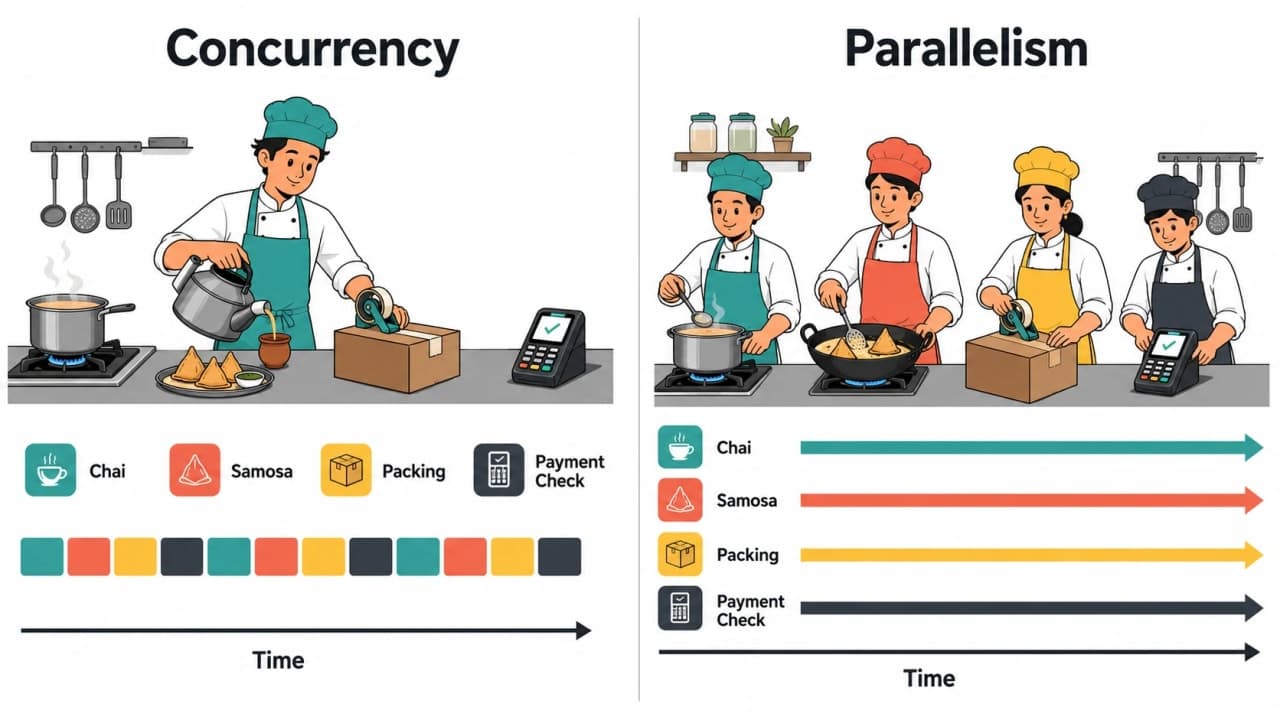
How to read this visual: the left timeline interleaves one cook's attention across tasks. The right timeline aligns several cooks working at the same moment. Both handle many orders, but only the right side is truly parallel.
A concurrent design can run on one core; a parallel design needs execution resources that can run at the same time.
Processes vs Threads
Meera can expand SnackNow with separate kitchens or more workers inside one kitchen. That maps neatly to processes and threads.
A process is an isolated execution environment with its own address space. A crash or memory corruption in one process is less likely to directly overwrite another process's memory. Isolation improves safety, but creating processes and moving data between them is usually heavier.
A thread is an execution path inside a process. Threads share the process memory, open resources, and heap, while each thread has its own stack and execution state. Sharing makes communication fast, but it also lets two threads touch the same data at dangerous times.
Visual purpose: This visual helps you understand why processes offer stronger isolation while threads communicate through shared memory.
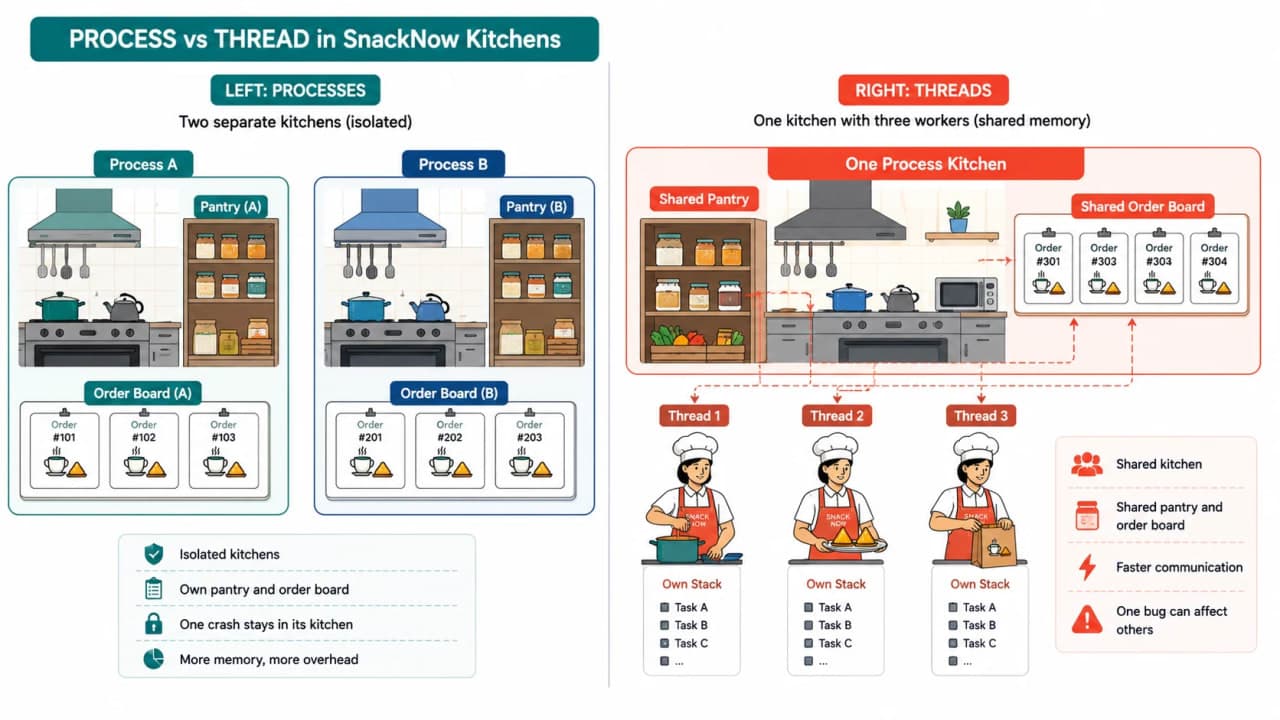
How to read this visual: separate process kitchens have their own pantry and board. Threads live in one kitchen and share those resources, so coordination is cheaper but shared-state mistakes are possible.
Property | Process | Thread |
|---|---|---|
Memory | Separate address space | Shares process memory |
Isolation | Stronger failure boundary | One bad thread can affect the process |
Creation/switching | Typically heavier | Typically lighter |
Communication | IPC, sockets, shared mechanisms | Direct shared memory |
Typical use | Service or compute isolation | Concurrent work within one runtime |
Modern runtimes add abstractions such as tasks, coroutines, fibers, and event loops. Aman does not force every abstraction into one operating-system label. He asks what actually executes, what waits, what memory is shared, and what failure boundary exists.
Thread Pools: Reusable Workers
Creating one new thread for every request sounds simple until ten thousand requests arrive. Each thread needs memory for its stack and scheduling overhead. Too many runnable threads spend time switching and competing instead of completing useful work.
A thread pool creates a bounded team of reusable workers. Incoming tasks wait in a task queue. An available thread picks a task, executes it, and returns to the pool. Reuse avoids repeated creation cost, while the bound protects the process from unlimited thread growth.
Pool size is a capacity decision. A CPU-heavy pool near the number of useful cores may be sensible. An I/O-heavy model may support more active tasks because many are waiting, but async I/O often avoids parking a thread per wait. An oversized pool can increase memory, contention, and latency.
Thread pools convert unlimited thread creation into a controlled queue plus a reusable worker budget.
Async I/O: Do Not Block the Worker While Waiting
How is it so far?
Vote with other readers
A SnackNow request calls the database. The database takes 80 milliseconds. A blocking model keeps the worker occupied until the answer returns even though the worker cannot make the network respond faster.
With async, non-blocking I/O, the worker starts the operation and yields control. The operating system or runtime tracks the wait. The worker can advance other ready work. When the result arrives, the continuation becomes ready and a worker resumes it.
Async does not mean no threads exist, and it does not make I/O instant. It changes resource use during waiting. That often raises concurrency and throughput because a small worker set can coordinate many in-flight operations.
Visual purpose: This visual helps you understand how a bounded worker pool remains available while database and payment operations wait.
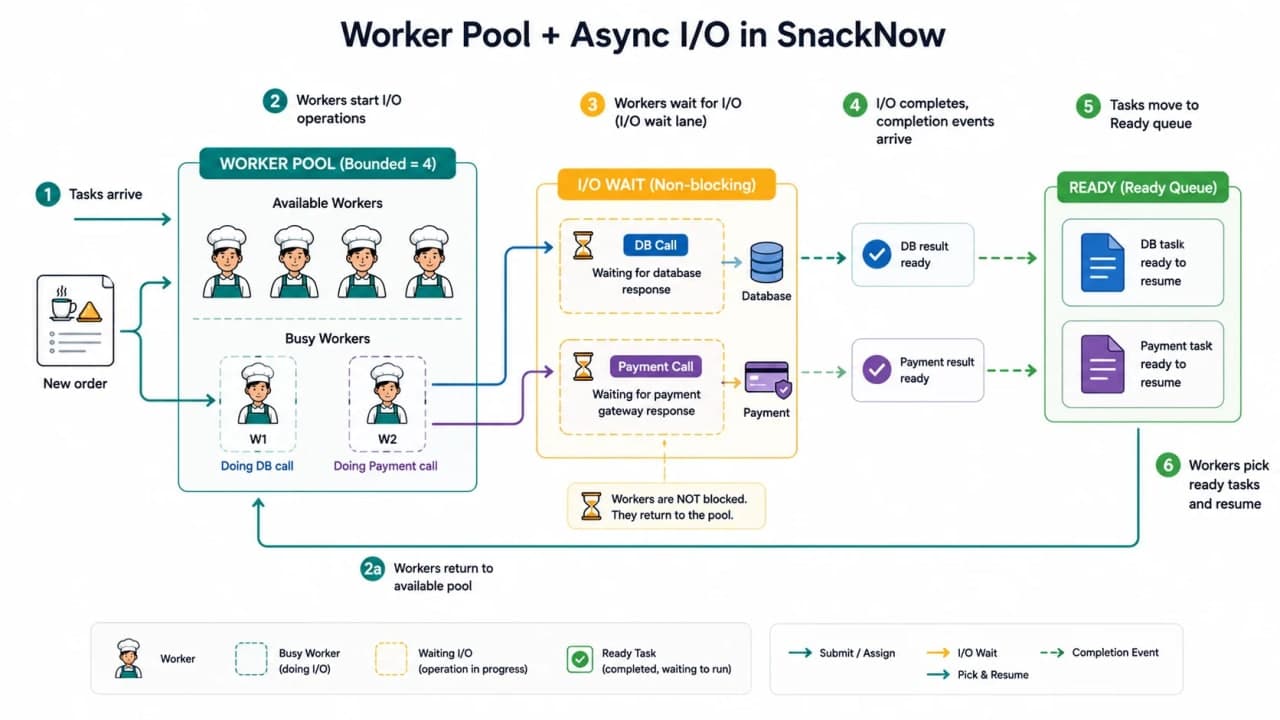
How to read this visual: workers start I/O, move the task into a waiting lane, and return to the pool. Completion places the task into a ready lane. A worker resumes it when capacity is available.
Async I/O improves the waiting model; it does not add CPU power for compute-heavy work.
How Web Servers Handle Thousands of Requests
Web servers combine several ideas. A traditional thread-per-request server may dedicate a thread to each active request. This model is straightforward but can become expensive when many requests mostly wait.
Event-loop servers coordinate many connections with non-blocking I/O and a small number of event-loop threads. Thread-pool-based runtimes can also use asynchronous APIs so request threads are not held during external waits. CPU-heavy tasks may move to separate worker pools or processes.
The implementation details differ across Nginx, Node.js, Java, .NET, and other runtimes. The reusable model is simpler: accept connections, avoid blocking scarce workers on I/O, bound queues and pools, isolate CPU-heavy work, and measure saturation.
Server concern | What can go wrong | Design direction |
|---|---|---|
Too many blocked workers | New requests wait for threads | Use non-blocking I/O and bounded pools |
CPU-heavy callback | Event loop or request worker stalls | Move to parallel worker/process capacity |
Unbounded task queue | Memory and tail latency grow | Apply limits and backpressure |
Shared mutable state | Race conditions corrupt results | Prefer ownership, atomic updates, or synchronization |
Interview-ready answer: High-concurrency servers avoid one blocked resource per waiting request, reuse bounded workers, and separate I/O-bound coordination from CPU-bound execution.
Background Jobs and Worker Models
SnackNow's order queue needs consumers. Those consumers are workers, and several worker instances may run concurrently. Increasing workers can raise throughput until they reach CPU, database, network, or downstream rate limits.
Background email sending is mostly I/O-bound: workers wait on a provider. Image transformation is CPU-bound: workers actively compute. The same worker count and runtime model should not be copied across both jobs.
A worker model needs a bounded intake, visibility into queue age and processing time, graceful shutdown, retry safety, and idempotent effects. Concurrency controls how many jobs one worker instance handles; horizontal scaling controls how many worker instances exist.
The queue explains where work waits. The concurrency model explains how available workers advance it. They connect, but they are not the same concept.
Race Conditions: Two Workers Touch the Same Slip
SnackNow has one samosa left. Worker A reads stock as one. Worker B reads stock as one before A commits. Both accept an order and both write stock as zero. Each individual calculation looks reasonable. Together they oversell.
A race condition occurs when the result depends on the unpredictable timing or interleaving of concurrent operations on shared state. Reproducing it can be difficult because logging and debugging change timing.
Possible protections include a database transaction with an atomic conditional update, a mutex around an in-process critical section, an atomic compare-and-swap operation, thread-safe collections, immutability, or assigning one owner to the state. The right mechanism depends on whether the contenders share one process, one database, or several machines.
A lock inside one server cannot protect inventory updates made by five other servers. Synchronization must cover the real sharing boundary.
The safest shared state is often state that has one clear owner or can be changed atomically.
Deadlocks: Everyone Waits Forever
Worker A holds the inventory lock and waits for the order lock. Worker B holds the order lock and waits for the inventory lock. Neither can continue, and neither releases what the other needs. The system is not slow; this part of it has stopped.
A deadlock requires a circular wait around resources that cannot simply be taken away. It becomes more likely when code acquires multiple locks in inconsistent orders or holds locks while performing slow I/O.
Acquire multiple locks in one documented global order.
Keep critical sections small and never hold a lock longer than necessary.
Avoid calling slow network or database operations while holding an in-process lock.
Use timeouts or cancellation where the operation can recover safely.
Prefer immutable data, atomic operations, concurrent collections, or ownership models when they remove the need for nested locks.
Capture thread or task dumps and lock-wait evidence when diagnosing a real deadlock.
Visual purpose: This visual helps you understand the timing difference between a race that produces a wrong result and a deadlock that prevents progress.
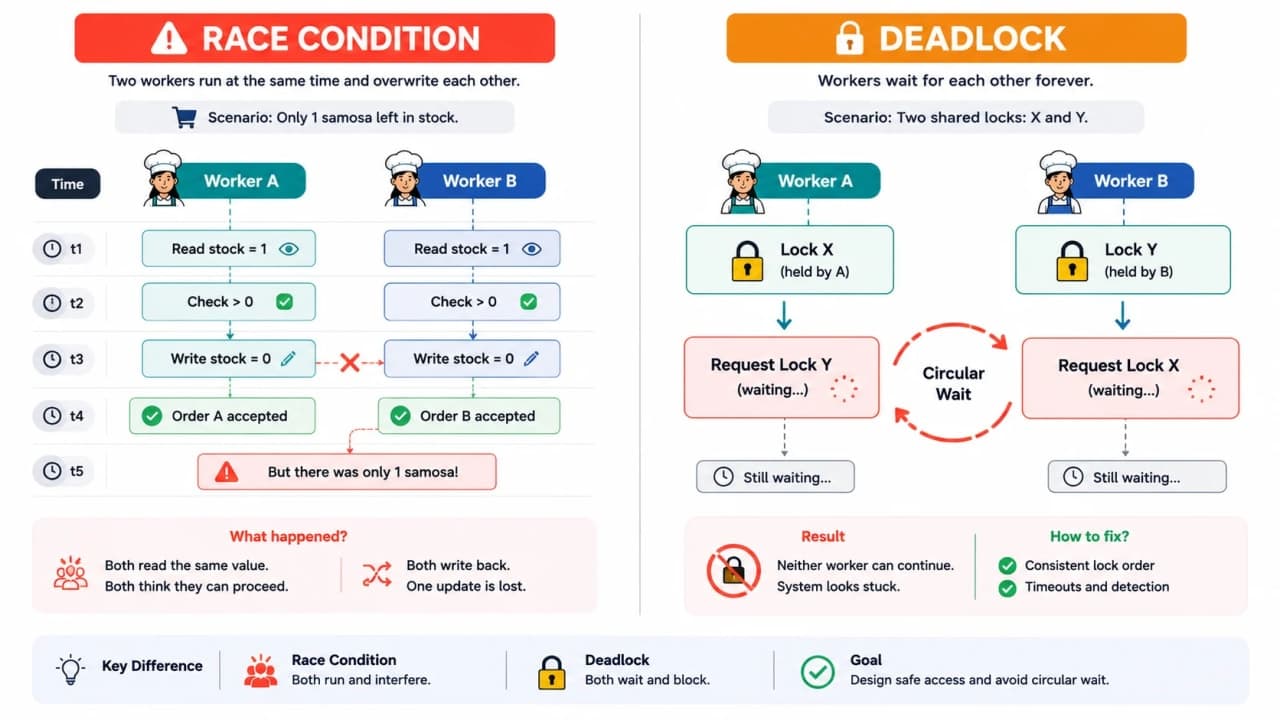
How to read this visual: the left timeline allows both workers to finish but produces an invalid stock result. The right timeline forms a cycle, so neither worker can finish at all.
Common mistake: Adding locks everywhere can prevent some races while creating contention and new deadlock paths.
When to Use What
Visual purpose: This visual helps you understand how workload shape points toward async coordination, bounded workers, or true parallel execution.
Workload | Better fit | Why | SnackNow caution |
|---|---|---|---|
I/O-bound API | Async I/O with bounded request resources | Most time is spent waiting | Do not block the event loop or worker pool |
CPU-heavy image processing | Parallel worker processes or threads | More cores can execute independent transforms | Bound workers to CPU and memory |
Background email sending | Queue plus concurrent I/O workers | Provider calls spend time waiting | Respect provider rate limits |
Payment waiting | Async I/O on the immediate request path | User needs the answer but worker need not block | Keep timeout and idempotency |
Large report generation | Background job plus bounded parallel partitions | Long compute and I/O should not hold HTTP request | Control database load and merge cost |
How to read this visual: first classify the dominant cost as waiting or computing. Then decide whether the caller needs the result now, how much parallel capacity exists, and what shared state requires protection.
Common Concurrency Mistakes
Treating concurrency and parallelism as synonyms
The design adds threads when the real benefit would come from not blocking during I/O, or adds async syntax to CPU-heavy work that still runs on one core.
Creating unlimited threads or tasks
Memory, scheduling, open connections, and downstream systems saturate. Concurrency must be bounded even when task creation is cheap.
Blocking an event loop or shared worker pool
One expensive callback or synchronous operation delays many unrelated requests sharing the same execution resource.
Ignoring shared state
The happy path works in tests, while production timing exposes lost updates, duplicates, and corrupt counters.
Using locks as the first answer
Broad locks serialize useful work. Nested locks create cycles. Ownership or atomic database operations may match the boundary better.
Forgetting cancellation and timeouts
Abandoned work keeps consuming workers, locks, or external capacity after the caller no longer needs it.
Using async as a CPU speed button
Async can free a worker during waiting, but compute still needs CPU time and may require parallel execution or a separate job.
Final Concurrency Cheat Sheet
Visual purpose: This visual helps you understand the vocabulary, workload fit, and failure risks needed for a clear interview answer.
Concept | Simple meaning | SnackNow hook | Best fit | Watch out for |
|---|---|---|---|---|
Concurrency | Overlapping progress | One cook juggles orders | Many waiting tasks | Unbounded active work |
Parallelism | Simultaneous execution | Many cooks work | Independent CPU tasks | Contention and coordination |
Process | Isolated execution space | Separate kitchen | Failure or compute isolation | Heavier communication |
Thread | Shared-memory execution path | Worker in one kitchen | Lightweight in-process work | Races and deadlocks |
Thread pool | Reusable bounded workers | Fixed cook team | Controlled task execution | Bad sizing and queue growth |
Async I/O | Yield while waiting | Cook works while water boils | Network, DB, file waits | Blocking shared executor |
Race condition | Timing changes result | Two sell last samosa | Shared-state review | Rare production timing |
Deadlock | Circular waiting | Workers hold each other's tools | Multi-lock code | No progress |
Atomic operation | One indivisible state change | Sell only if stock remains | Counters and guarded transitions | Wrong system boundary |
How to read this visual: classify waiting versus computing, choose a bounded execution model, identify shared state, and name how races, deadlocks, cancellation, and overload are controlled.
The Mental Model Aman Keeps
When many SnackNow requests arrive, Aman asks four questions. Are tasks mostly waiting or computing? Does the caller need the result now? Can work execute independently on several cores or workers? What state is shared?
For menu and payment network calls, concurrency with non-blocking I/O keeps workers useful during waits. For image transformation, bounded parallel workers use available CPU. For background notifications, a queue feeds concurrent workers. For the last samosa, an atomic inventory rule protects shared truth. For repeated menu reads, caching removes avoidable database work before those requests consume worker capacity.
He does not chase the largest thread count or add async keywords everywhere. He chooses an execution model that matches the workload, bounds it so overload becomes visible, and makes shared-state rules explicit.
Concurrency keeps many tasks moving; parallelism adds simultaneous execution; correctness decides whether the speedup is worth having.
Lock in the takeaway
Frequently asked questions
What is the difference between concurrency and parallelism?
Concurrency is the coordination of multiple tasks whose progress overlaps. Parallelism is the simultaneous execution of multiple tasks, usually using multiple CPU cores or workers. A system can be concurrent without being parallel.
What is the difference between a process and a thread?
A process has its own address space and stronger isolation. Threads run inside a process, share its memory and resources, and have separate execution stacks. Sharing makes communication cheaper but creates synchronization risk.
Why do servers use thread pools?
Thread pools reuse a bounded set of workers instead of creating a new thread for every task. This controls memory and scheduling overhead while letting tasks wait for an available worker.
How does async I/O improve concurrency?
Async I/O lets a worker start a network, database, or file operation and become available while the operating system or runtime waits. The task resumes when the result is ready, reducing blocked-worker time.
What is a race condition?
A race condition occurs when the result depends on the timing of concurrent operations that access shared state. For example, two workers may both read the last inventory item and both sell it unless the update is atomic.
What is a deadlock?
A deadlock occurs when tasks wait indefinitely for resources held by one another. Consistent lock ordering, smaller critical sections, timeouts, and avoiding unnecessary nested locks reduce the risk.
Should CPU-heavy work use async I/O?
Async I/O helps while waiting on external operations. CPU-heavy work still consumes compute time and usually needs bounded parallel workers, separate processes, or specialized compute capacity rather than more asynchronous callbacks.