
Listen to this article
Checking audio support
Riya Places an Order, But the App Makes Her Wait
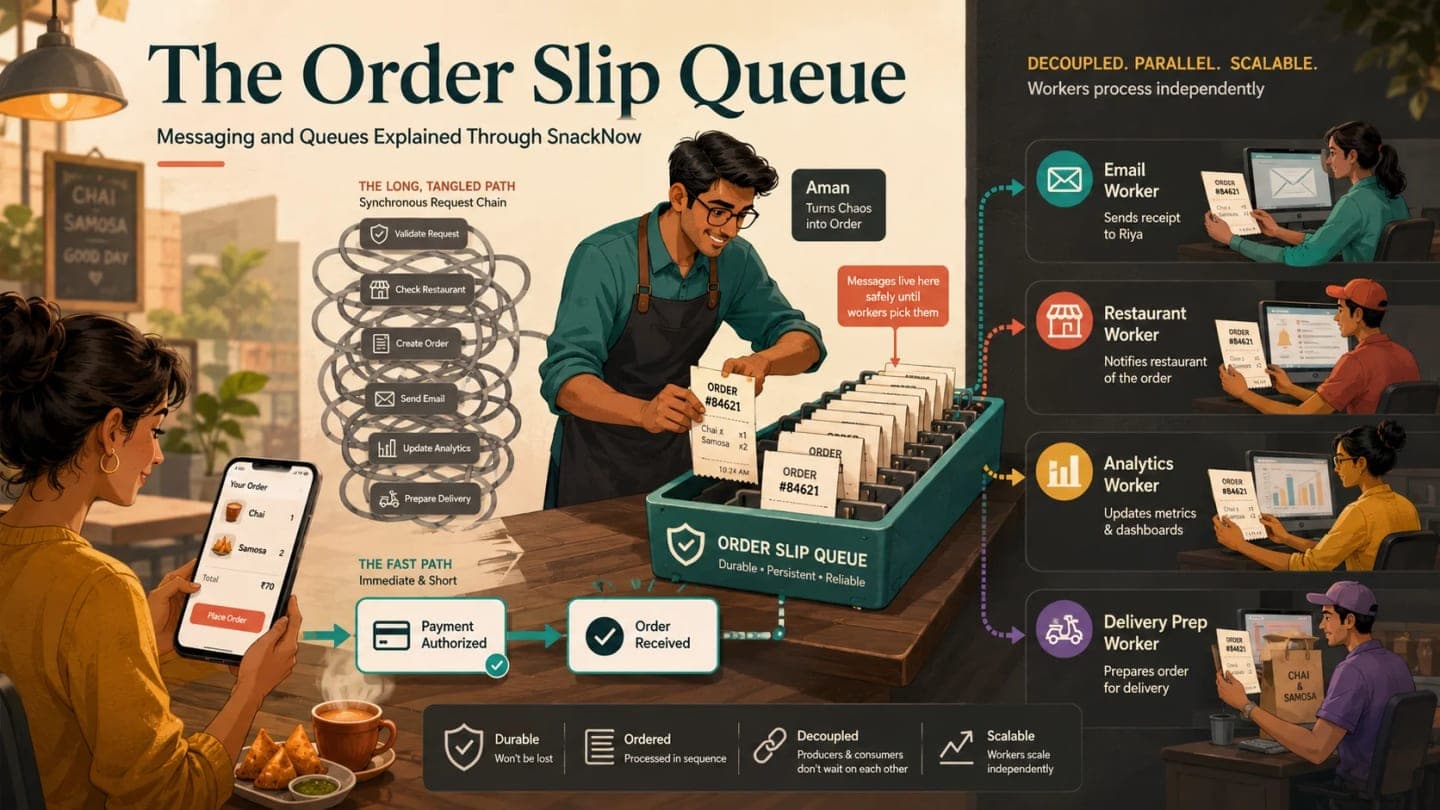
Riya taps Place Order. SnackNow validates the cart, creates the order, reserves inventory, calls the payment provider, sends an email, sends an SMS, updates analytics, notifies the restaurant, and starts delivery assignment. Every step waits for the previous one. Riya watches the spinner perform its longest solo of the evening.
Some of this work is essential before SnackNow can honestly say the order was received. The cart total must be valid. The system needs a durable order identity. Payment authorization may need an immediate result. But does Riya need to wait for the email provider, analytics pipeline, and delivery-planning worker before the app can acknowledge her order?
Aman: 'Not everything must finish before Riya sees Order received.'
That sentence is the doorway to asynchronous messaging. It does not mean 'make everything eventually happen.' It means separate the critical path from work that can complete later, then give that later work a reliable handoff.
A queue is useful only after the business decides what must be true now and what may become true later.
The Core Idea: Put Some Work on a Queue
Meera's restaurant already understands the pattern. The cashier writes an order slip and places it on a tray. The cook does not need the cashier to stand beside the stove. The cashier can accept the next customer while the cook works through slips at a safe pace.
In SnackNow, the order service can publish a message after critical checkout work succeeds. A broker stores and delivers that message. Background consumers pick it up for email, restaurant notification, analytics, or delivery preparation. The user-facing request no longer waits for every downstream task.
The queue is a buffer, not a teleportation device. Work still consumes CPU, network, database capacity, and third-party limits. The difference is that producers and consumers no longer have to move at the same instant.
Visual purpose: This visual helps you understand which checkout work belongs on the immediate path and which work can continue through a queue.
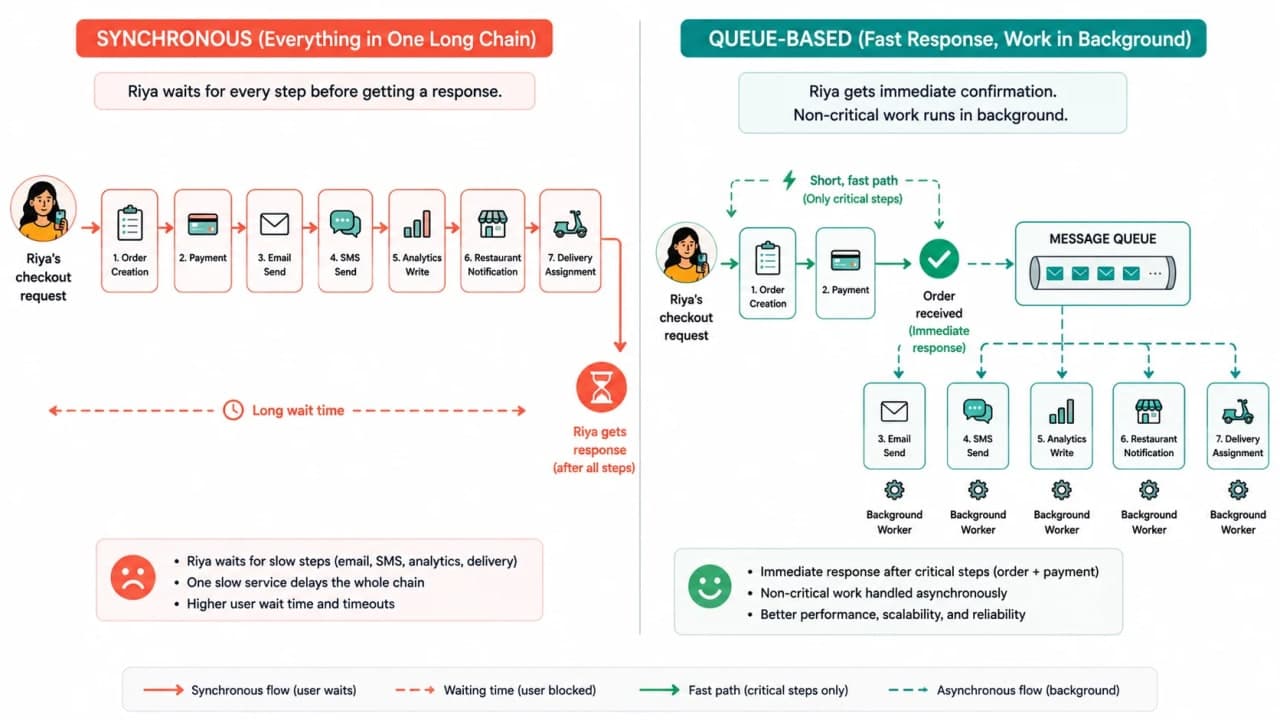
How to read this visual: compare response boundaries. On the left, the response waits at the end of the entire chain. On the right, SnackNow responds after critical order and payment work, while clearly non-critical tasks continue from the queue.
Checkpoint: Moving work to a queue changes completion time and failure handling. It does not make the work free or automatically safe.
Producer, Consumer, Broker, Queue, Topic, and Ack
Messaging becomes easier when each term gets one job in the SnackNow story.
Term | Plain meaning | SnackNow order-slip hook |
|---|---|---|
Message | A packet describing work or an event | Order 8421 was accepted |
Producer | The component that publishes | Order service writes the slip |
Broker | The system that stores and delivers | Counter manager controls the trays |
Queue | A channel where work is consumed | Email slips wait for email workers |
Topic | A named stream multiple subscribers can read | Order accepted reaches analytics and delivery groups |
Consumer | A component that processes | Email worker sends the confirmation |
Ack | Confirmation that required work completed | Worker says this slip is safely done |
A queue commonly distributes each message to one worker in a consumer group. A topic or publish-subscribe stream lets independent subscriber groups receive the same event for different purposes. Exact behavior depends on the broker, but the business distinction is stable: is this one task to complete, or one event that several capabilities may observe?
Acknowledgement is not a polite receipt. It transfers responsibility. An email consumer should acknowledge after it has sent the email or durably recorded the send state required by its design. If it acknowledges first and crashes before doing the work, the broker may believe the message is finished.
Visual purpose: This visual helps you understand how a message moves from producer through broker to consumers and how acknowledgement closes the responsibility loop.
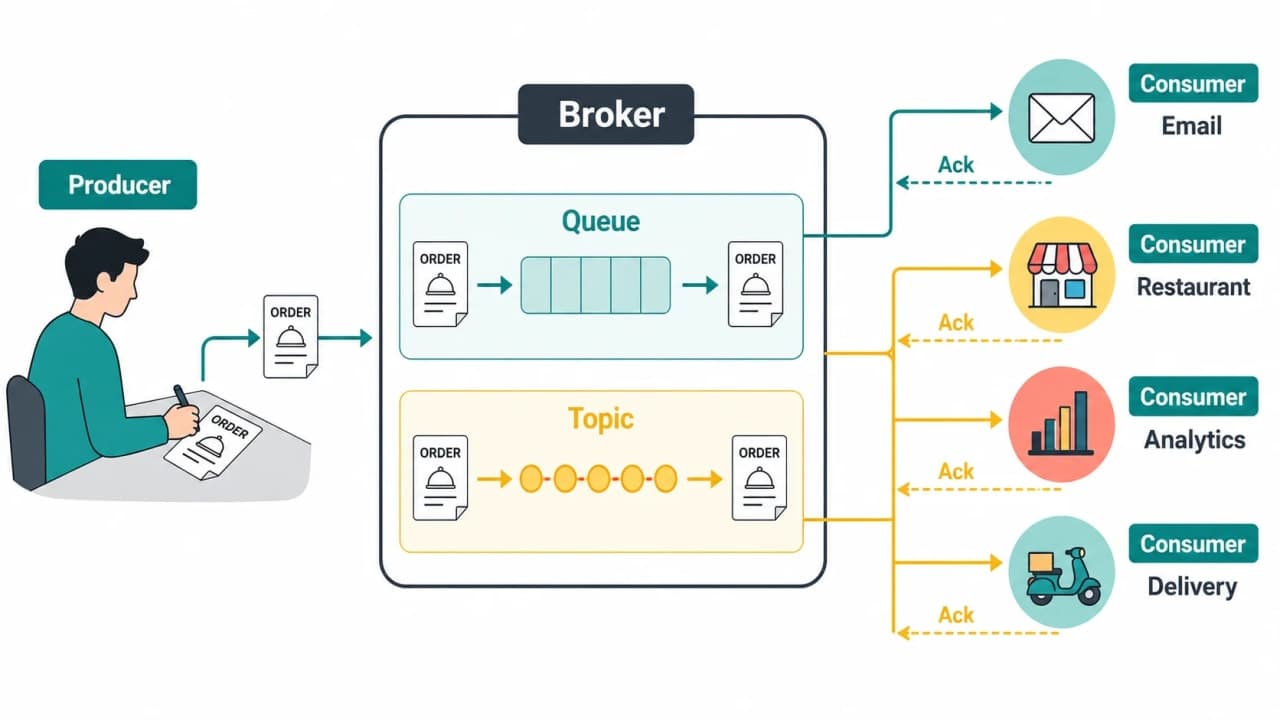
How to read this visual: follow the slip from producer to broker. A queue assigns work to a consumer, while a topic can feed several independent consumer groups. The acknowledgement travels back only after the consumer's responsibility is complete.
Acknowledge after the business effect is safe, not merely after the message reaches application code.
Durability: Will the Slip Survive a Restart?
A queue can separate time without guaranteeing survival. Message durability asks whether accepted work remains available when a broker process or node fails. The answer can depend on several layers: the queue or topic configuration, whether the message is marked for persistent storage, whether the broker replicated it, when data was flushed, and whether the producer received a confirmation that the broker took responsibility.
A durable queue carrying transient messages is not the same as durable work. Likewise, a producer that sends and forgets cannot know whether the broker accepted the message. For important SnackNow order events, Aman chooses durable broker storage, appropriate replication, and publisher confirmation, then tests broker failure instead of trusting configuration names.
Durability is an end-to-end claim: the producer knows the broker accepted the message, the broker can survive the intended failure, and the consumer acknowledges only after its own effect is safe.
Why Queues Improve Performance and Resilience
The visible speed improvement comes from shortening the critical path. Riya waits for order acceptance and payment, not for three notification providers and an analytics pipeline.
Producers return without waiting for non-critical consumers.
Consumers scale independently when one kind of work becomes busy.
The queue absorbs short traffic bursts instead of sending the entire burst downstream at once.
Services become loosely coupled because the producer publishes a contract rather than calling every consumer directly.
A temporary consumer outage can delay work without immediately rejecting the producer, if queue durability and capacity are designed correctly.
Failures remain closer to the consumer responsible for that work instead of breaking the checkout request.
There is a tradeoff. The system now contains work that is accepted but not yet complete. SnackNow must expose truthful states such as Order received, Restaurant notified, and Courier assigned instead of pretending every downstream action happened instantly.
Performance benefit: remove unnecessary waiting. Reliability obligation: make delayed work observable, retryable, and safe.
When to Use Queues
Queues fit work that may happen after the immediate response, arrives in bursts, needs independent scaling, or must respect a slower downstream limit.
Work | Why a queue helps | SnackNow example | Completion signal |
|---|---|---|---|
Email/SMS | Provider latency should not block checkout | Send order confirmation | Notification status recorded |
Image processing | CPU-heavy work can run on dedicated workers | Resize restaurant photos | Image variants ready |
Analytics logging | High-volume events can be buffered | Record order and click events | Event stored by analytics pipeline |
Background export | Long jobs outlive one HTTP request | Generate Meera's sales CSV | Export URL becomes available |
Rate-limited API | Workers can pace calls | Delivery partner assignment | Partner accepts request |
ETL/stream processing | Independent consumers transform events | Order events feed reporting | Processed checkpoint advances |
The decision is not based only on task duration. A 50-millisecond email enqueue can be asynchronous because the result is not needed immediately. A 200-millisecond payment authorization may remain synchronous because the user must know whether checkout succeeded.
When Not to Use a Queue
A queue is the wrong boundary when the caller needs the answer before it can continue. Login validation, cart totals, permission checks, available delivery slots, and payment authorization usually need a direct result in the user flow.
Queuing order creation itself can be dangerous if SnackNow shows success before any durable order exists. A safer beginner model is to create an idempotent pending order, obtain the required payment outcome, commit the accepted state, and then publish events for downstream work.
A tiny application with one reliable process may not need a broker for every background task. Queues add contracts, serialization, operations, dashboards, retention, retries, and failure states. Aman chooses them where decoupling or buffering pays for that complexity.
If the caller cannot proceed without the result, a queue usually moves the waiting somewhere else rather than removing it.
Delivery Guarantees: What Can Happen to One Slip?
How is it so far?
Vote with other readers
Distributed systems cannot promise delivery with one casual sentence. Networks fail, workers crash, acknowledgements disappear, and brokers restart. Delivery guarantees describe what the system prefers when it cannot know whether work completed.
Visual purpose: This visual helps you understand the tradeoff among message loss, duplicate processing, and implementation complexity.
Guarantee | Meaning | Primary risk | SnackNow example |
|---|---|---|---|
At-most-once | No retry after uncertain delivery | A message may be lost | Non-critical telemetry where duplicates cost more than gaps |
At-least-once | Retry until acknowledged | A message may be processed more than once | Order notification with idempotent consumer |
Exactly-once scope | One logical effect within defined boundaries | High complexity and hidden boundary assumptions | Transactional stream processing with supported broker and sink |
How to read this visual: choose the failure you can safely handle. At-most-once accepts possible loss. At-least-once accepts possible duplicates and demands idempotency. Exactly-once must name the precise systems and transaction boundary it covers.
Exactly-once delivery is often shorthand for exactly-once processing within a constrained platform workflow. It does not automatically prevent a consumer from charging a card twice in an unrelated external system. End-to-end business safety still depends on idempotency keys, unique constraints, or coordinated transactions.
Interview-ready answer: At-least-once is common because retries protect against loss, but consumers must be idempotent to make duplicates harmless.
Retries and Dead-Letter Queues
The email provider returns a temporary 503. Retrying makes sense. The consumer waits with exponential backoff and jitter, then tries again. Immediate tight-loop retries would create a retry storm and pressure a dependency that is already unhealthy.
Another message contains an invalid address format and fails every time. This is a poison message. Retrying it forever blocks capacity and hides the real defect. After a defined attempt count, the broker or consumer routes it to a dead-letter queue, sometimes called a DLQ.
A useful dead-letter record keeps the original message, error reason, attempt count, timestamps, and relevant tracing identifiers. Operators can inspect, repair, replay, or discard it through a controlled process. A DLQ is not a cupboard where failures are hidden forever.
Visual purpose: This visual helps you understand the branching policy for successful work, temporary failures, and repeatedly unprocessable messages.
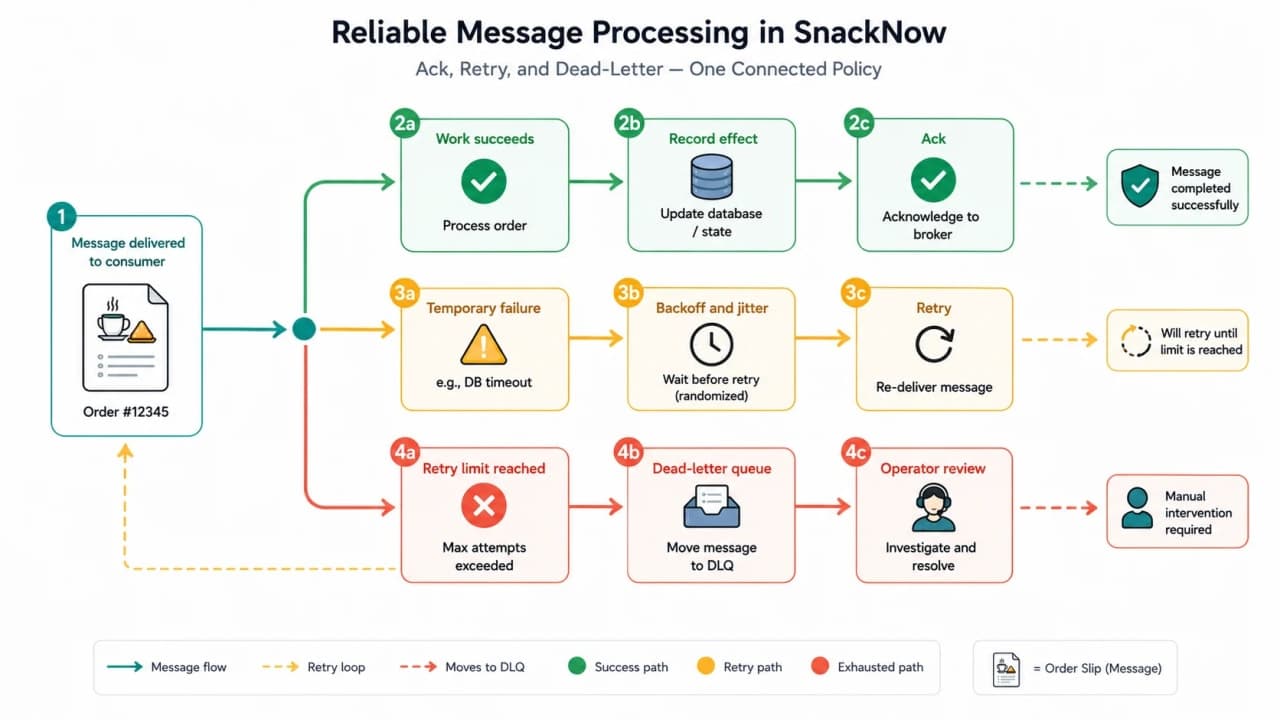
How to read this visual: green work completes and is acknowledged. Yellow failures retry after delay. Coral failures that exceed policy move to the DLQ for investigation instead of circulating forever.
Retry only errors that may succeed later.
Use exponential backoff and jitter to avoid synchronized retry bursts.
Limit attempts or total retry age.
Preserve failure context in the dead-letter record.
Alert on DLQ growth and oldest unreviewed message age.
Replay only after the underlying cause or message data is safe.
Idempotent Consumers: The Same Slip Must Not Create Two Orders
An email worker completes the send, but crashes before its acknowledgement reaches the broker. The broker delivers the message again. From the broker's view, retrying is correct. From the customer's view, receiving a second email is annoying. Repeating an inventory reservation or payment charge is much worse.
An idempotent consumer produces the same final business state when it handles the same logical message more than once. SnackNow can attach a stable message ID or order ID, record processed IDs, enforce a unique database constraint, and make state transitions conditional.
For example, Reserve inventory for order 8421 should succeed only if order 8421 has not already reserved those items. The consumer can commit the reservation and processed-message marker in one local transaction. On redelivery, it sees the existing effect and acknowledges without repeating it.
Duplicate-sensitive effect | Idempotency key | Safe guard |
|---|---|---|
Create order | Checkout request ID | Unique order creation constraint |
Reserve stock | Order ID + inventory operation | Conditional state transition |
Charge payment | Payment idempotency key | Provider and local unique record |
Send email | Order ID + template version | Send ledger or accepted duplicate policy |
Retries create reliability only when repeating the message cannot repeat the business effect.
RabbitMQ vs Kafka Without a Tool Dump
Meera does not need a famous broker. She needs a message model that matches the work.
RabbitMQ is a strong fit for task queues, commands, flexible routing, per-message acknowledgement, and work that is normally removed after successful consumption. Kafka is a partitioned, retained event log. Consumers track their position, independent consumer groups can replay events, and high-throughput streams remain available for a configured retention period.
Visual purpose: This visual helps you understand the architectural question that separates a routed task broker from a retained event stream.
Decision | RabbitMQ direction | Kafka direction |
|---|---|---|
Primary model | Queue and routed message delivery | Partitioned retained log |
Typical consumption | Broker pushes work subject to flow controls | Consumers pull and track offsets |
After consumption | Acknowledged queue work is normally removed | Events remain for retention and replay |
Ordering | Within a queue under defined consumer behavior | Within a partition |
Strong fit | Tasks, commands, routing, per-message workflow | Event streams, analytics, replay, multiple consumer groups |
SnackNow example | Send one confirmation email | Retain order events for analytics and derived streams |
How to read this visual: begin with whether the item is a task to complete or an event to retain and replay. Then check routing, ordering, retention, scale, operational experience, and failure semantics.
The products overlap, and both can be used badly. Aman avoids claims such as Kafka is always faster or RabbitMQ is only for small systems. He writes down the required delivery, retention, ordering, replay, routing, and consumer behavior before choosing.
Queue Backlog Under Heavy Load
A queue absorbs a burst only while it has capacity and consumers eventually catch up. If SnackNow publishes 100 delivery jobs per second but consumers complete 60, the backlog grows by roughly 40 per second. Queueing has converted immediate overload into delayed work, but it has not solved the rate mismatch.
Aman watches queue depth, publish rate, consume rate, oldest message age, processing duration, failure rate, retry rate, and DLQ growth. Depth alone can mislead: one thousand two-millisecond messages may be healthy, while fifty hour-old payment follow-ups may be an incident.
Visual purpose: This visual helps you understand how producer and consumer rates create backlog and which measurements explain the user impact.
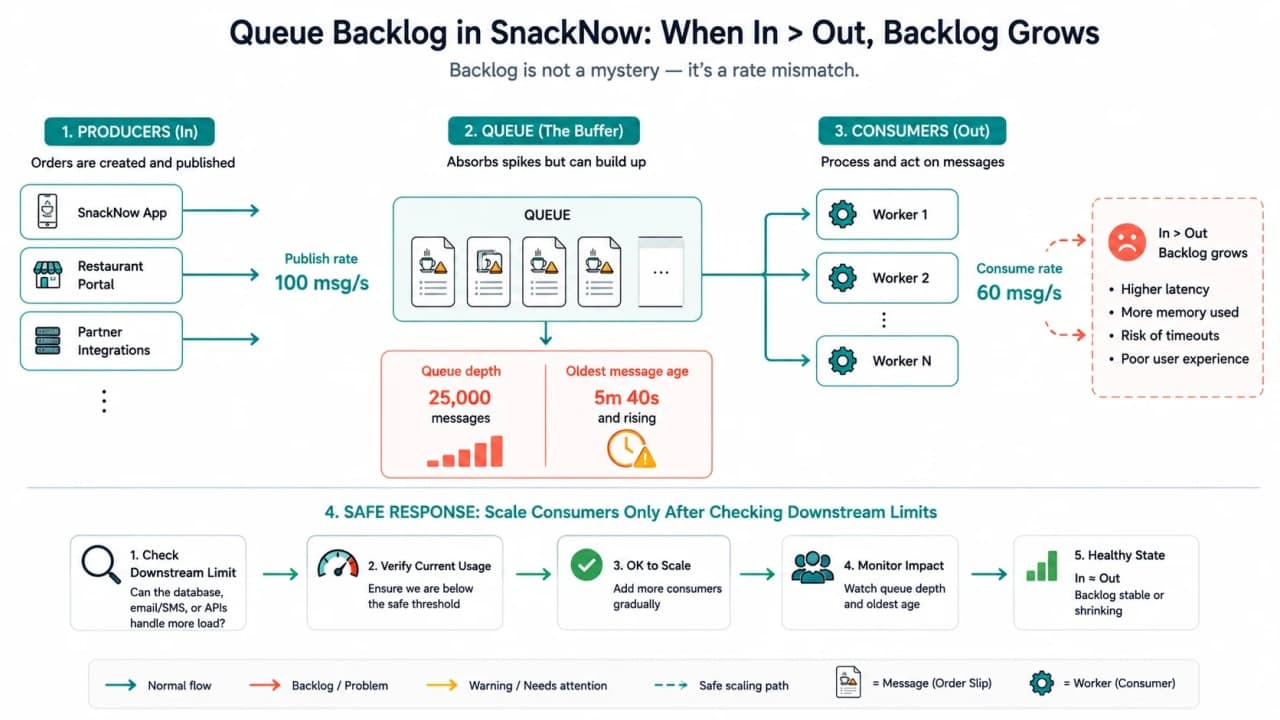
How to read this visual: compare publish and consume rates first. If publish remains higher, depth and oldest age rise. Consumer scaling helps only if the database and downstream APIs can accept the additional parallel work.
Confirm whether publish rate increased or consumer capacity fell.
Check oldest message age to understand real delay.
Inspect slow consumers, error rates, retries, and poison messages.
Scale consumers only within database and downstream limits.
Apply backpressure or rate limiting when producers can overwhelm safe processing capacity.
Reduce per-message work or batch compatible work when semantics allow it.
A growing queue is a performance signal. It says accepted work is arriving faster than the system can safely finish it.
Common Messaging Mistakes
Queueing work that needs an immediate answer
The user sees success before login, payment, inventory, or order creation has a trustworthy result.
Acknowledging before the effect is safe
A consumer crash loses work because the broker believes the message is complete.
Retrying forever
Poison messages consume capacity, create noise, and may block healthier work.
Skipping idempotency
A routine redelivery creates duplicate orders, charges, reservations, or notifications.
Ignoring ordering boundaries
Events for one order are processed out of sequence because the partition or routing key does not preserve the required local order.
Assuming exactly-once is easy
A broker guarantee is described without naming the database, external side effect, transaction boundary, or replay behavior.
Running without queue monitoring
The API looks fast while background work becomes hours late and customers never receive promised results.
Treating the queue as a database
Business state becomes difficult to query, correct, and retain because a transport was asked to become the source of truth.
Final Messaging Cheat Sheet
Visual purpose: This visual helps you understand the smallest dependable model for deciding, delivering, and operating asynchronous work.
Concept | Simple meaning | SnackNow hook | Use when | Watch out for |
|---|---|---|---|---|
Message | Work or event envelope | Order slip | Handing off data | Schema and sensitive content |
Producer | Publishes | Order service writes slip | Starting async work | Publishing before source commit |
Broker | Stores and delivers | Counter manager | Decoupling components | Capacity and availability |
Consumer | Processes | Worker picks slip | Independent background work | Slow or unsafe side effects |
Ack | Work completed safely | Worker says done | Removing responsibility | Acknowledging too early |
Retry | Try transient failure later | Provider temporarily down | Recoverable errors | Retry storms |
DLQ | Problem-message isolation | Failed-slip tray | Poison messages | Never reviewing it |
Idempotency | Duplicate-safe effect | One order from repeated slip | At-least-once delivery | Unstable keys |
Backlog | Accepted unfinished work | Tray keeps filling | Burst buffering | Oldest age and downstream limits |
Kafka/RabbitMQ | Different message models | Event log vs task tray | Choosing infrastructure | Tool-first decisions |
How to read this visual: first decide whether the user may continue before the work completes. If yes, define the message, delivery guarantee, acknowledgement point, retry policy, idempotency key, dead-letter path, and backlog signals.
The Mental Model Aman Keeps
Riya taps Place Order once. SnackNow creates one durable accepted order and gets the payment result it needs. Then it publishes a stable order event. Email, restaurant notification, analytics, and delivery preparation move independently, each with its own consumer, acknowledgement point, retry policy, and observable status.
If the email provider fails, checkout does not fail. If the consumer crashes, the message can return. If it returns twice, idempotency prevents the business effect from happening twice. If it cannot succeed, the message moves to a visible problem tray instead of circling forever.
That is the real value of messaging. The system does not merely become asynchronous. It gains an explicit boundary between accepting responsibility and completing work.
A queue improves responsiveness when delayed work remains reliable, duplicate-safe, and visible from publish to completion.
Lock in the takeaway
Frequently asked questions
What is a message queue in system design?
A message queue is a buffer where a producer places work for one or more consumers to process. It lets the sender continue without waiting for every downstream task to finish, when the business flow allows asynchronous completion.
How do message queues improve performance?
Queues shorten the user-facing critical path by moving non-immediate work to background consumers. They also absorb bursts and let consumers scale independently, although queued work still has processing cost and can build a backlog.
What is an acknowledgement in messaging?
An acknowledgement tells the broker that a consumer successfully completed the required work and has taken responsibility for the message. Consumers should acknowledge after the important side effect is safely recorded.
What is a dead-letter queue?
A dead-letter queue isolates messages that cannot be processed after defined attempts or that violate processing rules. It preserves failure context for investigation instead of retrying a poison message forever.
Why must message consumers be idempotent?
At-least-once delivery can redeliver a message after failures or lost acknowledgements. An idempotent consumer ensures handling the same message again does not create duplicate orders, charges, or other unintended effects.
What is the difference between RabbitMQ and Kafka?
RabbitMQ is commonly chosen for routed task and command queues with broker-managed acknowledgements. Kafka is a partitioned retained event log suited to high-throughput streams, replay, and multiple consumer groups. The required message model matters more than brand popularity.
When should a system not use a queue?
Use a direct request when the user needs the result before continuing, such as login validation, checkout totals, or payment authorization. A queue adds delay, eventual completion, monitoring, retries, and operational complexity.