
Listen to this article
Checking audio support
The public Application Programming Interface (API) and the employee admin panel share one internet-facing entrance. During a traffic spike, real customers time out. An attacker reaches the admin login directly. Worse, when one application process is compromised, it can probe the database and management interface because the internal network allows almost everything to talk to everything.
The first instinct is usually 'add a firewall'. That is a product answer before the path has been understood. We need three diagrams in our head: which paths should exist, what each path should be allowed to carry, and what remains reachable if one component is compromised. Only then can we place controls with distinct jobs.
This article follows one legitimate customer request from the internet to an application and a private database. A separate employee request reaches the admin interface. The request is the story; there is no invented cast or growing fictional company to remember.
Network security begins by deciding which paths should exist, then constraining what may travel along each path.
Network Security Terms in Plain English
Application Programming Interface (API) is the software boundary clients call. A Web Application Firewall (WAF) inspects web traffic, while an API gateway applies routing and consumer policy. Neither replaces service-owned object and action authorization.
Domain Name System (DNS) resolves names, and a Virtual Private Network (VPN) creates a controlled network path. Neither proves that the caller may use the resource reached through that path.
Distributed Denial-of-Service (DDoS) defence filters and absorbs large attacks before they exhaust the application. Transport Layer Security (TLS) protects a validated connection; it does not repair an overexposed route or insecure application.
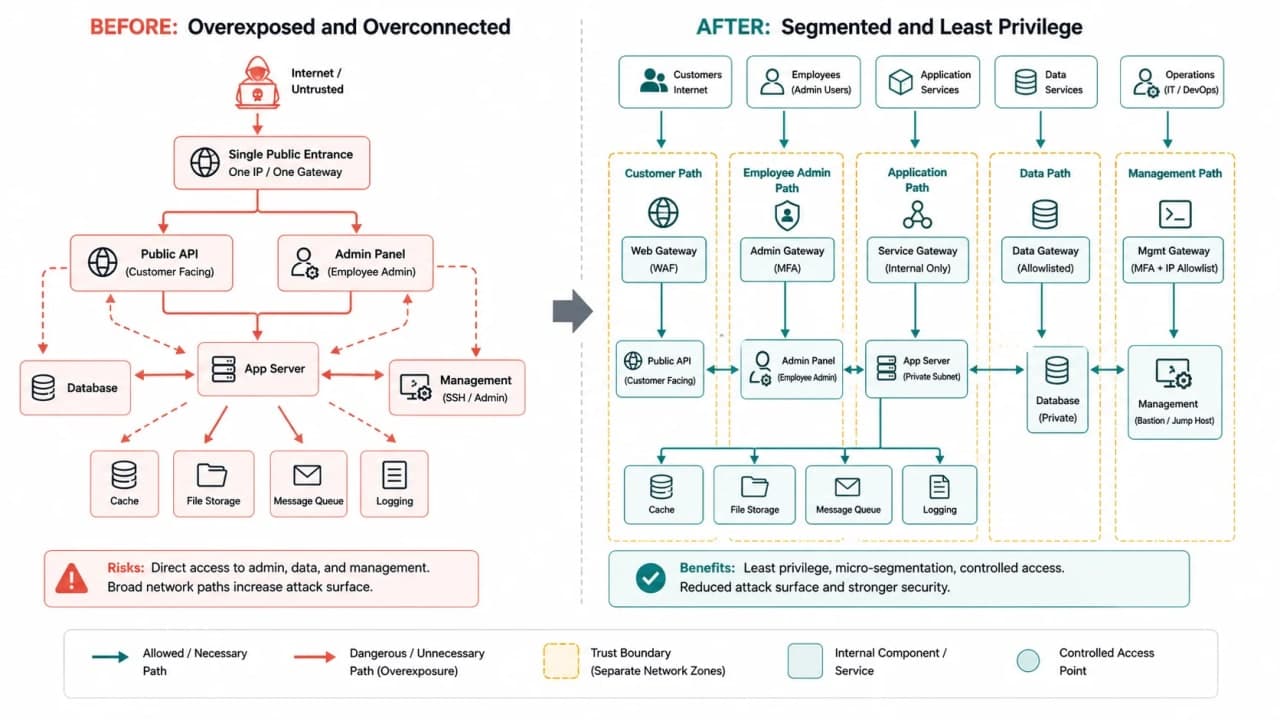
Read the exposed design by comparing expected arrows with dangerous extra arrows. The public request should not reach the database directly, the admin panel should not share every public path, and a compromised app should not inherit access to every management destination. The asset and threat questions behind those paths begin in Security in System Design: CIA, Threats and STRIDE.
Draw Source, Destination, Protocol, Direction, and Boundary
A network path has a source, destination, protocol, port or application endpoint, direction, and expected reason to exist. Add identity or workload context when the enforcement layer understands it. 'The application needs database access' is incomplete. Which application identity, from which workload zone, to which database listener, for which operation, and with what evidence?
North-south traffic crosses a boundary such as internet to edge or employee device to an internal service. East-west traffic moves among workloads or zones inside an environment. These labels describe direction relative to a boundary; they do not mean north-south is dangerous and east-west is trusted. A compromised internal service can be the most useful stepping stone an attacker has.
The journey from Domain Name System (DNS) resolution and connection establishment to Hypertext Transfer Protocol (HTTP), proxying, and backend communication is easier to reason about after Networking and Communication in System Design. Here we add the security questions to that journey.
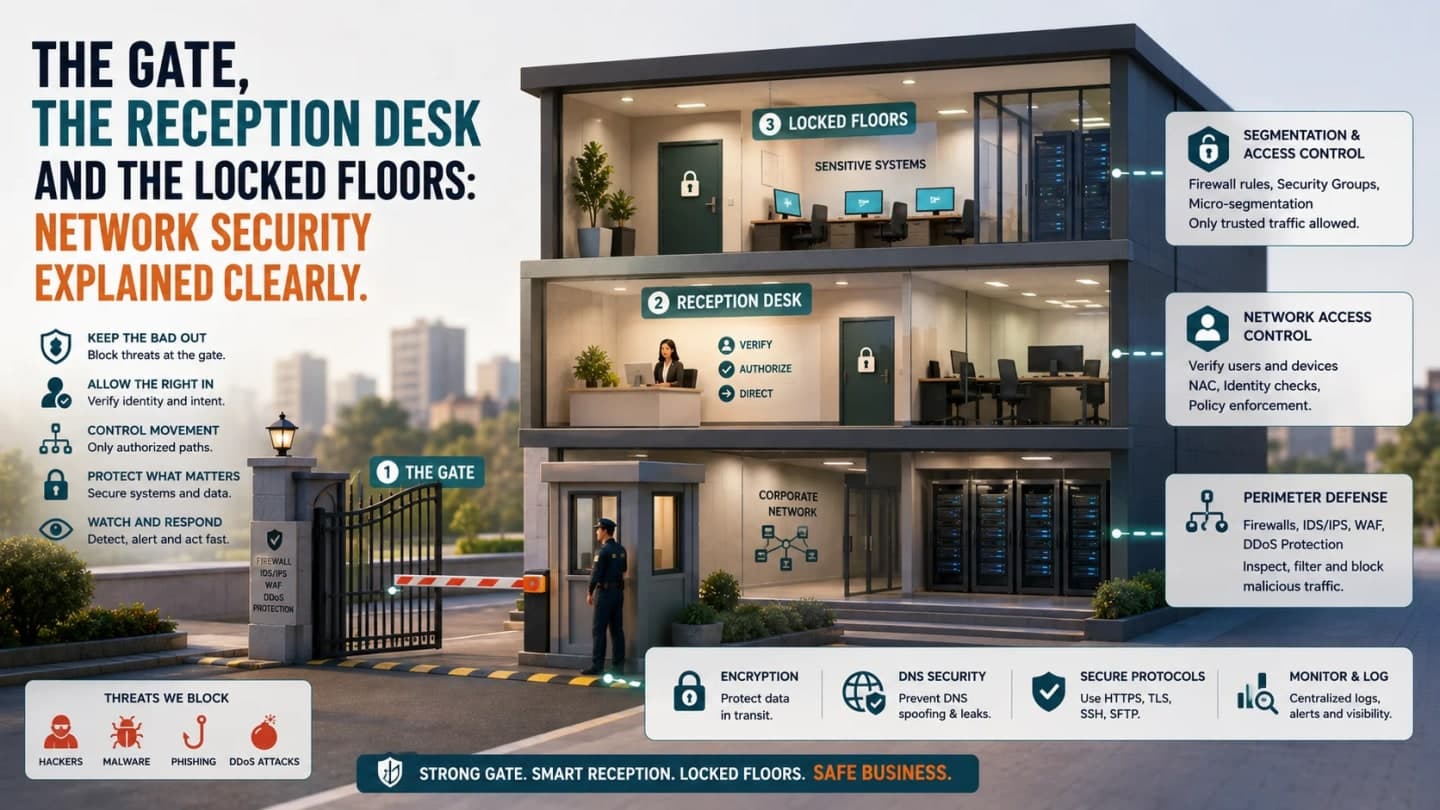
Analogy limit: a building has visible doors and people. Software paths can be ephemeral, encrypted, machine-to-machine, multi-tenant, dynamically scheduled, and reachable through identities or dependencies that are not visible on a floor plan.
Firewall, Reverse Proxy, Web Application Firewall, and API Gateway Ask Different Questions
At the building gate, a guard checks whether a vehicle may use an entrance. A network firewall similarly filters paths or connections using information such as addresses, ports, protocols, state, and policy. It may sit at an edge, between zones, or beside a workload. It usually does not understand the full business meaning of `HTTP POST /refunds/9182`.
The reception desk accepts visitors without exposing the internal office map, then routes each visitor to the right room. A reverse proxy terminates client-facing connections, hides backend addresses, selects or routes to upstreams, normalises some connection behavior, and may handle TLS or caching. Routing and shielding are its central memory cues.
The bag inspector examines what the visitor carries. A web application firewall, or WAF, examines HTTP-level attributes and applies managed or custom rules against suspicious patterns, protocol anomalies, bots, and abuse. Because traffic and applications vary, it can produce false positives and false negatives. It is a compensating layer, not repaired application code.
An API gateway can combine API routing, authentication integration, consumer policy, quotas, transformation, versioning, and observability. Some products also include WAF-like inspection or reverse-proxy behavior. Product overlap does not erase the design questions: may the connection exist, which backend receives it, does the web traffic violate inspection policy, and which API consumer/action policy applies?
Control | Primary question | Useful evidence | Cannot replace |
|---|---|---|---|
Firewall | May this path or connection exist? | Address, port, protocol, connection state | Object/action authorization |
Reverse proxy | Which hidden backend receives this request? | Host, path, connection and routing state | Secure application logic |
Web Application Firewall (WAF) | Does this HTTP traffic match attack or abuse policy? | Headers, path, body patterns, behavior | Parameterized queries and validation |
API gateway | Which API route, consumer, and policy apply? | Route, token context, quota, schema | Service-owned business authorization |
What this table is telling you is to describe responsibilities before naming products. A single managed edge may implement all four, while another architecture separates them. During failure or bypass, the owning service must still protect its resources.
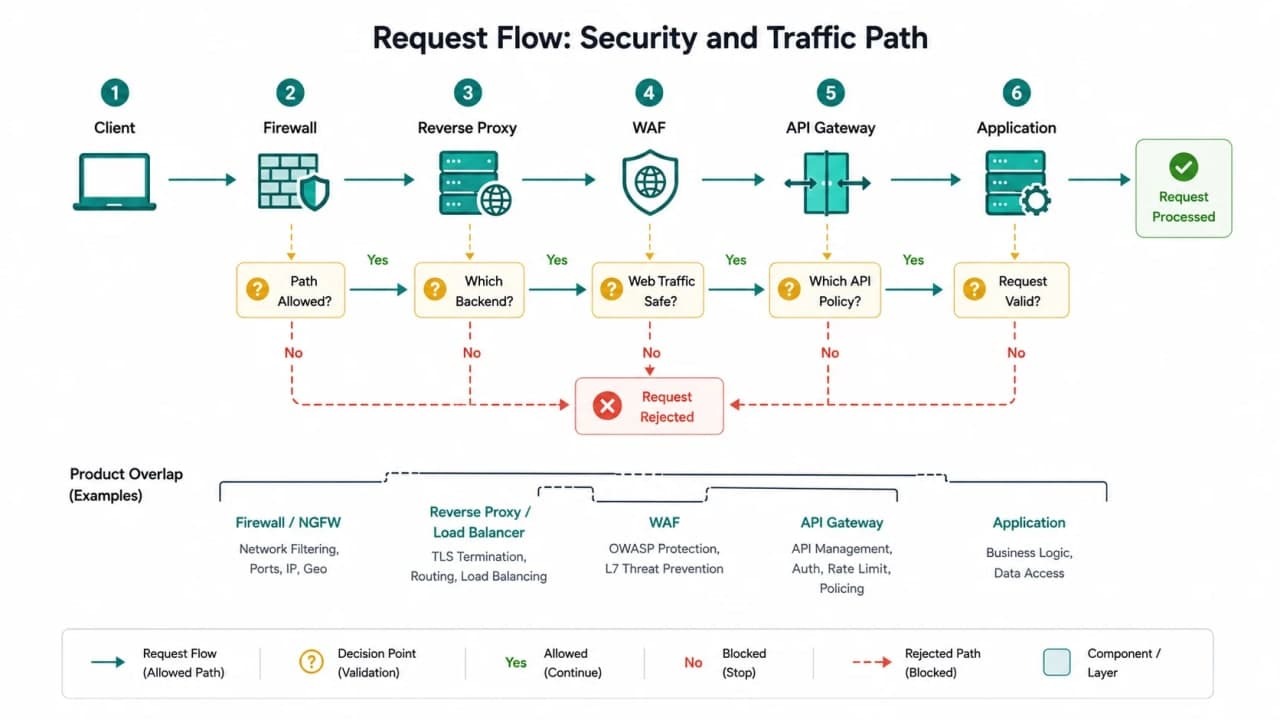
Read one HTTP request from left to right. At each layer say the question aloud: path, destination, web-traffic inspection, API policy. If two boxes answer the same question, the diagram should explain whether that is intentional layering or accidental duplication.
Rate Limits, Throttles, and Quotas Protect Fair Use
A ticket counter can issue a limited number of tickets per customer, allow a short burst when a bus arrives, slow the queue when staff is overloaded, and cap monthly membership visits. Network and API systems use related controls. A rate limit bounds requests over a window. Throttling delays or shapes excess traffic. A quota limits consumption over a longer period or budget.
The hard design question is the key. Per Internet Protocol (IP) address can unfairly group many users behind a shared network and is easy to distribute around. Per account fails before login and can be abused to lock out a victim. Per API key, tenant, device, operation, or resource cost may be fairer. Expensive report generation should not have the same limit as a cheap health check.
Distributed enforcement needs shared or partitioned counters, consistent policy, clock/window decisions, and behavior during counter-store failure. Fail open preserves availability but may expose capacity. Fail closed protects the resource but can create an outage. Clients need clear retry signals and idempotent behavior where retries could repeat side effects.
Control | Typical purpose | Example | Important limit |
|---|---|---|---|
Rate limit | Bound request frequency | 60 login attempts per hour per account/IP mix | Not volumetric link protection |
Throttle | Shape excess demand | Slow background imports | Can increase latency and queues |
Quota | Cap longer-term use | 10,000 reports per tenant per month | Needs fair accounting and reset rules |
Concurrency limit | Bound simultaneous expensive work | Five exports per tenant | Queued work still needs timeout/cancellation |
What this table is telling you is that volume controls protect fairness and bounded work at a particular layer. They do not guarantee that upstream bandwidth, connection state, DNS, or a third-party dependency remains available.
DDoS Defence Starts Before Traffic Reaches the Application
A crowd blocks the entire street outside a shop. The ticket counter inside may be perfectly configured, but real customers cannot reach it. A distributed denial-of-service attack can saturate bandwidth, exhaust connection/protocol state, or trigger expensive application work through many sources. Each form pressures a different layer.
A layered design distributes and filters early through upstream providers, Anycast or Content Delivery Network (CDN) edges, traffic scrubbing and classification, origin shielding, connection controls, WAF and application rate policy, load balancing, bounded worker pools, caching, circuit breakers, and degraded modes. Monitoring must distinguish attack, flash crowd, dependency failure, and accidental retry storm.
Autoscaling supports capacity after valid traffic reaches scalable components. It does not create infinite upstream bandwidth, protect a fixed database, stop expensive malicious requests, or control cost. It can scale the bill faster than the service. Autoscaling and Cloud Best Practices explains the capacity side; DDoS defence adds filtering, origin protection, cost boundaries, and incident operations.
Plan degraded service deliberately: keep checkout while pausing recommendations, serve cached or read-only content, challenge suspicious clients, shed expensive endpoints, protect control planes, and maintain an emergency communication path. The right goal is not 'never receive attack traffic'; it is preserve critical service, contain cost, and recover with evidence.
How is it so far?
Vote with other readers
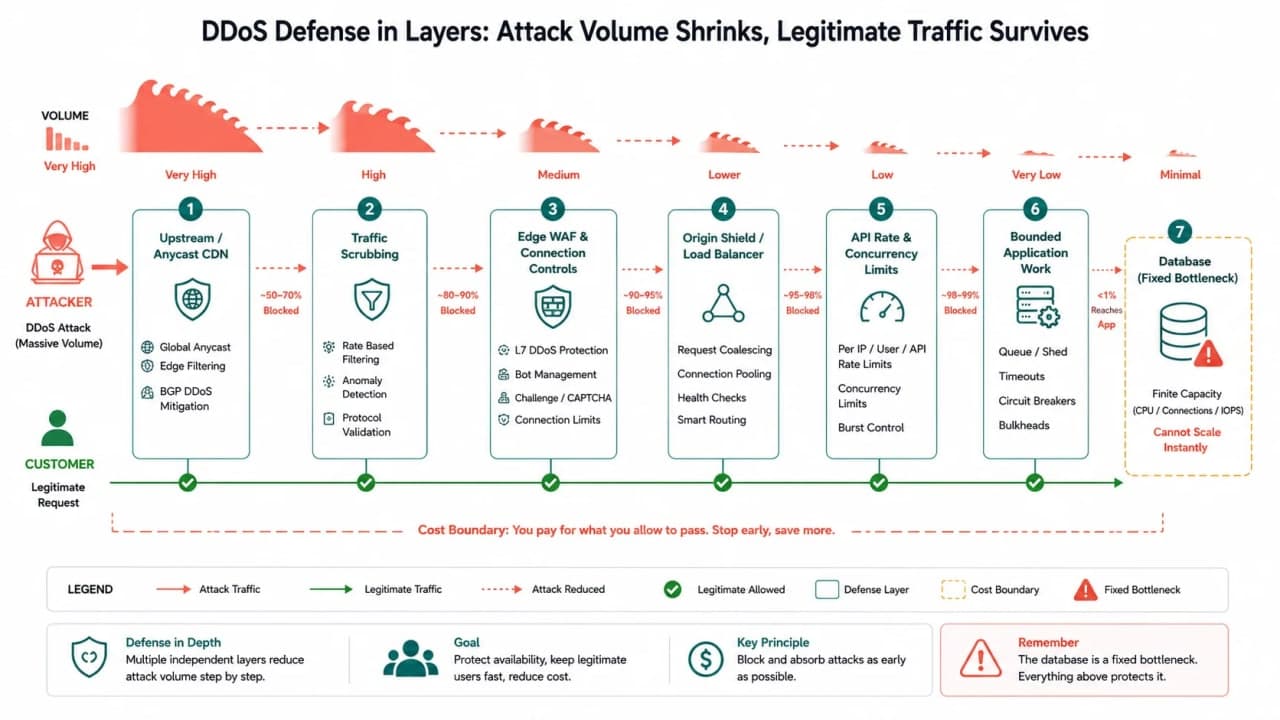
Read from the internet link inward. Mark where an attack can consume capacity before the application sees a request, where edge filtering removes traffic, and where application controls bound expensive work. Remember: absorb or filter early, then constrain cost at every downstream bottleneck.
Protect the Origin and the Control Plane
An edge service helps only if attackers cannot bypass it and reach the origin directly. Keep origin addresses and alternate hostnames out of unnecessary public exposure, restrict origin ingress to the approved edge or private path where practical, authenticate edge-to-origin connections, and ensure old DNS records or direct load-balancer endpoints do not remain forgotten entrances.
DNS is part of availability. Use a resilient authoritative service, protect registrar and DNS administration with strong identity and change controls, monitor unexpected record changes, and keep Time to Live (TTL) choices aligned with traffic-management and incident plans. Very short TTLs do not guarantee instant global change; very long TTLs slow planned failover.
Protect the control plane separately from customer traffic. During an attack, operators still need dashboards, policy changes, provider contacts, and deployment access. If the management path shares the saturated public route or the same exhausted identity system, the team may lose the ability to defend the service.
Test DDoS runbooks before the incident: who declares degraded mode, which endpoints are shed, how upstream filtering is requested, which metrics distinguish edge drops from origin work, who watches cost, and what confirms recovery. Technical capacity without an operating decision can arrive too late.
Pause and retrieve
Explain why a WAF cannot repair an unsafe query, why an API rate limit cannot stop every DDoS attack, and why one product may act as proxy, gateway, and WAF without making those responsibilities identical.
Segmentation: One Compromised Room Should Not Unlock the Building
In a flat office, anyone who enters reception can walk into finance, the server room, and management. In a segmented design, public edge components, application workloads, data stores, and management systems occupy separate zones with explicit paths. A customer request reaches the edge and application, but never the database listener directly.
Segmentation limits lateral movement and blast radius. If the web process is compromised, it may reach only the order API it genuinely needs, not backup storage, management ports, payroll, and every database. East-west policy becomes as important as the public perimeter. Egress policy can also limit unexpected outbound calls and data exfiltration.
Segmentation cannot make a vulnerable application safe. The allowed application-to-database path can still be abused through stolen application identity or injection. Identity, service authorization, data-layer controls, patching, and monitoring remain. The security gain is smaller reachable scope and better evidence, not magical trust inside a zone.
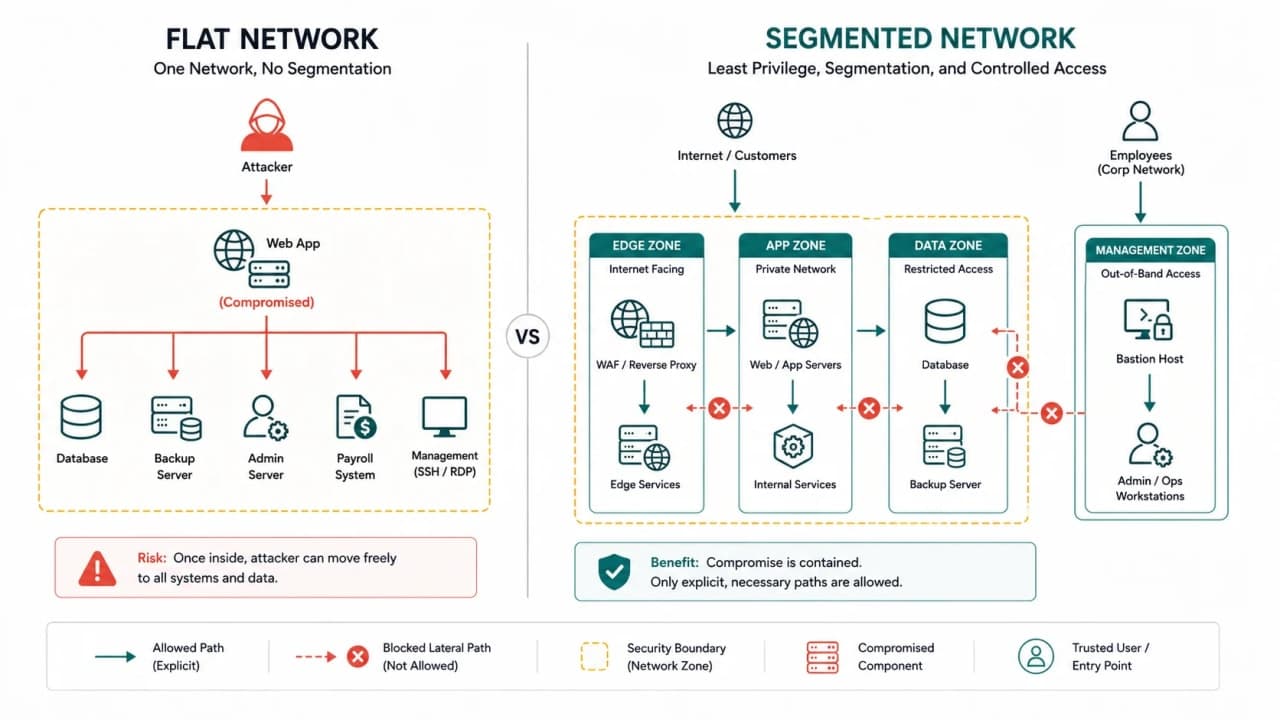
Compare the flat and segmented halves. Follow the compromised application marker. In the flat design it fans out; in the segmented design only explicit arrows remain. Remember that a line on the diagram should correspond to an enforced and owned policy.
Demilitarized Zone (DMZ), Public Networks, and Private Networks
A demilitarized zone, or DMZ, is a boundary area for systems that must receive untrusted external traffic without placing them in the same trust zone as sensitive internal resources. In cloud designs, internet-facing load balancers or gateways may sit in public subnets while application or data components use private routing. The exact terms and mechanics vary by platform.
A public subnet typically has a path to or from the internet through the environment's routing design. A private subnet lacks direct public ingress and may use controlled egress such as Network Address Translation (NAT), proxies, or private service endpoints. Private addressing reduces direct reachability; it does not authenticate callers, patch systems, encrypt traffic, protect credentials, or authorize a database query.
Minimise public endpoints, restrict ingress and egress, keep databases off direct internet paths, and document every translation or proxy boundary. Egress deserves attention because compromised workloads often need an outbound path for command, package download, or data exfiltration.
Egress policy should match real dependencies: package repositories during build, payment or messaging providers at runtime, DNS resolution, telemetry destinations, and update services. Route outbound calls through controlled proxies or private endpoints where that improves visibility and policy. Plan provider IP or domain changes; a brittle allowlist can become its own outage.
Inspecting encrypted outbound traffic may require termination or metadata-based policy and creates privacy, certificate, and operational tradeoffs. Not every service needs full content inspection. Start by removing unnecessary egress, identifying destinations, and alerting on unexpected volume or new endpoints.
Security Groups, Network ACLs, and Host Firewalls
Cloud providers use different terms and semantics, so avoid universal claims. Conceptually, a security-group-style policy attaches to a workload or network interface, an Access Control List (ACL) style policy applies at a subnet or boundary, and a host firewall filters at the operating system. Some controls are stateful, some stateless, and exact return-traffic behavior is provider specific.
Control scope | Protects near | Useful role | Operational risk |
|---|---|---|---|
Workload/interface policy | Virtual Machine (VM), pod interface, managed resource | Least paths to a specific workload | Copied broad groups and identity drift |
Subnet/boundary ACL | Network segment | Coarse guardrail across a zone | Stateless complexity and rule ordering |
Host firewall | Operating system | Final local port/process boundary | Configuration drift and host access dependence |
What this table is telling you is to use layers for different failure boundaries, not to repeat one giant rule set three times. Contradictory policies create outages that are difficult to debug; overly broad duplicates create false confidence. Assign ownership, generate policy from intent where possible, review reachability, and test both allowed and denied paths.
Debug a Denied Path Without Opening Everything
When a request fails, teams often replace a narrow rule with `allow all` to see whether the network is responsible. That shortcut may survive the incident and become permanent. Debug from the path: resolve the actual destination, verify route and translation, test the source identity/interface, inspect each enforcement layer, and use flow logs or connection telemetry to find the first denial.
Separate connection failure from TLS, proxy, authentication, and application failure. A timeout may mean a dropped packet or an exhausted backend. A Transmission Control Protocol (TCP) connection followed by a TLS alert points to trust or protocol. An HTTP 403 may come from WAF, gateway, identity proxy, or application authorization. Observability should preserve which layer made the decision. Certificate and protected-channel mechanics are explained in Encryption vs Hashing: TLS, PKI and Data Protection.
Repair the narrow policy and add a test. Reachability tests can confirm that the application reaches the database and cannot reach management. Synthetic checks can exercise the employee admin path. Policy-as-code review can show unintended expansion. The goal is not merely restore traffic; it is restore the intended path without creating another path.
Zero Trust: Being Inside Does Not Prove Permission
A person who enters the lobby still presents a badge at a restricted floor. Zero Trust removes implicit permission based only on network location. the National Institute of Standards and Technology (NIST) architecture focuses on protecting resources through explicit identity, authorization, context, least privilege, and observation rather than declaring an entire internal network trusted.
For an employee admin request, verify user identity and strong authentication, device or session context where justified, application/resource permission, and a narrow access path. For workloads, verify service identity and allowed communication. Use short-lived access, segmentation, monitoring, and re-evaluation when risk signals change.
Zero Trust is not one product, a demand to type a password for every packet, or a reason to remove firewalls. Nor does it mean no relationship can ever be trusted. It means trust is not inherited permanently from being 'inside'; each resource decision uses explicit evidence and policy. The primary reference is NIST Special Publication (SP) 800-207 Zero Trust Architecture.
Network location can reduce exposure, but it must never be mistaken for identity or permission.green
Administrative Access Needs a Separate Door
The employee admin panel should not simply share the public API's open path. An identity-aware access proxy or a carefully scoped VPN can establish a controlled route. Multi-Factor Authentication (MFA), managed-device context where appropriate, short-lived credentials, limited administrator roles, and audit records protect the resource. A bastion or jump host may concentrate access for systems that require it, but it also becomes a high-value component. The identity and permission checks on that path are detailed in Authentication vs Authorization: Sessions, JWT and OAuth.
Avoid broad public management ports. Separate routine support tools from infrastructure administration. Use approval and time-limited elevation for dangerous operations. Record who accessed which resource and what changed without logging secrets. Maintain an emergency path that is protected, tested, and not dependent on the failed identity component it is meant to repair.
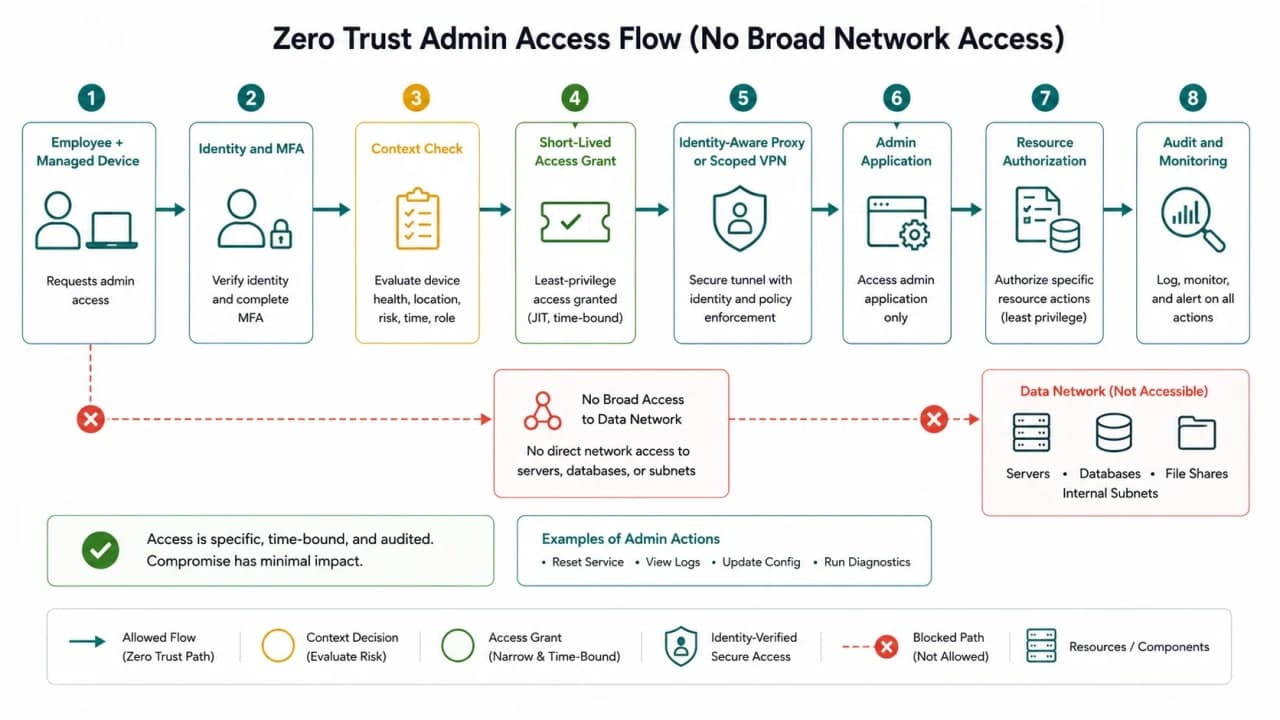
Read the employee path separately from the customer path. The employee does not receive broad network membership; the access layer verifies context and grants a narrow, time-bounded route to the admin resource. The resource still enforces its own authorization.
Put the Layers Together Around One Request
The final customer path is internet to upstream edge and DDoS protection, network policy, reverse proxy or load balancer, WAF and API policy, application zone, and an explicitly allowed data path. The employee path reaches an identity-aware admin boundary and then the admin application. Management traffic uses a third restricted path. Kubernetes and service-to-service boundaries continue in Cloud Security: Containers, Kubernetes, APIs and Services.
At the edge, ask whether traffic can be absorbed and classified. At the firewall, ask whether the path exists. At the proxy, ask which backend receives the request. At the WAF, ask whether HTTP traffic violates policy. At the gateway, ask which API consumer, route, schema, and quota apply. At the service, ask whether the identity may perform this action on this object. At the database boundary, ask whether only the owning workload identity has the necessary path.
Load distribution is only one part of this path. Load Balancing Explained shows health checks and backend selection; network security adds path restrictions, abuse handling, identity boundaries, and containment when one backend is compromised.
Interview phrasing: I draw the allowed request and administration paths first, place edge DDoS filtering and volume controls early, separate firewall, proxy, WAF, and gateway responsibilities, segment public/app/data/management zones, and require explicit identity and authorization even for internal traffic.
Common Misunderstandings That Leave Doors Open
Firewall and reverse proxy are the same. One primarily controls network paths; the other terminates and routes client-facing application connections.
A WAF fixes Structured Query Language (SQL) injection. It may filter patterns; safe queries and validation must still prevent command meaning from changing.
Rate limiting prevents every DDoS attack. Traffic can exhaust upstream capacity or protocol state before an application counter runs.
Autoscaling is DDoS protection. It adds capacity for scalable work but does not filter attacks or protect fixed bottlenecks and cost.
Private means secure. Private routing reduces direct exposure but does not establish identity, authorization, patching, or encryption.
IP allowlisting proves identity. Addresses can be shared, changed, spoofed in some contexts, or used by compromised systems.
VPN access completes authorization. A protected path into a network is not permission to every resource.
Zero Trust means constant password prompts. It means explicit, contextual resource access instead of inherited network trust.
Explain It Back Without Looking
Reconstruct the incident: customer timeouts, exposed admin path, compromised app probing internal systems. State the path mistake, design choices, consequence, and tradeoffs. Then match gate, reception, inspector, ticket counter, and locked floors to exact control responsibilities.
Draw the customer path and say what each layer asks: path, routing, inspection, API policy, service authorization.
Contrast firewall/reverse proxy, WAF/API gateway, rate limit/DDoS defence, public/private, and perimeter/Zero Trust.
Redraw the zones after assuming the application process is compromised.
Design a separate employee path to an admin panel without granting broad network access.
Choose a failure policy for the distributed rate-limit store and explain the availability/security tradeoff.
Now transfer it. A public webhook must reach one ingestion service, which writes to a queue; workers call one internal API and no database directly. Place the edge, path, inspection, identity, rate, segmentation, and audit controls. Explain what remains possible if the webhook service is compromised.
A sixty-second retelling might sound like this: network security starts by drawing allowed paths. Firewalls constrain connections, reverse proxies shield and route backends, WAFs inspect web traffic, and API gateways apply API consumer and route policy. Rate limits bound application work, while DDoS defence filters and absorbs traffic upstream. Segmentation contains compromise, private networks reduce exposure, and Zero Trust requires explicit identity and authorization instead of trusting location.
Lock in the takeaway
Frequently asked questions
What is the difference between a firewall and a reverse proxy?
A firewall primarily controls whether network paths or connections may exist. A reverse proxy accepts client-facing application connections, hides backends, and routes requests to the appropriate upstream. Products may overlap, but the responsibilities differ.
What is the difference between a Web Application Firewall (WAF) and an Application Programming Interface (API) gateway?
A Web Application Firewall (WAF) inspects Hypertext Transfer Protocol (HTTP) traffic against attack and abuse rules. An Application Programming Interface (API) gateway manages API routing and consumer policies such as authentication integration, quotas, schemas, and versions. Neither replaces service-owned business authorization.
Does rate limiting stop Distributed Denial-of-Service (DDoS) attacks?
Rate limiting can bound application work and some abuse, but large attacks may saturate bandwidth or connection state before the application limiter runs. Distributed Denial-of-Service (DDoS) defence needs layered upstream filtering, capacity, origin protection, and incident response.
What is network segmentation?
Network segmentation divides an environment into zones with explicit allowed paths. It reduces lateral movement and blast radius after compromise, but it does not repair vulnerabilities or replace identity and application authorization.
What is the difference between a public and private subnet?
A public subnet has a designed path for internet connectivity. A private subnet lacks direct public ingress and may use controlled egress. Private routing reduces exposure but does not make workloads trusted or automatically secure.
What is the difference between a security group, network Access Control List (ACL), and host firewall?
Broadly, a security-group-style control attaches near a workload/interface, a network Access Control List (ACL) applies at a subnet or boundary, and a host firewall filters at the operating system. Exact stateful behavior and rule semantics vary by provider.
What does Zero Trust mean?
Zero Trust means no implicit permission based only on network location. Access to a resource uses explicit identity, authorization, context, least privilege, segmentation, and monitoring. It is an architecture principle, not one product.
How should administrative access be secured?
Use a separate restricted path with strong identity and Multi-Factor Authentication (MFA), short-lived least-privileged access, identity-aware proxy or scoped Virtual Private Network (VPN) where appropriate, controlled bastion access when justified, audit logs, and protected emergency access.