The Day the Region Went Dark: Disaster Recovery Explained Through SnackNow
At 6:58 PM SnackNow loses an entire cloud region. Build a practical DR plan with RTO, RPO, pilot light, warm standby, multi-region failover, quorum, drills, and safe failback.

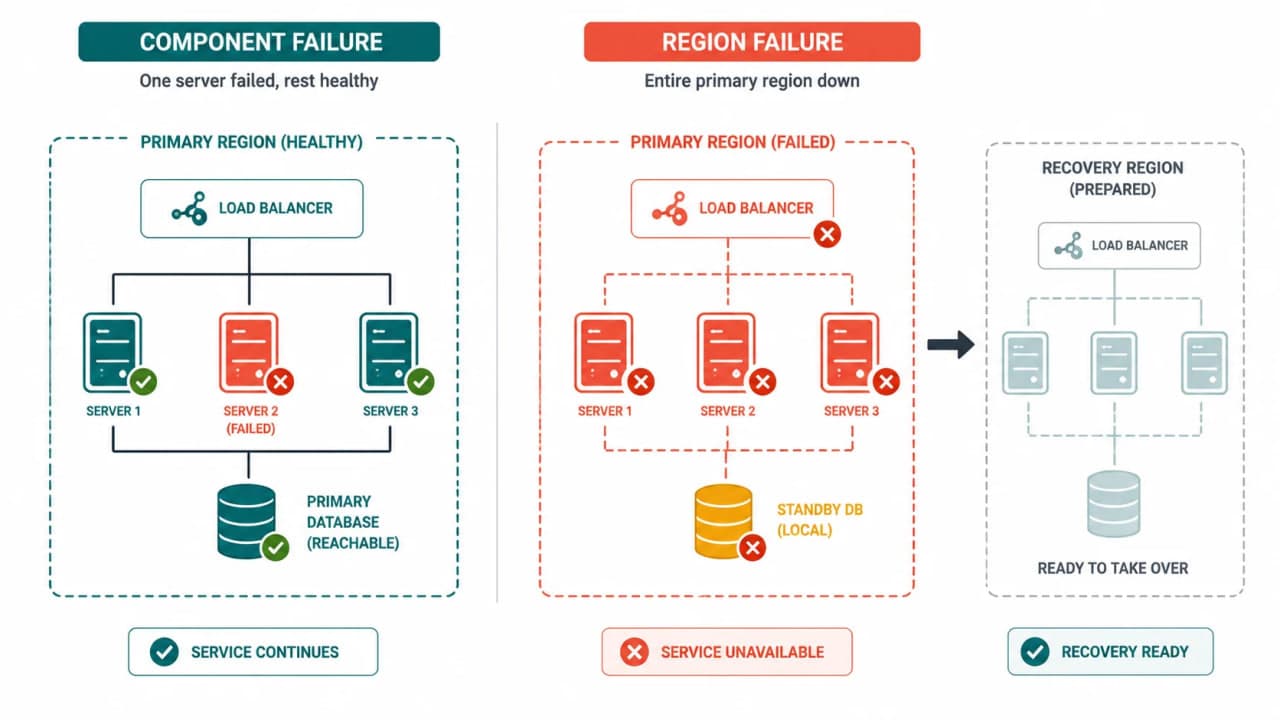
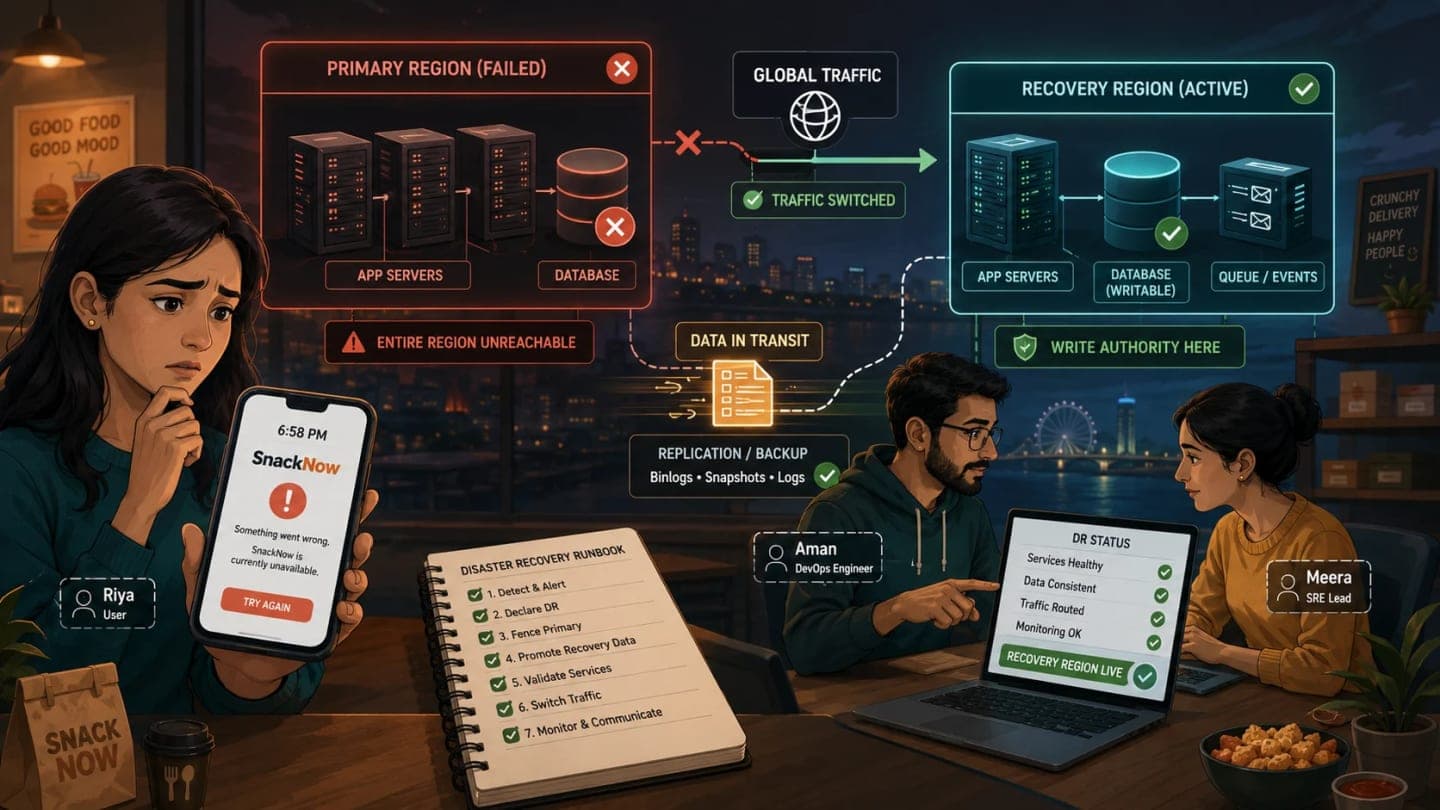
SnackNow's redundant servers disappear together when the whole primary region becomes unreachable.
SnackNow Survived a Server Failure but Not a Region Failure
A week after the earlier incidents, SnackNow is prepared for an application-server failure. It has redundant instances, representative health checks, N+1 capacity, failover, protected backups, and a tested database restore. At 6:58 PM, two minutes before the evening offer, the entire primary cloud region becomes unreachable. The local survival design comes from High Availability vs Fault Tolerance: Failover Explained; this failure removes the whole boundary around it.
Every SnackNow application instance in that region disappears from the network together. The primary database and its local standby are unavailable. The load balancer still knows how to route around one unhealthy server, but it has no reachable backend. Riya sees the app fail before she can add the offer to her cart.
Meera: 'We prepared for a server failure. Why did everything still go down?'
Aman: 'We prepared for a component failure. This is a location failure.'
A fault domain is a set of components that can fail together because they share infrastructure or location. An availability zone is commonly designed as a distinct infrastructure failure domain inside a region. A region groups multiple zones in a geographic area, but exact provider boundaries differ. SnackNow spread across servers and perhaps zones locally; it did not yet have a complete service outside the unavailable region.
The story event is regional isolation, the visible symptom is a total outage, and the technical cause is that all supposedly redundant paths still share one larger location boundary. The design decision is to create a recoverable business service in another region. The consequence can be continuity through a regional event. The tradeoff is cost, cross-region data behaviour, security, operational complexity, and new failure modes.
Redundancy survives only the failures that leave at least one complete, reachable path outside the failed boundary.
At work, draw boundaries around process, host, rack, zone, region, account, and provider dependencies, then state which boundary the target covers. Memory callback: one broken counter is a component failure; the whole market closing is a regional disaster.
Reader question: Why does local HA survive one server failure but not one region failure?
Why this visual is needed: Multiple replicas look reassuring until their shared fault-domain boundary is visible.

How to read it: Compare what remains reachable after removing one server with what remains after removing the entire region boundary.
What to remember: Protection ends where all copies still share the same failure.
Disaster Recovery Is a Business Continuity Decision
Disaster recovery, or DR, is the preparation and controlled work required to restore an application, its data, and the critical business journeys after a severe event prevents the primary environment from meeting business objectives. The event becomes a disaster for SnackNow when ordinary local recovery cannot restore the required service within acceptable time and impact.
A disaster can be a regional infrastructure outage, widespread data corruption, ransomware, natural disaster, account or control-plane compromise, destructive deployment, or network isolation. The technical shape differs, so the response cannot be one universal 'switch region' button. A compromised account may make the recovery region unsafe; corruption may require historical restore; network isolation can make both sides believe the other is dead.
The visible business symptoms include stopped orders, stranded restaurant work, uncertain payments, lost support access, and breached commitments. The design decision begins with business continuity: which customer and operator functions must return, with what data, under whose authority, and within which targets? The consequence is a scoped plan instead of a cloud diagram. The tradeoff is explicit acceptance that some lower-tier functions may remain unavailable longer.
At work, define the severe scenario and critical journey before choosing products. Memory callback: the duplicate shop in another city represents a DR environment only when it can conduct the business, not merely store boxes.
Backup, Failover, HA and DR: Four Different Jobs
Capability | Job | Result during the failed region |
|---|---|---|
Backup | Restore protected historical data | Useful if live data is lost or corrupt, but does not route users by itself |
Failover | Switch work to a healthy component or environment | Moves traffic and data authority only if a complete destination exists |
High availability | Minimise ordinary outage impact | Local HA survives covered component or zone failures, not every regional event |
Disaster recovery | Restore the full scoped business service after severe failure | Coordinates environment, data, traffic, validation, people, and return |
Use Riya's order path. A backup can reconstruct order history. Failover can point her request elsewhere. HA keeps covered local failures brief. DR ensures the alternate location has application capacity, safe write authority, order data, objects, queues, secrets, observability, operations access, communication, and a tested path back.
The design decision is to combine these capabilities without calling them interchangeable. The consequence is correct incident response: a deletion does not trigger blind replica promotion, and a region outage does not wait for a cold database restore when a warm target was promised. The tradeoff is multiple controls and runbooks. The previous backup and recovery article preserves history; this DR plan puts a complete business around that recovered or replicated state.
At work, answer 'Which failure does this tool solve?' before naming it. Memory callback: sealed records, a changing road sign, spare counters, and a duplicate city shop have different jobs.
Start With Business Impact, Not Architecture Diagrams
Meera cannot fund identical recovery for every SnackNow feature. Aman classifies functions by consequence, then maps dependencies beneath each one.
Tier | SnackNow capability | Failure consequence |
|---|---|---|
Tier 0 | Payment truth and confirmed orders | Financial ambiguity, unfulfilled orders, and direct trust loss |
Tier 1 | Menu, cart, and checkout | New revenue stops, but no accepted transaction should become uncertain |
Tier 2 | Order tracking and notifications | Customers lose visibility while core fulfilment may continue |
Tier 3 | Recommendations, reviews, and analytics | Experience and insight degrade without blocking the critical order path |
The business impact analysis asks how harm grows with time and data loss. It identifies the critical journey, acceptable downtime, acceptable missing data, dependency order, manual workarounds, legal or contractual constraints, and the people authorised to act. Tier 0 may depend on identity, database, payment integration, restaurant dispatch, and audit data, so restoring only the checkout frontend is meaningless.
The story event is Riya unable to order while an analytics pipeline is also down. The visible symptoms are both outages, but their immediate business impacts differ. The design decision is tiered recovery. The consequence is that expensive readiness protects the payment-and-order promise first. The tradeoff is a deliberately degraded product during recovery.
At work, make product, operations, security, and engineering agree on the tier and dependency graph. Memory callback: during a market closure, the emergency shop opens the payment and order counter before the recommendation display.
RTO and RPO Become Architecture Decisions
Article 3 defined the clocks. In DR, those clocks choose infrastructure. RTO, the maximum acceptable service-recovery duration, influences how much automation and standby capability must already exist, how traffic is switched, how long provisioning takes, and how validation is performed. RPO, the maximum acceptable data-loss window, influences backup cadence, log shipping, change-data capture, and synchronous or asynchronous replication choices.
Suppose Tier 0 has a 15-minute RTO and a one-minute RPO. Rebuilding an empty region from backups in two hours cannot meet the RTO, even if the backup is perfect. Copying data every 30 minutes cannot meet the RPO. The architecture may need a functioning warm environment, near-continuous log or data replication, automated promotion, and validation scripts.
Tier 3 analytics might accept an eight-hour RTO and a four-hour RPO, so cold recovery from protected data can be reasonable. Zero RTO and zero RPO are not casual settings; cross-region physics, coordination, availability, and cost make them difficult, and some failure modes still require deliberate interruption.
The decision is a target per business tier plus evidence that drills meet it. The consequence is an architecture tied to impact. The tradeoff is rising cost and coordination as either target approaches zero. At work, trace the outage timeline from 6:58 detection through declaration, data promotion, app validation, and safe order acceptance. Memory callback: RPO asks which ledger pages reach the second city; RTO asks when that city's shop can safely serve Riya.
Four DR Strategies on One Cost-and-Recovery Ladder
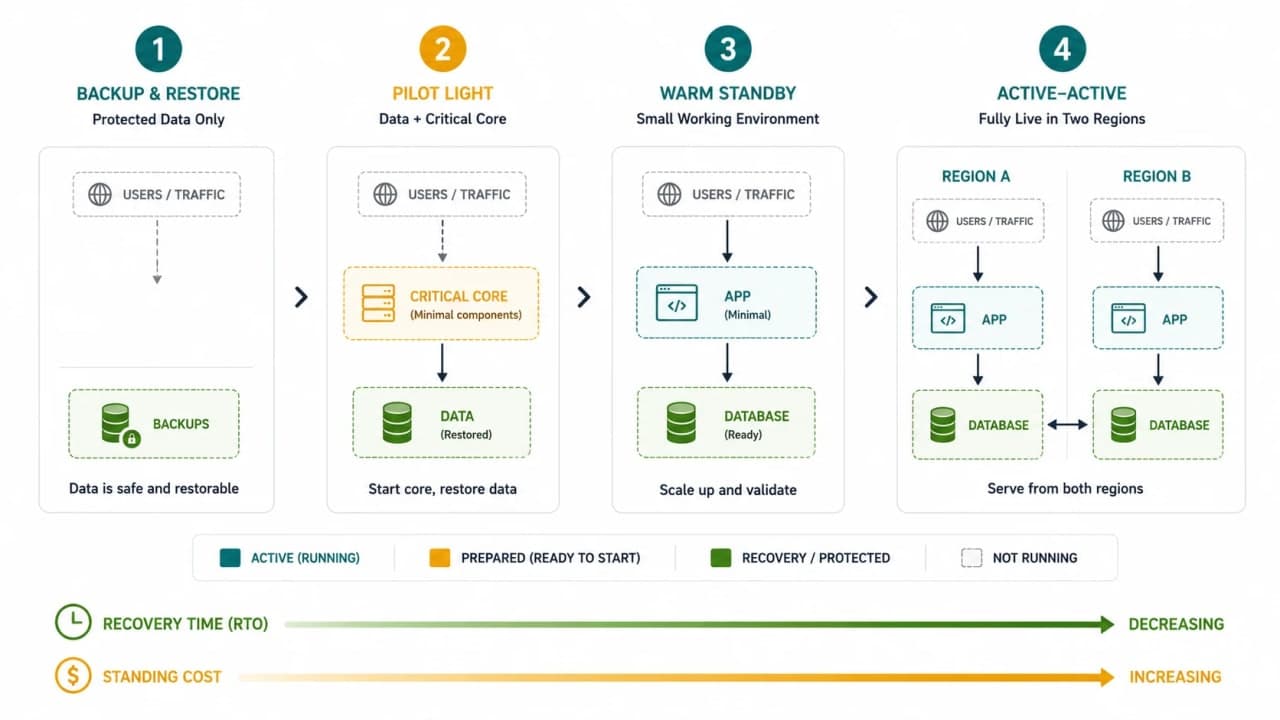
Backup and Restore
SnackNow keeps protected data and infrastructure definitions, then creates the recovery environment after disaster. Standing cost is lowest because little application capacity runs elsewhere. Recovery is longest because provisioning, restoration, configuration, validation, and traffic changes begin after declaration. It fits services whose business can wait and whose data set can restore within target.
Pilot Light
Critical data services and a minimal core remain ready in the recovery region, like a small flame that can start the rest. During disaster, SnackNow provisions or scales application capacity, activates integrations, validates dependencies, and routes traffic. It costs more than pure backup-and-restore but shortens the path by keeping the hardest core alive.
Warm Standby
A smaller but functioning SnackNow environment runs in the recovery region. It receives data, passes essential checks, and can serve limited or test traffic. Regional failover promotes or verifies data authority, scales the environment, and ramps production traffic. The design costs more continuously but can meet a shorter RTO.
Multi-Site or Active-Active
Multiple regions actively serve production traffic. This can provide the fastest continuity for covered events, but it demands sophisticated global routing, write ownership, conflict handling, capacity, observability, and deployment compatibility. Active-active does not remove every interruption or disaster; shared software, identity, control planes, and data rules can still fail.
Cold, warm, and hot are useful readiness descriptions, but organisations and providers use them differently. SnackNow documents what is actually running, current, scalable, authorised, and tested. The decision is driven by tier targets, not prestige. The consequence is appropriate recovery speed. The tradeoff is pre-incident cost and operational complexity.
Faster disaster recovery usually means paying for more verified readiness before the disaster.
Reader question: Which DR readiness level best matches SnackNow's recovery target and budget?
Why this visual is needed: Different architecture drawings hide that the strategies are stages of pre-positioned readiness.

How to read it: Move toward faster recovery as more of the same secondary environment stays active before failure, while cost and coordination rise.
What to remember: Pay before the incident for faster recovery after it, only where impact justifies it.
Building SnackNow Across Two Regions
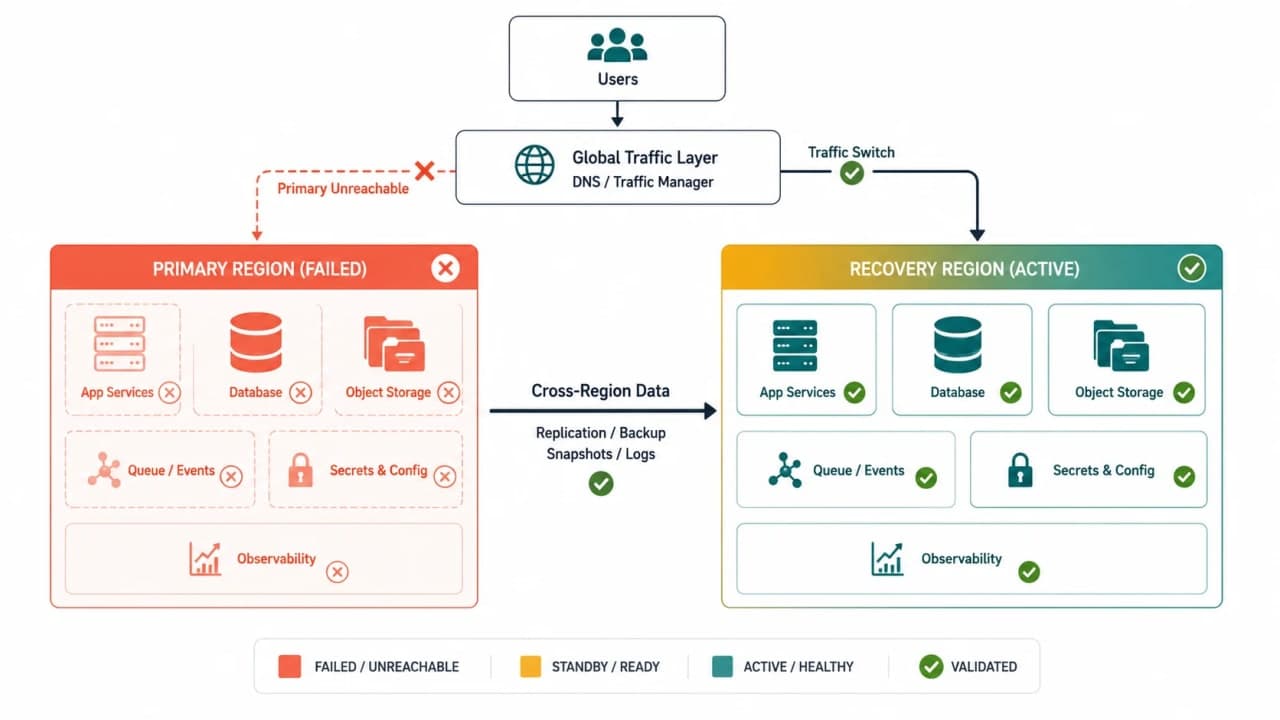
SnackNow selects warm standby for Tier 0 and Tier 1 because a cold rebuild misses the target while full active-active writes would add complexity the team cannot yet operate safely. Users first reach a global traffic layer capable of steering them to a healthy regional endpoint. The primary region normally serves traffic; the recovery region runs smaller verified capacity.
The recovery region needs compatible application images, network policy, identity and access, secrets and configuration, database recovery or replication, object data, queue and event handling, observability, certificates, third-party allowlists, quotas, and enough scaling headroom. Infrastructure as code makes resources reproducible, but account access and external dependencies must also work during a control-plane incident.
Queues need a clear authority and replay story. If both regions consume the same event after isolation, customers can receive duplicate notifications or restaurants can process duplicate dispatch commands. Object storage needs replicated or recoverable objects plus metadata consistency. The messaging and queues article explains decoupled work; regional DR must decide where producers, consumers, and durable backlogs live.
The story symptom is a healthy global router pointing to an empty or incomplete region. The technical cause is treating compute duplication as service duplication. The design decision is an end-to-end recovery dependency inventory and continuous validation. The consequence is a usable order path. The tradeoff is cross-region storage, secrets, integration, and testing work.
At work, execute one synthetic order in the recovery region without relying on the primary. Memory callback: the duplicate shop in another city needs the ledger, keys, menu, payment connection, staff instructions, and working road sign.
Reader question: What must already exist in the recovery region before traffic can move safely?
How is it so far?
Vote with other readers
Why this visual is needed: Duplicate app servers hide the data and operational dependencies required by a complete business journey.

How to read it: Follow users through global routing into the recovery region and verify each grouped dependency before the order completes.
What to remember: A recovery region is a recoverable business journey, not a region label.
Data Replication: Fast Recovery Has a Price
Cross-region data movement determines how current the recovery region can be and how much latency the write path accepts. In synchronous replication, a write waits for acknowledgements from the required remote participants before success. This can reduce the committed-data loss window for covered failures, but inter-region round-trip latency affects every protected write and a partition may reduce write availability.
In asynchronous replication, the primary acknowledges before the remote copy confirms. Ordinary writes are faster and can continue through some remote problems, but replication lag creates a data-loss window if the primary disappears before changes arrive. The actual RPO depends on measured lag, buffering, log durability, monitoring, and promotion rules, not the word asynchronous alone.
Workload decision | Likely direction | Tradeoff to state |
|---|---|---|
Accepted payment and confirmed order truth | Stronger coordination or tightly monitored low-lag path | Higher latency or reduced write availability during partition |
Menu updates | Asynchronous replication may be acceptable | Recent edits can be temporarily missing after failover |
Recommendation and analytics events | Asynchronous transfer and rebuild may fit | Larger lag or replay window is accepted |
The design decision is per-data-domain consistency and loss tolerance. The consequence is a balanced user experience and DR target. The tradeoff is the familiar distributed-systems triangle among latency, availability during partition, and consistency. The storage fundamentals and CAP theorem article provides the partition foundation. At work, ask what the application tells Riya if the region vanishes after the local commit but before remote replication. Memory callback: the travelling ledger can be current only if the city waits for it, or slightly behind if the first city keeps writing quickly.
Split Brain: When Both Regions Think They Are Primary
Now the network link between Region A and Region B fails, but each region remains reachable to some users. Region A cannot tell whether Region B is dead or merely isolated. Region B has the same uncertainty. If both independently declare themselves primary and accept writes, two managers claim control.
Riya can place Order 501 in Region A while a retry or another request creates a conflicting Order 501 in Region B. Inventory, payment status, coupon use, and order sequence can diverge. When the network returns, there may be no automatic, lossless way to merge the histories.
The technical cause is loss of coordination combined with dual write authority. Controls include leader election, quorum, fencing tokens or leases, a single-writer rule, and explicit conflict-safe data models where multi-writer operation is truly required. Fencing means the old or minority authority cannot continue protected writes after a new authority is chosen.
The design decision is to prefer one safe write authority for Tier 0 rather than maximise write availability on both sides. The consequence is preserved consistency for payments and orders. The tradeoff is that the minority region may reject writes during partition. At work, test network isolation rather than only process death. Memory callback: two managers can both serve tea, but they cannot safely assign the same paid order without a shared authority rule.
Quorum: A Majority Before a Dangerous Decision
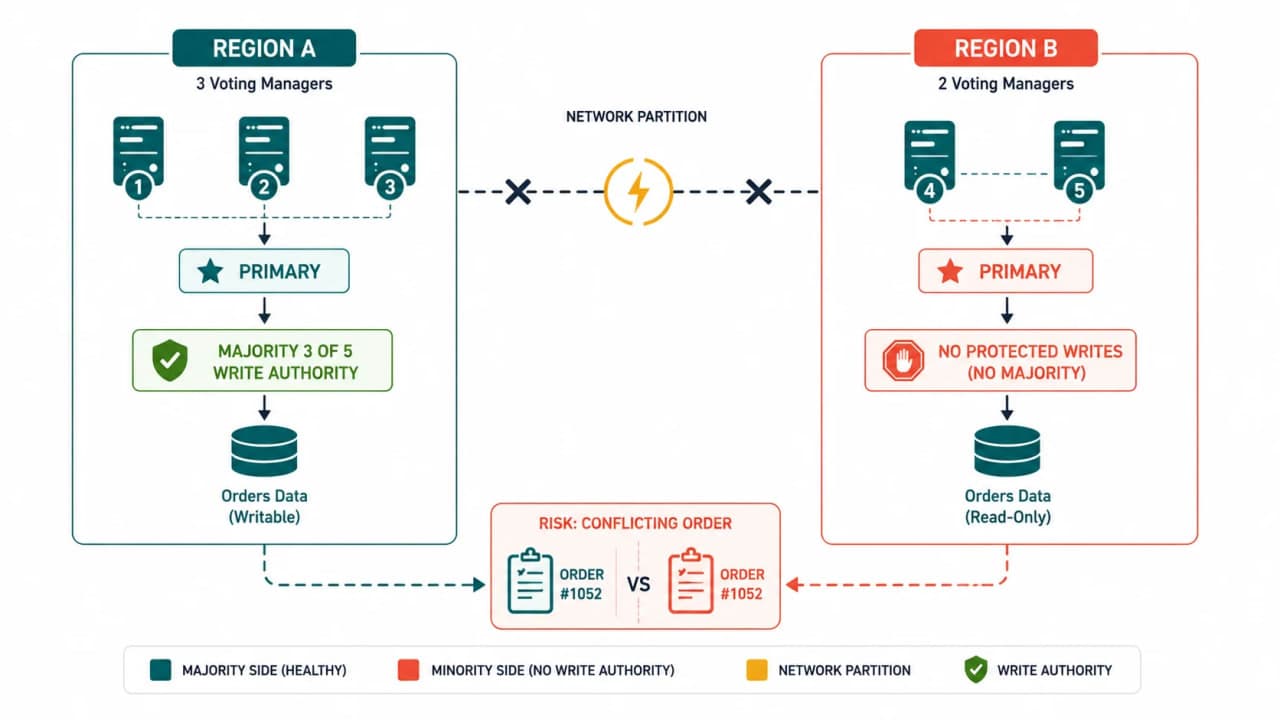
Quorum requires a configured minimum set of voting participants before protected operations such as leader election or certain commits can proceed. In a five-voter system, a majority is three. If a partition leaves three voters together and two isolated, only the three-voter side can form the majority required by the system's rules. The two-voter minority must not elect a protected leader or accept protected writes.
Why odd counts are common becomes visible: moving from four to five voters can increase tolerated voter failure under majority rules, while an even split cannot produce two separate majorities. Placement matters; five voters badly distributed across failure domains can still lose quorum together.
Quorum does not mean every node agrees, does not repair corrupted data, and does not guarantee availability. If no side has three reachable voters, protected operations stop. That reduced availability is the cost of avoiding two unsafe authorities. Consensus systems such as those based on Raft or Paxos use quorum concepts, but their protocol details are beyond this incident.
The design decision is a voting and fencing arrangement aligned with regional failure domains and write safety. The consequence is one protected authority under covered partitions. The tradeoff is losing write availability when the majority is unreachable. At work, remove each region or link and count reachable voters before claiming safety. Memory callback: majority vote among managers prevents both isolated groups from appointing a manager.
Reader question: How does a five-node quorum stop both isolated regions from safely declaring themselves primary?
Why this visual is needed: Definitions hide that the minority side must sometimes stop writing to preserve one authority.

How to read it: Count three voters on one side and two on the other; then connect majority to write authority and minority to fencing.
What to remember: A majority can preserve one safe authority, but the minority may have to stop.
How Traffic Moves During Regional Failover
At 6:58 PM, regional health signals fail. SnackNow first distinguishes a local endpoint problem from a regional event. A human incident commander confirms scope because automatically promoting a region on one ambiguous probe could create split brain or move traffic into an incomplete environment.
Declare the disaster and freeze risky deployments or data changes.
Fence or otherwise prevent the old primary from accepting protected writes.
Confirm the recovery data point, replication state, and any expected loss window.
Promote or activate the recovery database and establish one write authority.
Validate application, objects, queues, secrets, third-party access, and critical journeys.
Change the global traffic layer or DNS answer and start with controlled canary traffic.
Ramp traffic while monitoring errors, latency, capacity, data invariants, and customer reports.
Communicate status and the known RPO consequence honestly.
A global load balancer can steer traffic based on health and policy. DNS failover changes name resolution, but resolver and client caches may retain old answers until TTLs and local behaviour permit refresh. Therefore DNS failover is not literally instantaneous. Some clients may continue reaching the failed endpoint, so clear timeout, retry, and status communication matter.
Automatic regional failover can meet a strict RTO for well-modelled signals, but a wrong decision can create dual writers or route users to stale data. SnackNow automates preparation and validation, then requires human approval for Tier 0 write promotion until evidence justifies more automation. The decision is risk-based orchestration. The consequence is controlled recovery; the tradeoff is approval time. At work, measure every step during a drill. Memory callback: the road sign changes cities only after the new shop has one valid ledger and working counters.
The Missing Half: Failback
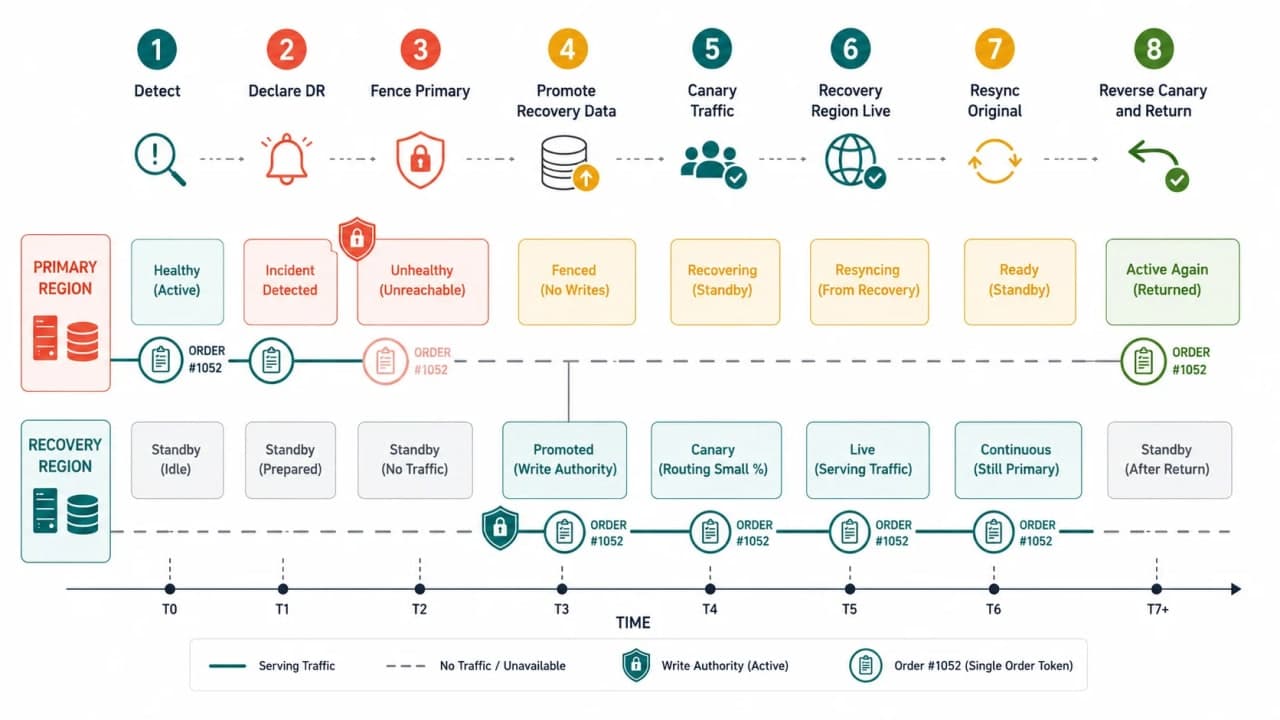
The primary region becomes reachable the next morning. It is now stale. While Region B served orders, its database, queues, objects, and audit history advanced. Sending traffic back to Region A immediately could resurrect old state or create another split brain.
Failback begins by treating the recovered original region as a new recovery target. SnackNow rebuilds or cleans it, patches the root cause, copies the authoritative Region B state back in the correct direction, verifies object and event completeness, and prevents the stale side from writing. It checks quotas, configuration, certificates, third-party allowlists, and application versions.
A reverse canary sends a small safe traffic share to Region A. Teams compare business invariants and operational signals before increasing traffic. A rollback route remains ready if errors return. Only after traffic and write authority are stable does SnackNow re-establish the intended replication topology and close the disaster.
The story event is the original city reopening. The visible risk is stale service causing a second incident. The decision is reconciliation plus controlled traffic return. The consequence is safe normalisation. The tradeoff is extended time operating from the recovery region and complex replication reversal. At work, include failback ownership and success criteria in the original DR plan. Memory callback: returning business to the first city requires moving the current ledger back, not reopening yesterday's book.
Reader question: What sequence safely moves SnackNow to the recovery region and later returns it?
Why this visual is needed: Regional diagrams often stop at failover and hide changed write authority, accumulated data, and stale failback risk.

How to read it: Follow one write-authority marker through declaration, fencing, promotion, traffic ramp, resynchronisation, reverse canary, and verified return.
What to remember: Fail over with one authority; fail back only after reconciliation and proof.
Runbooks, Automation and DR Drills
SnackNow writes an emergency instruction folder, immediately mapped to a runbook: an owned, versioned sequence with decision points, commands or automation, expected evidence, rollback paths, contacts, and communication responsibilities.
Declare the incident and appoint authority.
Confirm scope, failure domain, and business impact.
Freeze dangerous deployments and ambiguous writes.
Activate or scale the recovery environment from versioned infrastructure definitions.
Promote data systems with fencing and record the recovery point.
Route canary traffic through the global layer.
Validate Tier 0 and Tier 1 business journeys, not only health endpoints.
Communicate customer, restaurant, support, and executive status.
Monitor capacity, replication, errors, queues, objects, and data invariants.
Prepare reconciliation and controlled failback before declaring recovery complete.
Infrastructure as code reduces manual reconstruction. Automated validation checks resources, permissions, certificates, replication state, object availability, queue ownership, and synthetic orders. Break-glass access must be usable and audited when the primary identity path is unavailable. Notifications and decisions form an incident audit trail.
A recovery plan that has never been exercised is an assumption with page numbers.
Rehearsal day maps to a DR drill. SnackNow runs backup restores, game days for dependency loss, regional evacuation drills, and controlled failback rehearsals. Each drill measures actual RTO, observed RPO, manual bottlenecks, capacity, and unexpected dependencies. A postmortem turns findings into owned changes, not just a report.
The design decision is recurring evidence rather than annual paperwork. The consequence is operational memory and realistic targets. The tradeoff is planned disruption, staff time, and temporary test cost. At work, ensure the people on call can execute without the plan's original author. Memory callback: an emergency folder becomes trustworthy only on rehearsal day.
Geo-Distributed Challenges
Challenge | SnackNow symptom | Design response and tradeoff |
|---|---|---|
Latency | Cross-region payment writes slow | Choose coordination only where loss and consistency justify added round trips |
Replication lag | Recent orders are absent after promotion | Monitor lag, define RPO, reconcile and communicate known gaps |
Split brain | Both regions accept conflicting orders | Leader rules, quorum, fencing, or conflict-safe models; may reduce availability |
Data locality and compliance | User or payment data cannot move freely | Select lawful placement and minimise data; limits topology choices |
Cloud quota and capacity | Warm region cannot scale for evening traffic | Reserve or test quota and capacity; costs money before disaster |
Third-party integrations | Payment or restaurant callbacks allow only primary endpoints | Pre-register recovery endpoints and test credentials |
Operational complexity | Teams deploy mismatched versions or misread authority | Versioned automation, staged releases, clear ownership, and drills |
Table takeaway: Every extra location reduces one failure risk while adding coordination, policy, capacity, and human-operability risks.
The visible incident can therefore continue after the region recovers: payment callbacks may still target old addresses, a warm fleet may hit quota, or data may violate locality policy. The design decision is to include non-cloud dependencies and governance in the DR inventory. The consequence is fewer surprises. The tradeoff is broader ownership. At work, run the critical journey with the primary region and its credentials intentionally unavailable. Memory callback: the road between cities includes laws, tolls, capacity, and external suppliers.
Design a DR Plan for SnackNow
SnackNow chooses a plan the team can operate, not the most expensive diagram available.
Plan element | SnackNow decision | Why and tradeoff |
|---|---|---|
Service tiers | Tier 0 payments/orders; Tier 1 menu/cart/checkout; slower lower tiers | Spend follows business harm |
RTO/RPO | Short, measured targets for Tier 0/1; wider targets for rebuildable data | Lower targets cost more and require coordination |
Readiness | Warm standby for critical service; cold recovery for selected analytics | Meets target without full active-active complexity |
Data | Low-lag cross-region path, continuous logs, and immutable historical backup | Replication supports continuity; backup survives corruption |
Traffic | Global routing with health evidence, human-approved Tier 0 promotion, and canary ramp | Reduces wrong automatic failover risk |
Write safety | Single protected authority, fencing, and quorum where the data system requires it | Minority writes may stop during partition |
Rebuild and proof | Infrastructure as code, synthetic-order validation, and quarterly drills | Recurring effort produces recovery evidence |
Return | Documented reconciliation, reverse replication, canary failback, and rollback | Normal topology returns without stale overwrite |
People | Named incident commander, data authority, communications owner, and audit record | Clear decisions reduce dangerous ambiguity |
Table takeaway: The selected strategy is the cheapest architecture that repeatedly proves the required business recovery, not a universal best practice.
During the next regional drill, the primary disappears. The team declares DR, freezes writes on the old authority, verifies the recovery point, promotes the warm data path, scales application capacity, validates a synthetic paid order, and shifts canary traffic. Recommendations remain unavailable while checkout returns. Later, the original region is rebuilt from authoritative state and receives reverse canary traffic.
The consequence is that a lost region becomes a managed business continuity event. The tradeoff is continuous expenditure and operational practice. At work, record the target, actual result, data gap, manual step, and next improvement. Memory callback: the duplicate city shop, travelling ledger, majority managers, road sign, instruction folder, rehearsal, and return journey now form one plan. Every target still traces back to System Reliability Explained: MTBF, MTTR and SLA, because disaster recovery succeeds only when the restored journey keeps the original promise.
Common Misunderstandings
Claim | Why it fails | SnackNow correction | Memory line |
|---|---|---|---|
Backups are our DR plan | Data alone does not restore application, traffic, access, and operations | Restore the full critical journey | Boxes are not a working shop |
Multi-AZ equals multi-region DR | Zones remain inside one region-level boundary | Name the fault domain and recovery location | Several counters can share one market |
Active-active removes all downtime | Shared code, identity, dependencies, partitions, and conflicts remain | State covered failures and write rules | Two cities can share one bad instruction |
Lower RPO costs nothing | Faster replication adds storage, coordination, latency, or availability tradeoffs | Set target from business loss | A current ledger must travel faster |
DNS failover is instant | Resolver and client caches can retain old answers | Design TTLs, retries, status, and global routing evidence | Road signs are not seen at once |
Replication prevents corruption | It can copy corruption quickly | Keep immutable history and tested restoration | The travelling ledger copies crossed-out pages |
Quorum means every node agrees | A majority can proceed while a minority is fenced | Document voter count and failure placement | Three of five is not five of five |
Automatic failover is always safer | Wrong signals can create dual authority or stale promotion | Automate known evidence and choose approval points | A fast wrong city switch is still wrong |
Failback is easy | The original region is stale after recovery-region writes | Reconcile, reverse safely, canary, and retain rollback | Return with today's ledger |
A DR document proves recovery | Untested access, capacity, dependencies, and timing remain assumptions | Run drills and measure business validation | Rehearse the folder |
Every service needs zero RPO and RTO | The cost and physics are extreme and impact differs | Tier services and fund justified targets | Open the payment counter first |
Table takeaway: A DR claim is complete only when it names the scenario, business tier, targets, data authority, traffic path, validation, and tested return.
Memory Reconstruction: Remember the Dark Region
A. Series Incident Ladder
The app stayed online but produced an unreliable order outcome.
One server failed and exposed a single service path.
A deletion propagated to every live database copy.
The whole primary region became unreachable at 6:58 PM.
Retell why each failure expands the boundary. The first is behavioural, the second a component path, the third historical data integrity, and the fourth a location-scale business service loss.
B. One Tool per Failure
Reliability engineering defines and measures the correct promise. High availability and failover provide another usable path for covered component failures. Backup and recovery restore protected history after deletion or corruption. Disaster recovery coordinates the full service after a severe primary-environment loss. They support one another, but none is a synonym for all four.
C. Four DR Readiness Scenes
Describe the second region four times: protected data only; critical pilot-light core; smaller functioning warm environment; fully active second site. For each, name what starts after disaster, likely recovery speed, standing cost, and the new coordination burden.
D. RTO/RPO Decision Exercise
Tier 0 orders require a 15-minute RTO and one-minute RPO. Analytics accepts eight hours and four hours. Choose a readiness and data path for each, then state what evidence would prove the targets. If your chosen restore takes two hours for orders, redesign rather than renaming the target.
E. Split-Brain Retelling
The regional link fails. Both regions can still serve some users. Explain why failure detection cannot reveal whether the other side is dead or isolated, how dual primaries create conflicting orders, and why fencing or one write authority may sacrifice minority-side write availability to preserve correctness.
F. Five-Node Quorum Exercise
Split five voters into 3 and 2, then 2 and 2 with one unavailable. State which side can form a majority, which protected actions stop, and why quorum is a safety mechanism rather than a guarantee of uptime. Next place three voters in one region and explain the shared-failure mistake.
G. Failover and Failback Sequence
Without looking back, say: detect, declare, freeze, fence, verify data, promote one authority, validate dependencies, canary traffic, ramp, communicate, operate, rebuild original, resynchronise, reverse canary, restore topology, verify. If failback is absent, the plan is unfinished.
H. Cause -> Choice -> Consequence
Cause: every local replica shared one regional boundary. Choice: a warm, independently operable recovery region. Consequence: shorter regional recovery, at standing cost. Cause: cross-region partition could create two writers. Choice: quorum and fencing for protected data. Consequence: one authority, at the cost of minority write availability. Cause: the original region became stale. Choice: reconcile and canary failback. Consequence: safe return, at the cost of longer recovery operations.
I. Ninety-Second Retelling and Workplace Transfer
Design DR for a SaaS product with payments, file uploads, notifications, and analytics. The primary region is unavailable for six hours. Payments need a 15-minute RTO and one-minute RPO; analytics can wait eight hours.
A strong answer tiers the services, selects warm or hotter readiness for payment and order truth, uses an explicit cross-region replication and write-authority model plus immutable history, ensures uploaded objects and metadata recover together, controls queue ownership to avoid duplicate notifications, rebuilds analytics from protected source data, routes canary traffic globally, validates critical journeys, communicates any data gap, and includes a measured failback. It names latency, split-brain, quota, data-locality, access, third-party, and cost tradeoffs.
Final Series Mental Model
At 6:58 PM, Riya did not need a cloud vocabulary lesson. She needed SnackNow's essential business to exist somewhere reachable, with one trustworthy order history and enough tested capacity to serve her. The region outage forced every earlier lesson into one decision: define the promise, preserve a path, preserve history, and recover the whole journey.
Disaster recovery is not a second diagram. It is a tested way to restore business authority, data, dependencies, traffic, and trust after the primary environment is lost.
SnackNow learned reliability through four different failures. Correct behaviour needed reliability. A dead server needed redundancy and failover. Deleted data needed backup and recovery. A lost region needed disaster recovery. The tools are related, but they are not interchangeable, and that difference is what keeps one incident from becoming the end of the business.
Lock in the takeaway
Frequently asked questions
What is disaster recovery in system design?
Disaster recovery is the preparation and controlled process for restoring an application's critical business services, data, dependencies, traffic, access, and operations after a severe event prevents the primary environment from meeting business objectives.
What is the difference between high availability and disaster recovery?
High availability minimises outage impact for defined ordinary failures, often within a local architecture. Disaster recovery handles severe events that remove or compromise the primary environment and requires restoration of the full scoped business service in another recoverable context.
What is backup vs failover vs disaster recovery?
Backup preserves historical data for restoration. Failover switches work to a healthy component or environment. Disaster recovery coordinates data, applications, dependencies, traffic, validation, people, communication, and eventual failback after a major failure.
What are backup and restore, pilot light, warm standby, and active-active DR?
They are increasing levels of pre-incident readiness. Backup-and-restore rebuilds after failure; pilot light keeps a critical core ready; warm standby runs a smaller working environment; active-active has multiple sites serving production, with increasing speed, cost, and coordination complexity.
How do RTO and RPO shape disaster recovery architecture?
RTO drives standby readiness, automation, provisioning, validation, and traffic-switch speed. RPO drives replication, log shipping, backup, and data-recovery frequency. Lower targets generally require more cost, coordination, and testing.
What is split brain in a multi-region system?
Split brain occurs when isolated regions or nodes both believe they hold primary authority and accept conflicting protected writes. Leader rules, quorum, leases, and fencing can preserve one authority, sometimes by reducing minority-side write availability.
How does quorum help during regional failure?
Quorum requires a minimum voting set, commonly a majority, before protected actions such as leader election or certain commits proceed. In a five-voter system, three can form a majority; a two-voter minority cannot safely create a competing protected authority.
Why is DNS failover not instantaneous?
DNS answers can remain cached by resolvers, operating systems, applications, and clients until TTLs and local behaviour permit refresh. Global traffic systems, retries, timeouts, and communication must account for clients still using an old endpoint.
Why are DR drills and failback required?
Drills prove access, capacity, automation, data recovery, traffic routing, validation, ownership, and actual RTO/RPO. Failback safely reconciles authoritative data and gradually returns traffic without allowing stale infrastructure to overwrite recovery-region state.