

Listen to this article
Checking audio support
Storage Series Path: From Memory to Insight
SnackNow is about to learn storage step by step: storage fundamentals and CAP theorem, SQL vs NoSQL, replication and sharding, object storage, file systems, distributed storage, and finally big data fundamentals. We are starting with the foundation: how an app remembers things, why different data needs different homes, and what CAP theorem really means when systems start running across machines.
Reader promise: by the end of this piece, you should be able to explain storage fundamentals and CAP theorem without sounding like you copied a cloud vendor brochure.
SnackNow Can Take Orders, But Can It Remember Them?
Riya opens SnackNow at 6:45 PM. Chai, samosa, maybe one extra green chutney because life is already complicated enough. She taps Add to Cart, checks the address, pays, and waits for the delivery status.
At first glance, this feels like normal app behavior. A request comes in, the backend processes it, and the app responds. But look closely. SnackNow is not only answering Riya. It is remembering her.
It must remember who Riya is, what she added to the cart, whether payment succeeded, which restaurant accepted the order, what address should be used, what delivery partner picked it up, and what happened if something failed midway.
Storage is the app's memory room: the place where important facts survive after the request is over.
Without storage, SnackNow becomes a very forgetful waiter. It may nod politely when Riya orders, then immediately forget the chai as soon as the browser refreshes. Funny in a sitcom. Not funny when money is involved.
Persistent storage means data survives beyond one request, one browser session, one app restart, and ideally even one machine failure. That is why storage is not a boring backend detail. It directly affects whether the product feels fast, trustworthy, scalable, and affordable.
Visual purpose: This visual helps you understand where storage sits in a normal request flow.
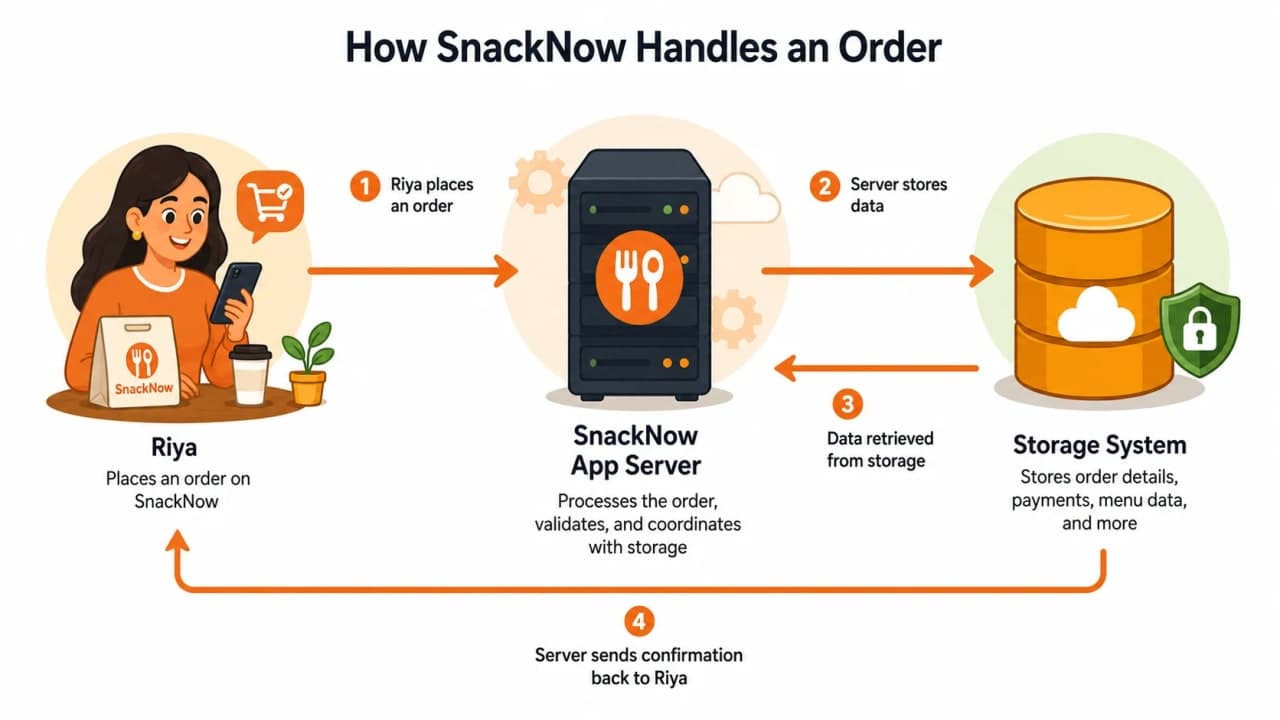
How to read this visual: Riya does not talk to the database directly. The app receives her request, uses storage to read or write memory, and then responds. If the storage layer is slow, confused, or unavailable, the user experience breaks even if the app server code is clean.
Checkpoint: A backend server can process a request, but storage lets the product remember what happened after that request ends.
Interview-ready answer: Storage is critical in system design because it provides persistence, recovery, querying, and state. The storage choice influences scalability, performance, availability, reliability, and cost.
The Notebook Works Until It Doesn't
Before SnackNow became an app, Meera handled orders in a notebook. Customer name, order item, payment status, address, complaints, daily sales. For ten orders a day, this was charming. Almost artisanal.
Then business improved. Orders came every minute. Someone called about a missing payment. Someone sent a food photo complaint. Meera wanted yesterday's sales. Aman, the backend engineer, wanted logs because the app crashed at exactly the wrong time.
The notebook did not become evil. It simply stopped matching the job. Manual memory breaks when volume, accuracy, search, recovery, and concurrency start mattering.
Problem | What Meera Sees | What the System Needs |
|---|---|---|
Too many orders | Pages fill up and search becomes painful | Queryable order storage |
Lost payment record | Riya says money was deducted but order is missing | Durable transactional record |
Food image storage | Complaint photo cannot fit neatly into a row | File-like or object storage |
Search history | No quick way to know what users browse | Event/log storage |
Daily sales report | Manual counting becomes slow | Aggregated analytics-ready data |
App crash | Recent actions may disappear | Persistent storage and recovery |
Takeaway: Storage appears when memory needs to become searchable, recoverable, reliable, and scalable.
The first big lesson is simple: storage is not one thing. It is a set of choices. A payment record, a food photo, a delivery log, and a database disk volume do not want the same home.
Structured vs Unstructured Data: Registers and Boxes
SnackNow's data does not all look the same. Some data is neat. A payment has an amount, status, method, timestamp, and order ID. An order has a user, restaurant, items, and delivery state. This is structured data.
Structured data has a predictable shape. It is the kind of data that fits beautifully into tables, rows, columns, rules, and indexes. If a payment must always have an amount, structured storage can enforce that discipline.
But SnackNow also stores food photos, support audio, invoices, short videos, and exported reports. These do not naturally fit into a table cell. They are unstructured data: file-like data without a fixed row-column shape.
Then there is a middle child: semi-structured data. Menu attributes may change by item. Coffee has size and ice level. Momos have filling type. Sandwiches have bread type. Logs are often JSON-like. They have structure, but not always a fixed table structure.
Before choosing a storage tool, first ask: what is the shape of the data?
Visual purpose: This visual helps you understand why different data shapes need different storage directions.
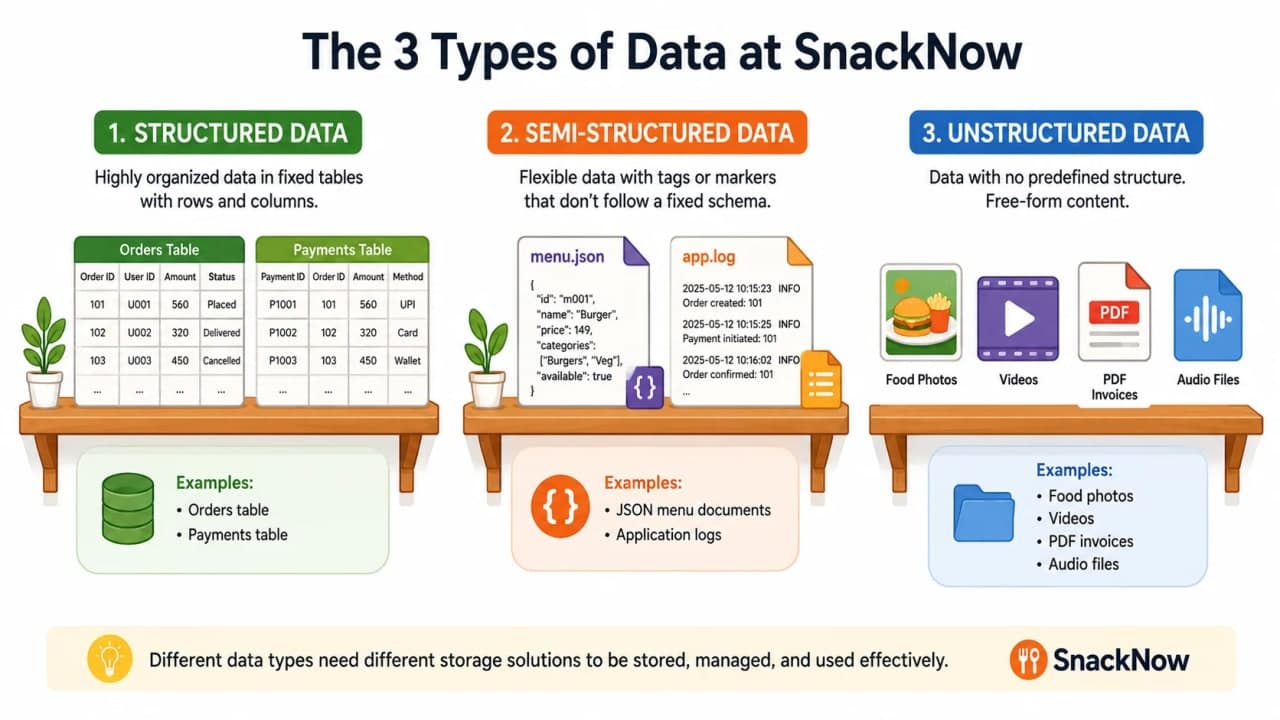
How to read this visual: the structured shelf is for predictable records, the semi-structured shelf is for flexible documents and logs, and the unstructured shelf is for files and media. The mistake is forcing every shelf to behave like the first one.
Data Type | Shape | SnackNow Example | Best Storage Direction | Common Mistake |
|---|---|---|---|---|
Structured | Fixed fields | Orders, payments, users | Database tables | Ignoring schema and constraints |
Semi-structured | Flexible fields | Menu attributes, JSON logs | Document/log-friendly stores | Pretending it has no structure |
Unstructured | File-like | Food photos, videos, invoices | Object/file storage | Putting large files directly into rows |
Takeaway: Data shape is the first filter. Access pattern is the second.
Categories of Storage: Register, Box, Folder, and Raw Disk
When Aman starts designing SnackNow's storage, he should not ask, 'Which database is famous?' He should ask, 'What does this feature need to remember, and how will that memory be used?'
A practical beginner mental model helps:
Database storage is a register with searchable rows and rules. Use it for users, orders, payments, inventory, and anything that needs querying or transactions.
Object storage is a warehouse of labeled boxes. Use it for images, videos, invoices, exports, backups, and large unstructured files.
File storage is folders and files. Use it when systems need shared directory-like access.
Block storage is raw disk building blocks. Use it for database volumes, VM disks, and low-level high-performance storage needs.
Visual purpose: This visual helps you choose a storage category based on the job instead of memorizing definitions.
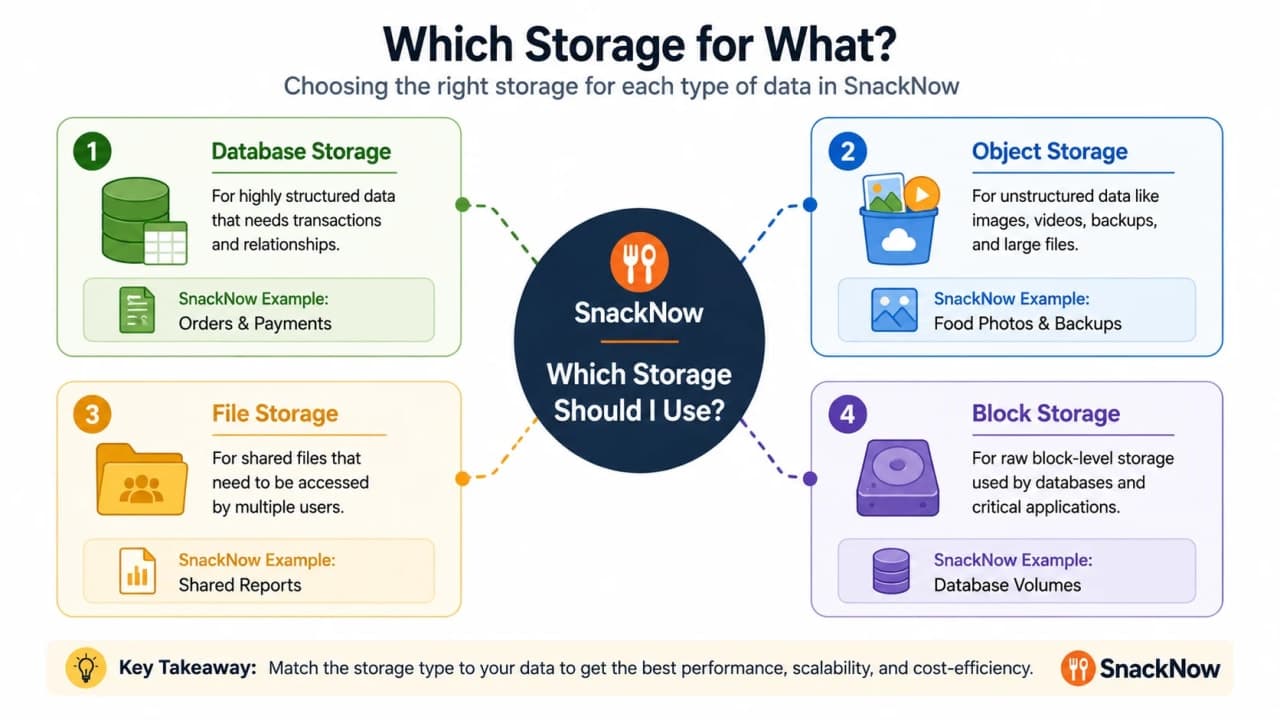
How to read this visual: each storage type has a natural job. Orders belong in a queryable register. Food photos belong in labeled boxes. Shared reports can live in a folder-like system. A database engine itself may need block storage underneath.
Need | Better Storage Type | Why | SnackNow Example |
|---|---|---|---|
Store orders | Database storage | Needs queries, relationships, and correctness | Riya's paid order |
Store food images | Object storage | Large file-like data with metadata | Samosa photo |
Store shared reports | File storage | Folder-style access is convenient | Monthly sales CSV folder |
Store database disk volume | Block storage | Fast low-level reads and writes | PostgreSQL volume |
Store backups | Object storage | Durable, cheap tiers, lifecycle rules | Daily database export |
Store logs for analytics | Object, log, or distributed storage | Append-heavy and high volume | Clickstream logs |
Takeaway: Good storage design is not one perfect tool. It is matching the tool to the data and access pattern.
The Three Big Promises: Durability, Availability, and Consistency
Now Riya pays for her order. This is where storage stops being theoretical. If SnackNow loses her payment record, she will not care that the architecture diagram looked elegant.
A storage system usually tries to make three big promises: durability, availability, and consistency. A fourth idea, atomicity, matters heavily when multiple changes must succeed or fail together.
Durability means data survives failure. Availability means the system responds. Consistency means users see correct data.
Property | Plain Meaning | SnackNow Example | What Goes Wrong If Missing |
|---|---|---|---|
Durability | Committed data should not vanish | Paid order survives crash | Payment proof disappears |
Availability | System keeps responding | Order status page opens | Users see errors or timeout |
Consistency | Reads show correct latest state | Order says paid after payment | Riya sees unpaid after paying |
Atomicity | All-or-nothing operation | Payment and order creation both succeed or both roll back | Money deducted but no order exists |
Takeaway: these words sound academic until a user pays, refreshes, and expects the truth.
Atomicity is easy to understand through payment. SnackNow should not create half an order. Either payment succeeds and order creation succeeds, or the whole operation is rolled back. Aadhe mein latka hua order is not a feature; it is a support ticket.
Interview-ready answer: Atomicity means an operation is all-or-nothing. In SnackNow, payment capture and order creation should not split into one success and one failure.
How is it so far?
Vote with other readers
Storage Tradeoffs: Fast, Safe, Cheap, and Scalable
Every storage choice comes with tradeoffs. A system can be extremely consistent but slower. It can be highly available but sometimes show stale data. It can be cheap for archives but slow to retrieve. It can scale beautifully but become operationally complex.
This is where system design becomes real. There is no universal storage answer. There is only a better answer for this data, this traffic, this failure mode, and this cost boundary.
Performance <-> Reliability <-> Cost/Scale

Push one side too hard, and another side usually moves.
The job is not to avoid tradeoffs.
The job is to choose the tradeoff the product can survive.
How to read this visual: the triangle is not a formula. It is a reminder that every storage decision moves pressure somewhere else.
Choice | Improves | Hurts | Good For | Bad For |
|---|---|---|---|---|
Strong synchronous writes | Correctness | Write latency | Payments, wallet | Like counters |
Eventually consistent reads | Availability and speed | Immediate correctness | Catalogs, feeds | Payment confirmation |
Archive storage | Long-term cost | Fast retrieval | Old backups | Hot order status |
Horizontal distributed storage | Scale and fault tolerance | Operational simplicity | Global traffic | Tiny simple apps |
Takeaway: pick storage based on what failure would hurt most.
CAP Theorem: The Day Two SnackNow Branches Could Not Talk
SnackNow expands to two city branches. Delhi has one database copy. Mumbai has another. Under normal conditions, they talk to each other and keep data synchronized.
Then the network between them has a bad evening. Delhi can talk to Delhi. Mumbai can talk to Mumbai. But Delhi and Mumbai cannot talk to each other.
Now Riya updates her order during this network problem. SnackNow has a choice. Should it reject the update until both sides agree? Or should it accept the update locally and sync later?
This is the heart of CAP theorem. CAP stands for Consistency, Availability, and Partition Tolerance.
Consistency means every read gets the latest committed write.
Availability means every request receives a response, even during failures.
Partition tolerance means the system continues despite network splits between nodes.
In real distributed systems, network partitions are not fantasy. So during a partition, the practical CAP choice is usually consistency or availability.
Visual purpose: This visual helps you understand the exact failure moment CAP is talking about.
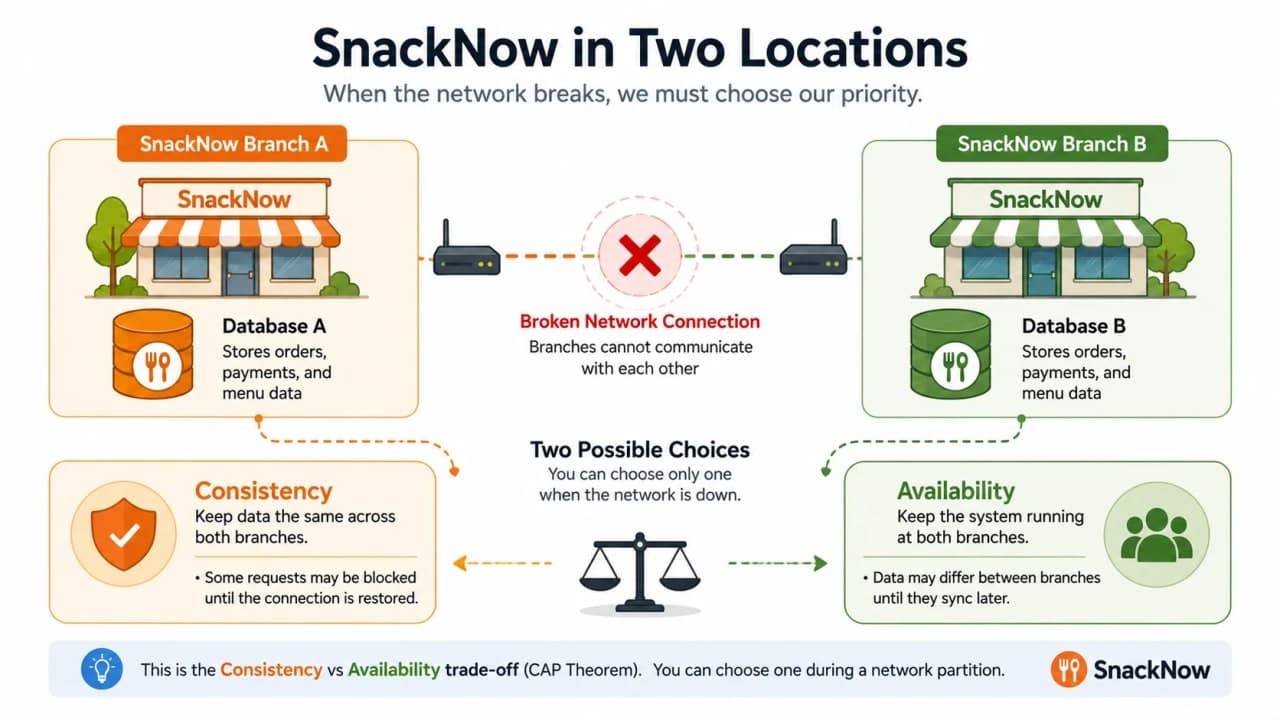
How to read this visual: the broken connection is the partition. If SnackNow protects consistency, it may reject or pause some requests. If it protects availability, it may accept requests even though another branch has not seen the latest update yet.
Common mistake: Do not say CAP means a system randomly chooses any two forever. The useful interview framing is: when a network partition happens, a distributed system must trade consistency against availability.
CP vs AP vs CA Without Confusion
Once CAP is clear, CP and AP become much less scary. CP means the system protects consistency and partition tolerance. AP means the system protects availability and partition tolerance. CA means consistency and availability when partition tolerance is not required.
For SnackNow, a payment ledger should behave more like CP. If the system is unsure whether the payment update is safe, it is better to pause than show two different truths. A menu catalog can behave more like AP. If one branch shows yesterday's photo for five minutes, the business survives.
CAP Choice | What It Protects | What It Sacrifices | SnackNow Example | Real-World Style |
|---|---|---|---|---|
CP | Correct data during partitions | Some availability | Payment ledger pauses uncertain writes | Banking, ledgers, critical state |
AP | Response during partitions | Immediate freshness | Menu catalog stays online with stale data | Feeds, catalogs, social counters |
CA | Correct and responsive without partitions | Partition tolerance | Single-node internal tool | Mostly classroom for distributed systems |
Takeaway: CP and AP are product decisions, not just database labels.
Warning: CA is mostly a classroom idea for distributed systems because real networks can fail. A single-node database may feel CA, but a real distributed system has to plan for partitions.
Choosing Consistency or Availability in Real Features
Aman should not label the whole SnackNow app as CP or AP and go home. Different parts of the same product can make different choices.
SnackNow Data | Prefer | Why | Storage Design Hint |
|---|---|---|---|
Payment confirmation | Consistency | Wrong payment state causes real damage | Transactional database, careful writes |
Wallet balance | Consistency | Money cannot be approximate | Strong consistency and audit log |
Menu availability | Availability | Slightly stale menu is tolerable | Cache/catalog store with refresh |
Food photo loading | Availability | Image can load from nearest copy | Object storage plus CDN |
Likes and reviews | Availability | Counts can catch up later | Eventually consistent counters |
Analytics dashboard | Availability | Reports can lag slightly | Batch/stream pipeline later |
Order tracking | Balanced | Users need fresh enough status | Fresh leader read for critical states, cached reads for safe states |
The right consistency level depends on the damage caused by a wrong answer.
This is also why one app often uses several storage systems. Payments, photos, logs, reports, and counters have different needs. That idea becomes important later, but you do not need to master it yet. For now, remember the question: what happens if this data is wrong, late, lost, or unavailable?
Common Beginner Mistakes
Storage mistakes usually begin before any tool is chosen. The team skips the shape of the data, the access pattern, or the failure mode, and jumps directly to a product name.
Mistake | Why It Hurts | Better Thinking |
|---|---|---|
Storage means only database | Images, logs, backups, and files need different homes | Start with data shape |
Treating images like rows | Database becomes heavy and expensive | Store files separately, keep references in DB |
Confusing durability with availability | Data surviving and system responding are different | Name the exact promise you need |
Thinking consistency means fast | Strong coordination can add latency | Decide where freshness matters |
Saying CAP always means pick any two | It misses the partition-time nuance | During partition, choose C or A |
Thinking AP means wrong forever | Eventually consistent data can converge | Know staleness tolerance |
Choosing storage before access patterns | Wrong indexes, wrong cost, wrong scale | Ask read/write/query patterns first |
Ignoring cost | Storage, requests, egress, and retention add up | Design lifecycle and retention early |
Takeaway: beginner storage design improves quickly when you replace tool-first thinking with data-first thinking.
The Interview Version: Say This Without Panicking
Why is storage a critical component in system design?
Storage gives the system durable memory. It lets applications persist, retrieve, update, and recover data. The storage choice affects performance, availability, scalability, reliability, and cost.
How would you differentiate structured and unstructured data?
Structured data has a fixed shape such as rows and columns: users, orders, payments. Unstructured data has no fixed table shape: photos, videos, documents, audio, and raw files. Semi-structured data, like JSON logs or flexible product attributes, sits in the middle.
What are the different storage systems and use cases?
Use database storage for queryable records and transactions, object storage for large unstructured files, file storage for folder-like shared access, and block storage for raw volumes behind databases or virtual machines.
What do durability, availability, and consistency mean?
Durability means committed data survives failure. Availability means the system responds when requested. Consistency means reads reflect the latest correct state according to the system's rules.
Can a system be highly available and strongly consistent?
Sometimes, but not always during network partitions. CAP theorem says a distributed system facing a partition usually must choose whether to keep responding or protect the latest consistent answer.
What is CAP theorem?
CAP theorem explains the tradeoff between consistency, availability, and partition tolerance in distributed systems. Since partitions can happen in real networks, the practical design choice during a partition is usually consistency versus availability.
Explain CP vs AP with examples.
A CP design protects correctness during partitions and may reject requests, like a payment ledger. An AP design keeps responding during partitions and may show stale data briefly, like a menu catalog or social counter.
How would you design storage for photos vs user metadata?
Store photos in object storage because they are large unstructured files. Store user metadata in a database because it needs queries, updates, permissions, and relationships. Keep the object key or URL reference in the database.
What storage would you choose for logs and metrics?
For raw logs, object storage or distributed storage can hold large append-heavy data. For metrics, time-series or columnar systems may help querying. The final choice depends on ingestion volume, query latency, retention, and cost.
Visual Cheat Sheet
Concept | Plain Meaning | SnackNow Hook | Use When | Interview Keyword |
|---|---|---|---|---|
Storage | App memory | Remembers Riya's order | Any persisted state | Persistence |
Structured data | Predictable shape | Orders and payments | Tables and constraints | Schema |
Semi-structured data | Flexible shape | Menu JSON, logs | Changing attributes | Document/log |
Unstructured data | File-like data | Food photos | Media and files | Blob/object |
Database storage | Searchable register | Users, orders | Queries and transactions | Database |
Object storage | Labeled boxes | Images and backups | Large files | Object/key/metadata |
File storage | Folders and files | Shared reports | Directory access | NFS/SMB |
Block storage | Raw disk blocks | DB volume | Low-level high performance | Volume |
Durability | Survives crash | Paid order stays saved | Committed records | Persistence |
Availability | Responds to requests | Status page opens | Uptime matters | Uptime |
Consistency | Correct latest answer | Paid means paid | Truth matters | Fresh reads |
Atomicity | All or nothing | Payment plus order | Transactions | Rollback |
CAP | Partition tradeoff | Two branches cannot talk | Distributed systems | C/A/P |
CP | Correct over always-on | Payment ledger | Critical correctness | Consistency |
AP | Always-on over fresh | Menu catalog | Tolerable staleness | Availability |
CA | Correct and available without partitions | Single-node tool | Non-distributed cases | Rare in distributed systems |
Takeaway: if you can explain this table in your own words, you can handle most beginner storage interview questions calmly.
FAQs
Why is storage important in system design?
Storage is important because it lets an application remember data beyond one request or crash. It affects performance, reliability, cost, availability, and how safely the system can grow.
What is the difference between structured and unstructured data?
Structured data has a predictable shape, like rows and columns for users, orders, and payments. Unstructured data has no fixed table shape, like images, videos, invoices, support audio, and raw files.
What are the main storage types in system design?
The common categories are database storage for queryable records, object storage for large file-like data, file storage for folders and shared files, and block storage for raw high-performance volumes.
What does CAP theorem mean in simple words?
CAP theorem says that when a distributed system faces a network partition, it usually has to choose between consistency, where reads return the latest correct data, and availability, where the system keeps responding.
How do you choose between consistency and availability?
Choose consistency for payments, wallet balances, and anything where a wrong answer causes real damage. Choose availability for catalogs, photos, likes, or analytics where slightly stale data is usually acceptable.
Keep Reading the Storage Series
Once the storage foundation is clear, continue with The Register or the Flexible Box: SQL vs NoSQL Explained Without the Holy War to decide how SnackNow models its data.
After that, move into When One Database Gets Tired: Replication, Sharding, and Polyglot Persistence Explained, The Pantry for Photos, Videos, and Backups: Object Storage Explained with S3-Style Thinking, When One Disk Is Not Enough: File Systems and Distributed Storage Explained Through SnackNow, and From Orders to Insights: Big Data Storage, Batch Processing, and Streaming Explained to see how the same app grows from basic memory into analytics.
Final Mental Model
SnackNow's app does not only need servers that answer requests. It needs memory that survives crashes, grows with users, returns the right answer, and stays available when parts of the system fail.
Remember the storage room. Some data goes into registers, some into labeled boxes, some into folders, and some into raw disk blocks. System design begins when you stop asking Where do I store it? and start asking How will this data be read, written, protected, scaled, and paid for?
Lock in the takeaway
Frequently asked questions
Why is storage important in system design?
Storage is important because it lets an application remember data beyond one request or crash. It affects performance, reliability, cost, availability, and how safely the system can grow.
What is the difference between structured and unstructured data?
Structured data has a predictable shape, like rows and columns for users, orders, and payments. Unstructured data has no fixed table shape, like images, videos, invoices, support audio, and raw files.
What are the main storage types in system design?
The common categories are database storage for queryable records, object storage for large file-like data, file storage for folders and shared files, and block storage for raw high-performance volumes.
What does CAP theorem mean in simple words?
CAP theorem says that when a distributed system faces a network partition, it usually has to choose between consistency, where reads return the latest correct data, and availability, where the system keeps responding.
How do you choose between consistency and availability?
Choose consistency for payments, wallet balances, and anything where a wrong answer causes real damage. Choose availability for catalogs, photos, likes, or analytics where slightly stale data is usually acceptable.