
Listen to this article
Checking audio support
Storage Series Path: Now the Memory Needs a Model
If the storage vocabulary is still new, start with The App That Needed a Memory: Storage Fundamentals and CAP Theorem Explained Clearly. It explains storage types and CAP theorem first, so this SQL vs NoSQL choice feels less like a debate and more like a design decision.
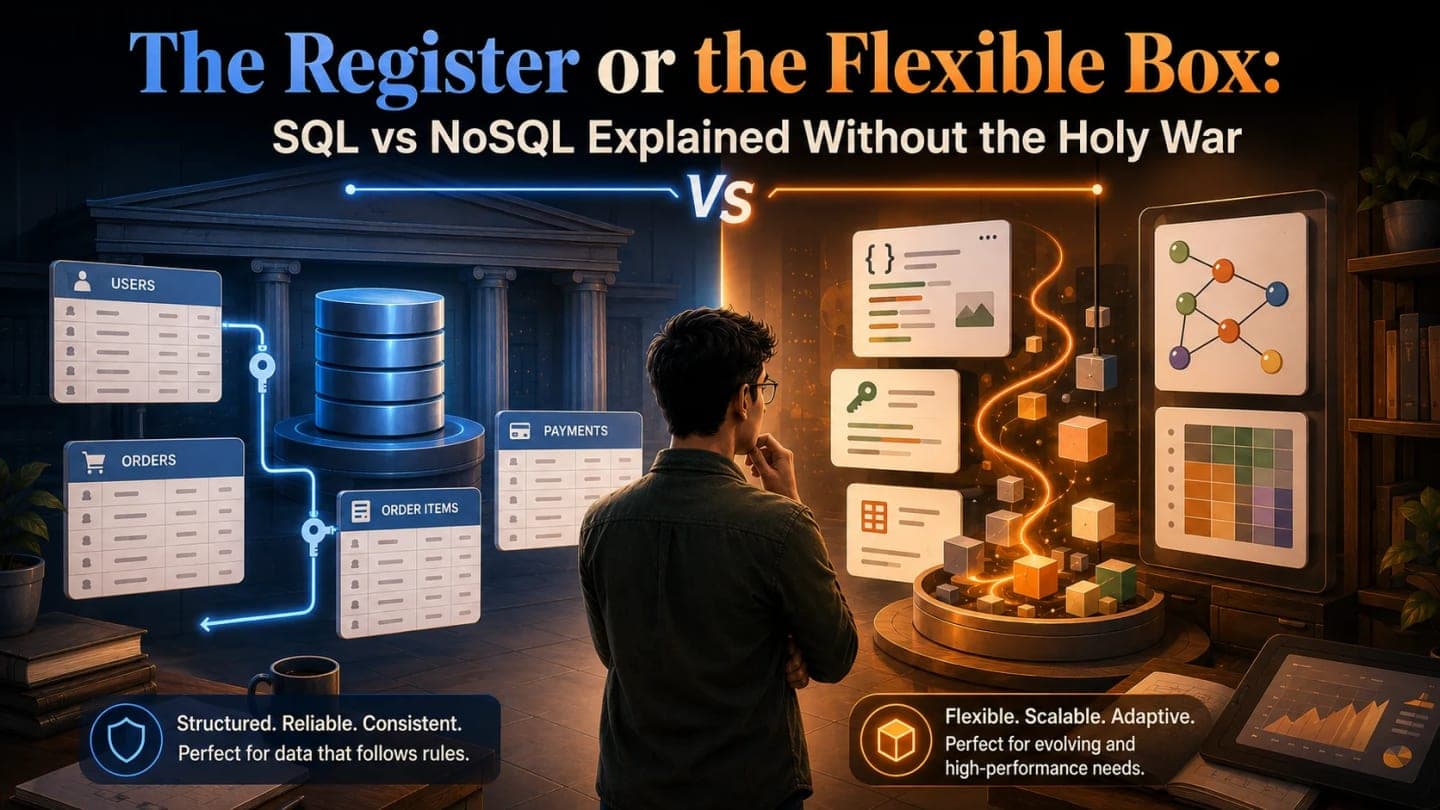
SnackNow already learned that an app needs memory. Now the memory needs a shape. Orders, payments, menus, carts, reviews, recommendations, and logs do not behave the same way. So the next question is not Which database is cooler? The better question is: what shape is this data, and how will the app use it?
Reader promise: this piece explains SQL vs NoSQL without turning it into a holy war. No fan clubs. No drama. Just practical system design.
SnackNow Needs More Than Files
Riya places another order: chai, samosa, and one coupon because she has become a responsible bargain hunter. SnackNow must store her profile, address, cart, order, payment, coupon, delivery status, item details, restaurant availability, and support messages.
Some of this data is strict. A payment cannot be a vague feeling. An order amount cannot randomly be a paragraph. Inventory cannot quietly become negative because two users clicked at the same time.
A database is a structured way to store, retrieve, update, and manage data. The important word is structured, but the structure can take different forms.
The SQL vs NoSQL decision begins with data shape and access pattern, not popularity.
Visual purpose: This first database visual helps you understand why structured SnackNow data naturally starts as tables.
The First Database Looks Like a Register
Meera's old notebook had separate pages: customers, orders, payments, menu items. A relational database makes that discipline formal. It stores data in tables. Tables contain rows. Rows contain columns. A schema defines the allowed shape.
For SnackNow, a relational model feels natural for core business data. Users are users. Orders are orders. Payments are payments. Order items connect an order to the chai and samosa inside it.
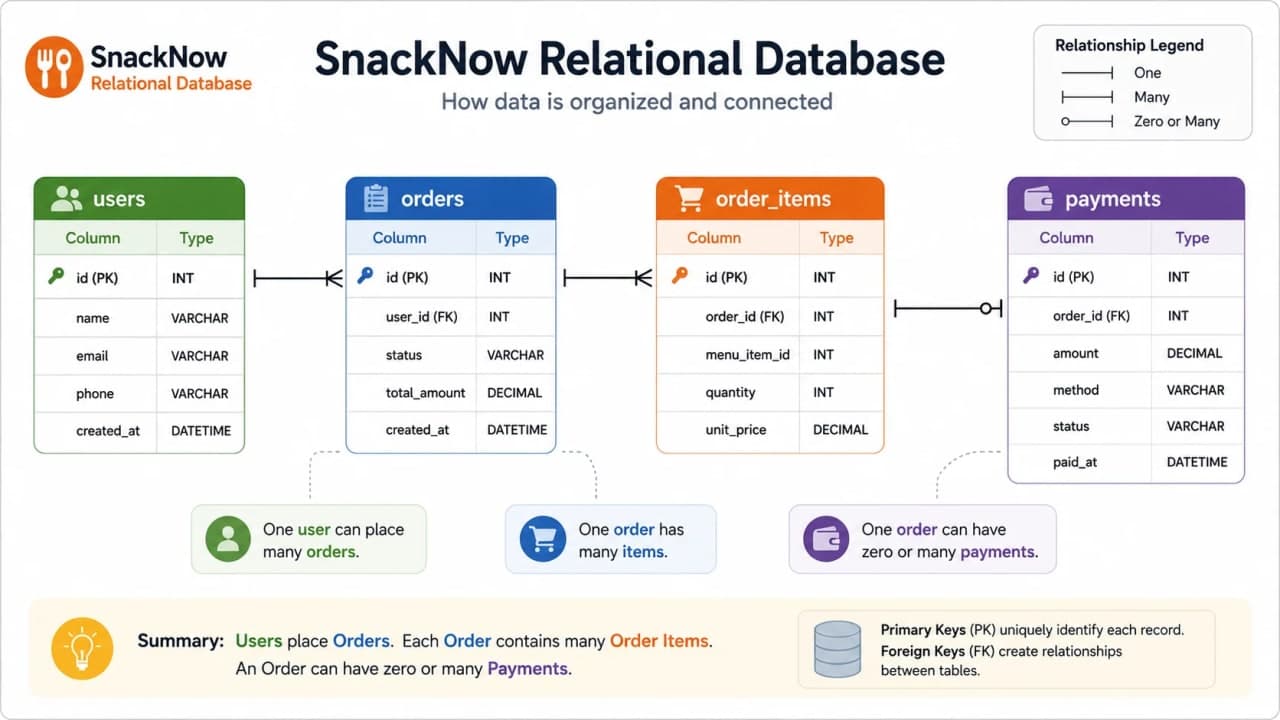
How to read this visual: users, orders, order items, and payments are separate tables because each has a clear meaning. Keys connect them so the system can rebuild a complete order without duplicating every detail everywhere.
Table | Stores | Example Columns | Why It Fits SQL |
|---|---|---|---|
users | Customer profile | id, name, phone, email | Stable shape and identity |
orders | Order record | id, user_id, status, total | Needs querying and status updates |
order_items | Items in an order | order_id, item_id, quantity | Connects orders to menu items |
payments | Payment result | order_id, amount, provider, status | Needs correctness and audit trail |
menu_items | Sellable food | id, name, price, availability | Structured catalog fields |
Takeaway: SQL is comfortable when the data has clear fields, relationships, and rules.
Schema: The Rulebook Before Data Enters
A schema is the database's rulebook. It says what columns exist, what type each value should be, which fields are required, and which relationships are valid.
If every order must have an order ID, user ID, status, amount, and creation time, SQL can enforce that. If payment amount must be numeric, SQL can reject nonsense before it becomes production data.
That discipline is not bureaucracy. It is protection. When money and orders are involved, predictable shape is a feature.
Interview-ready answer: A schema defines the structure and rules of data before it enters the database, which helps maintain correctness and predictable queries.
Joins: Connecting the Register Pages
Relational databases do not usually store one giant copy of everything in one row. Riya's name lives in users. Her order lives in orders. Her chai and samosa live in order_items. A join connects those pages when the app needs the full story.
Visual purpose: This visual helps you understand why SQL splits related data and how joins bring it back together.
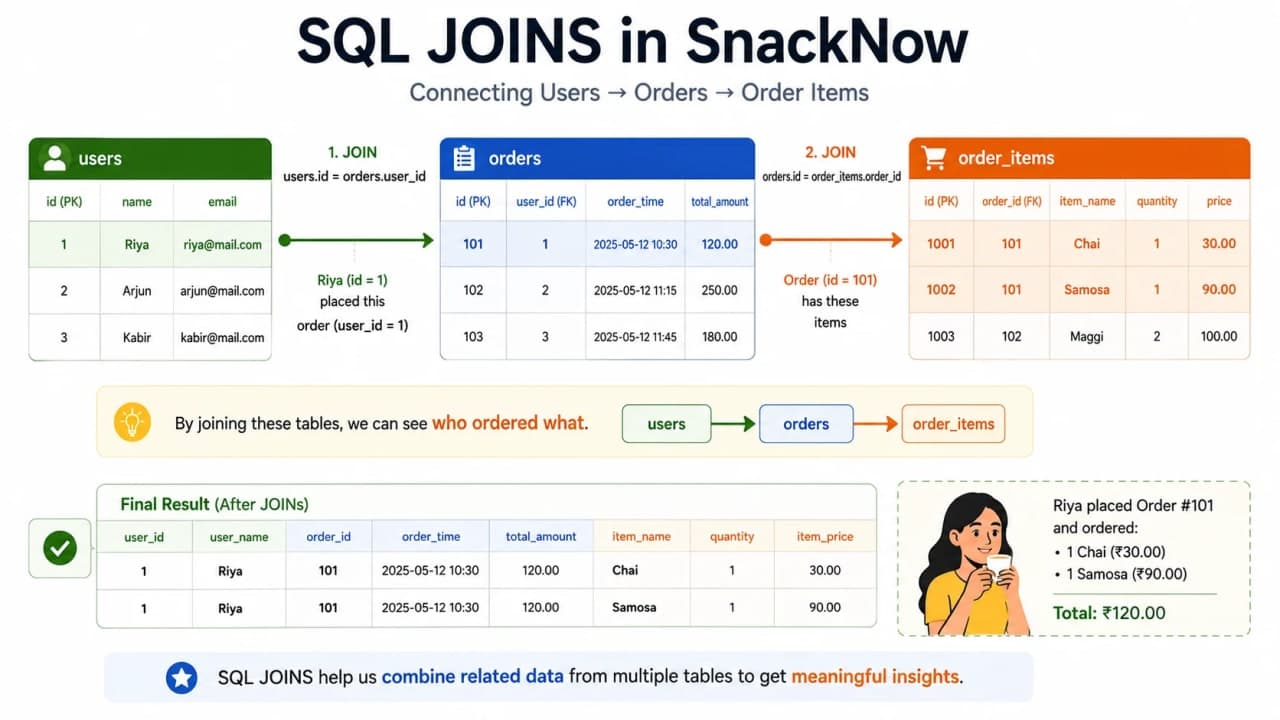
How to read this visual: the user ID connects Riya to her order. The order ID connects the order to its items. A join is the database saying: show me the related pieces together.
SELECT users.name, orders.id, order_items.item_name
FROM orders
JOIN users ON orders.user_id = users.id
JOIN order_items ON order_items.order_id = orders.id;

-- Meaning:
-- Find the order.
-- Connect it to the user.
-- Connect it to the items inside the order.
The goal is not to memorize SQL syntax here. The goal is to understand the relational idea: split cleanly, connect when needed.
ACID: Why Payment Data Needs Discipline
Now comes the sensitive part. Riya pays. The payment succeeds. But order creation fails. If SnackNow stores these as two unrelated operations, Riya may lose money without getting an order. That is the kind of bug that ruins everyone's evening.
ACID is the set of transaction promises that helps databases protect important operations.
ACID Letter | Meaning | SnackNow Example | Why It Matters |
|---|---|---|---|
Atomicity | All or nothing | Payment and order both succeed or both roll back | Avoids half-done business events |
Consistency | Rules stay valid | Order total matches item prices | Keeps data trustworthy |
Isolation | Transactions do not corrupt each other | Two users cannot both buy the last item incorrectly | Protects concurrent actions |
Durability | Committed data survives crash | Paid order remains saved | Protects user trust |
Use SQL when correctness, relationships, and transactions are central to the feature.
Common mistake: Do not treat ACID as interview vocabulary only. ACID is what keeps payment bugs from becoming customer support nightmares.
Where SQL Shines
SQL shines when data is structured and questions are relational. What orders did Riya place? Which payments failed today? Which restaurant has the most delayed orders? Which items belong to this order?
Need | SQL Fit? | Why |
|---|---|---|
Payment ledger | Strong fit | Transactions, correctness, auditability |
Inventory | Strong fit | Rules and updates matter |
Order history | Strong fit | Relationships and queries matter |
Admin reports | Strong fit | Joins and filtering help |
Flexible product attributes | Mixed | Can work, but schema may become awkward |
Huge raw logs | Weak fit | Volume and write pattern may need another store |
Takeaway: SQL is not old-fashioned. It is still one of the best choices when correctness and relationships matter.
Where SQL Starts Feeling Tight
Then SnackNow grows. Menu items become messy in a very real-world way. Coffee has size and ice level. Momos have filling type. Sandwiches have bread type. Combo offers change daily. Restaurant metadata changes faster than Aman's migration files can keep up.
A strict schema can still handle flexible data, but it may become awkward. You may add nullable columns everywhere, create complex side tables, or store JSON inside SQL. Sometimes that is fine. Sometimes it is the database quietly asking for a different model.
New Requirement | Why SQL Feels Awkward | Possible Alternative |
|---|---|---|
Every item has different attributes | Too many optional columns | Document database |
Cart lookup by user ID | Relationship power is unnecessary | Key-value store |
Millions of event logs | Write volume and analytics pattern differ | Columnar/log store |
Recommendations by relationships | Many relationship traversals become complex | Graph database |
Takeaway: SQL can do many things, but not every thing should be forced into SQL just because it can.
NoSQL Appears: Flexible Storage for Flexible Problems
NoSQL means non-relational databases designed around flexibility, scale, and specific access patterns. It does not mean chaos. It does not mean no rules. And it definitely does not mean, 'throw JSON somewhere and hope for the best.'
NoSQL is not one database model. It is a family of models: document, key-value, columnar, and graph are the common beginner categories.
How is it so far?
Vote with other readers
Visual purpose: This visual helps you see NoSQL as multiple storage models, not one vague alternative to SQL.
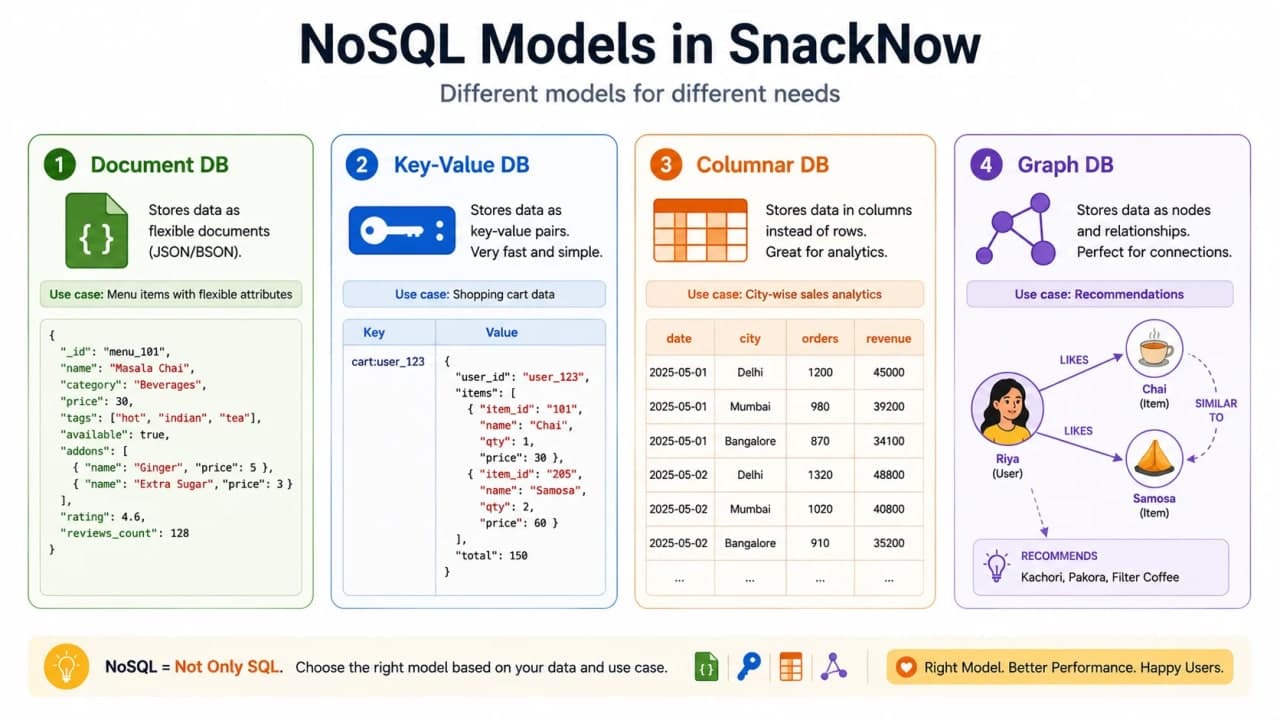
How to read this visual: document databases store flexible objects, key-value databases optimize direct lookup, columnar stores help analytics-style scans, and graph databases make relationships the main data.
Document Databases: The Flexible Order Slip
A document database stores JSON-like documents. For SnackNow's menu catalog, this can feel natural because each item may have different attributes.
{
  "item_id": "momo_101",
  "name": "Paneer Momos",
  "category": "Snacks",
  "attributes": {
    "filling": "Paneer",
    "spice_level": "Medium",
    "steam_or_fried": "Steamed"
  }
}
This is useful when the app usually reads the whole item together and the item shape changes often. The tradeoff is that relationships and multi-document transactions need more care than a traditional relational design.
Key-Value Databases: The Fast Token Counter
A key-value database is the simplest mental model: give a key, get a value. It is excellent when the access pattern is direct and fast.
Use Case | Key | Value | Why Key-Value Fits |
|---|---|---|---|
Cart | cart:user_123 | Current cart JSON | Fast direct lookup |
Session | session:token_abc | User/session data | Short-lived access |
Feature flag | flag:new_checkout | true/false/config | Simple reads |
Rate limit | rate:user_123 | Count and expiry | Fast counters |
Takeaway: key-value storage is powerful when you know the exact key and do not need complex querying.
Columnar and Graph Databases: Analytics and Relationships
Columnar databases optimize for reading columns across many rows. SnackNow may use this for city-wise sales, clickstream analytics, or time-series style reports. This is not the same as 'SQL has columns.' The storage layout and access pattern are different.
Graph databases are useful when relationships are the data. Riya likes masala chai, often orders samosa with it, shares a card with another account, and matches a recommendation cluster. Fraud and recommendation systems often care about those links.
Riya -> likes -> Masala Chai
Riya -> ordered_with -> Samosa
Similar users -> recommend -> Cold Coffee
Suspicious account -> shares_card_with -> Another account
BASE: Availability and Eventual Consistency
Many NoSQL systems talk about BASE: Basically Available, Soft state, Eventually consistent. This is a different philosophy from strict ACID transactions.
Model | Plain Meaning | SnackNow Example | Best For |
|---|---|---|---|
ACID | Strict transaction correctness | Payment plus order creation | Money, inventory, critical state |
BASE | Available now, consistent eventually | Menu likes count catches up | Feeds, counters, catalog-style data |
Eventual consistency does not mean wrong forever. It means replicas or views may lag briefly, then converge.
CAP Revisited for Database Choice
CAP theorem matters when databases become distributed. During a network partition, the system may protect consistency or availability. Payment data leans toward consistency. Product catalogs and likes often lean toward availability.
Data | Prefer CP or AP? | Why |
|---|---|---|
Payment ledger | CP | Wrong answer is dangerous |
Inventory count | Often CP | Overselling can hurt |
Menu catalog | Often AP | Stale menu is tolerable briefly |
Likes counter | AP | Exact count can catch up |
Analytics events | AP-ish | Ingestion should continue |
Chat messages | Depends | Delivery expectations define tradeoff |
Takeaway: database choice and CAP choice are tied to the business damage caused by stale or unavailable data.
SQL vs NoSQL Decision Matrix
Visual purpose: This visual turns the debate into a decision path you can use in interviews.
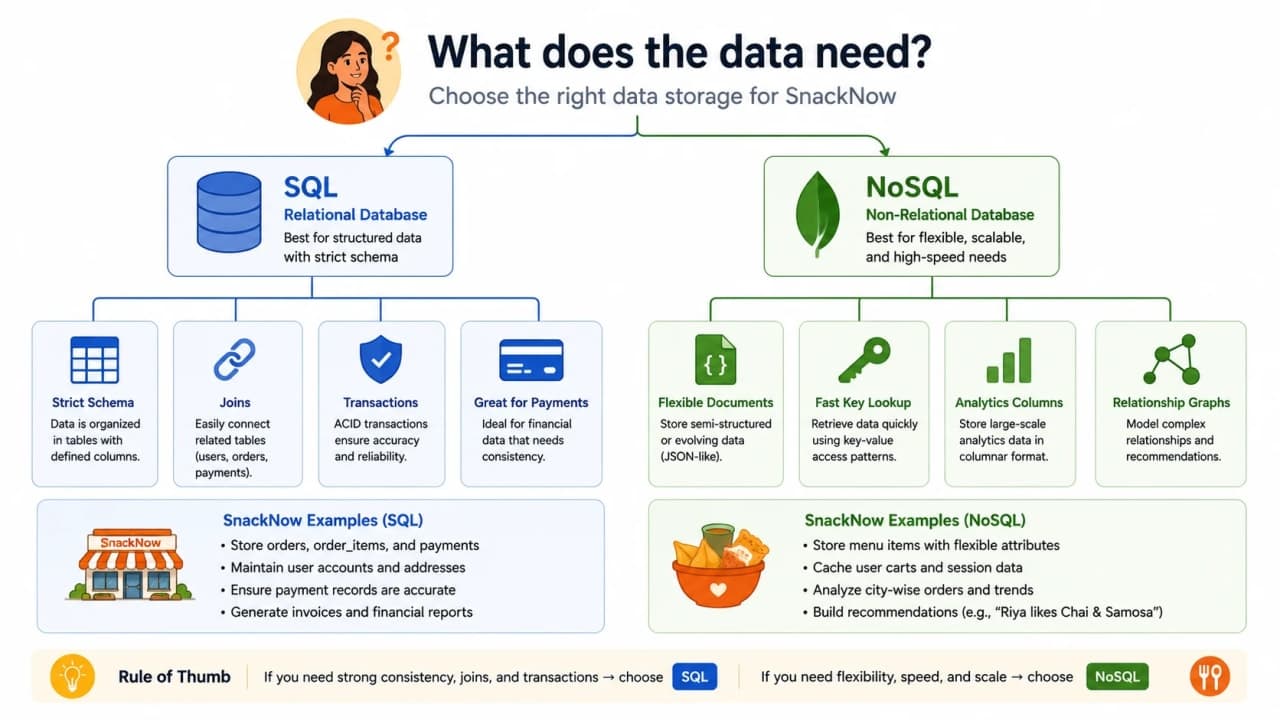
How to read this visual: start with the requirement. If the feature needs strict schema, relationships, joins, and transactions, SQL is the default. If it needs flexible shape, high-scale direct lookup, analytics scanning, or relationship traversal, a NoSQL model may fit better.
Requirement | Choose SQL When | Choose NoSQL When | SnackNow Example |
|---|---|---|---|
Schema stability | Fields are predictable | Fields change by item/user | Payment vs menu attributes |
Relationships | Joins are central | Data is read as one document/key | Order history vs catalog item |
Transactions | All-or-nothing matters | Eventual update is acceptable | Payment vs likes |
Horizontal scale | Scale is moderate or managed | Huge distributed scale is expected | Core orders vs clickstream |
Flexible nested data | Nested data is limited | Nested document is natural | Menu product details |
Low-latency lookup | Querying is relational | Known key lookup dominates | Session/cart |
Analytics | Operational reports | Massive column scans/events | Daily admin report vs click logs |
Graph relationships | Simple relationships | Relationships are the product | Fraud/recommendations |
Choose based on data shape and access pattern, not database fashion.
Data Modeling: Normalize or Design for Access Pattern?
SQL often normalizes data. That means it splits repeated data into separate related tables to reduce duplication and protect consistency. NoSQL often denormalizes or nests data so a common read can be served quickly in one lookup.
SQL style:
users + orders + order_items + payments

Document style:
order document with nested items and delivery snapshot

Neither is automatically better.
The better model is the one that matches the reads, writes, correctness needs, and scale.
Common mistake: choosing MongoDB just because data looks like JSON, without asking how it will be queried, updated, indexed, and kept correct.
Common Beginner Mistakes
Mistake | Why It Hurts | Better Thinking |
|---|---|---|
SQL is old, NoSQL is modern | Turns design into fashion | Both are useful |
NoSQL has no schema | Creates messy unreliable data | Validate and model deliberately |
MongoDB because JSON | Ignores queries and consistency | Model around access patterns |
SQL for every cache/session | Overuses relational power | Use key-value when direct lookup is enough |
Ignoring transactions | Breaks payments and inventory | Use ACID where correctness matters |
Ignoring query patterns | Creates slow systems later | Design from reads and writes |
Confusing columnar with SQL columns | Misunderstands analytics storage | Learn access layout |
Takeaway: strong engineers are not loyal to a database brand. They are loyal to the data's needs.
Interview-Ready Answers
What are the key differences between SQL and NoSQL?
SQL uses relational tables, predefined schemas, joins, and strong transactions. NoSQL uses non-relational models such as documents, key-value, columnar, and graph stores for flexible shape, scale, and specific access patterns.
Explain ACID vs BASE.
ACID protects strict transaction correctness: atomicity, consistency, isolation, durability. BASE favors availability and eventual consistency: basically available, soft state, eventually consistent.
When would you prefer MongoDB over PostgreSQL?
Choose MongoDB when data is naturally document-shaped, nested, flexible, and commonly read together, such as SnackNow's flexible menu catalog. Choose PostgreSQL when relationships, joins, constraints, and transactions are central.
What database would you choose for a financial ledger?
Use a strongly consistent relational database because ledger data needs transactions, auditability, constraints, and correctness. SnackNow payments should not be eventually correct in a casual way.
What database would you choose for a product catalog?
It depends. A stable catalog can fit SQL. A highly flexible catalog with changing nested attributes may fit a document database. The decision depends on update patterns, query patterns, and consistency needs.
What is polyglot persistence?
Polyglot persistence means using different databases for different parts of the system. SnackNow may use SQL for payments, Redis for carts, a document database for catalog data, and a graph database for recommendations.
One-Page Cheat Sheet
Concept | Simple Meaning | SnackNow Hook | Use When | Avoid When |
|---|---|---|---|---|
Database | Managed data store | App memory with rules | Data must be stored and queried | Temporary calculation only |
SQL | Relational tables | Orders/payments register | Relationships and transactions matter | Schema changes wildly |
Schema | Data rulebook | Order must have amount | Shape is predictable | Every item differs deeply |
Join | Connect tables | Riya plus order plus items | Related records need combining | Single key lookup is enough |
ACID | Strict transaction promise | Payment and order together | Correctness matters | Approximate counters |
NoSQL | Non-relational models | Flexible memory tools | Access pattern needs different shape | Transactions/joins dominate |
Document DB | JSON-like documents | Flexible menu item | Nested flexible data | Complex cross-document joins |
Key-value DB | Fast key lookup | cart:user_123 | Known key reads/writes | Ad-hoc querying |
Columnar DB | Column-oriented analytics | City sales logs | Large scans and analytics | Tiny transactions |
Graph DB | Relationship model | Recommendations/fraud links | Relationships are central | Simple table data |
BASE | Available and eventually consistent | Likes count catches up | Staleness is tolerable | Money state |
Normalization | Reduce duplication | Separate order tables | Consistency and relationships | Read pattern needs one document |
Denormalization | Duplicate/nest for reads | Order snapshot document | Fast known reads | Many updates must stay in sync |
FAQs
What is the main difference between SQL and NoSQL?
SQL databases use relational tables, predefined schemas, joins, and strong transaction rules. NoSQL databases use non-relational models such as documents, key-value pairs, column-family stores, or graphs for flexibility, scale, and specific access patterns.
When should I choose SQL?
Choose SQL when the data is structured, relationships matter, transactions are important, and correctness is non-negotiable, such as SnackNow orders, payments, inventory, and financial records.
When should I choose NoSQL?
Choose NoSQL when the data shape is flexible, lookup pattern is simple and high-volume, horizontal scale matters, or the model naturally fits documents, key-value access, column analytics, or graph relationships.
Does NoSQL mean there is no schema?
No. NoSQL usually means the database is non-relational and may allow flexible or dynamic schemas. Good NoSQL systems still need deliberate data modeling and validation.
What is ACID vs BASE?
ACID focuses on strict transaction correctness: atomicity, consistency, isolation, and durability. BASE favors availability and eventual consistency: basically available, soft state, and eventually consistent.
Keep Reading the Storage Series
Next, read When One Database Gets Tired: Replication, Sharding, and Polyglot Persistence Explained to see what happens after the database model is chosen and traffic starts pressing on it.
For the rest of the storage path, continue with The Pantry for Photos, Videos, and Backups: Object Storage Explained with S3-Style Thinking, When One Disk Is Not Enough: File Systems and Distributed Storage Explained Through SnackNow, and From Orders to Insights: Big Data Storage, Batch Processing, and Streaming Explained.
Final Mental Model
When SnackNow needs a disciplined payment register, SQL feels natural. When it needs flexible menu documents, fast carts, analytics events, or relationship maps, NoSQL options become useful.
The best engineers do not ask which database is cooler. They ask what the data looks like, how it is read, how it is written, how correct it must be, and what failure the product can survive.
Lock in the takeaway
Frequently asked questions
What is the main difference between SQL and NoSQL?
SQL databases use relational tables, predefined schemas, joins, and strong transaction rules. NoSQL databases use non-relational models such as documents, key-value pairs, column-family stores, or graphs for flexibility, scale, and specific access patterns.
When should I choose SQL?
Choose SQL when the data is structured, relationships matter, transactions are important, and correctness is non-negotiable, such as SnackNow orders, payments, inventory, and financial records.
When should I choose NoSQL?
Choose NoSQL when the data shape is flexible, lookup pattern is simple and high-volume, horizontal scale matters, or the model naturally fits documents, key-value access, column analytics, or graph relationships.
Does NoSQL mean there is no schema?
No. NoSQL usually means the database is non-relational and may allow flexible or dynamic schemas. Good NoSQL systems still need deliberate data modeling and validation.
What is ACID vs BASE?
ACID focuses on strict transaction correctness: atomicity, consistency, isolation, and durability. BASE favors availability and eventual consistency: basically available, soft state, and eventually consistent.