
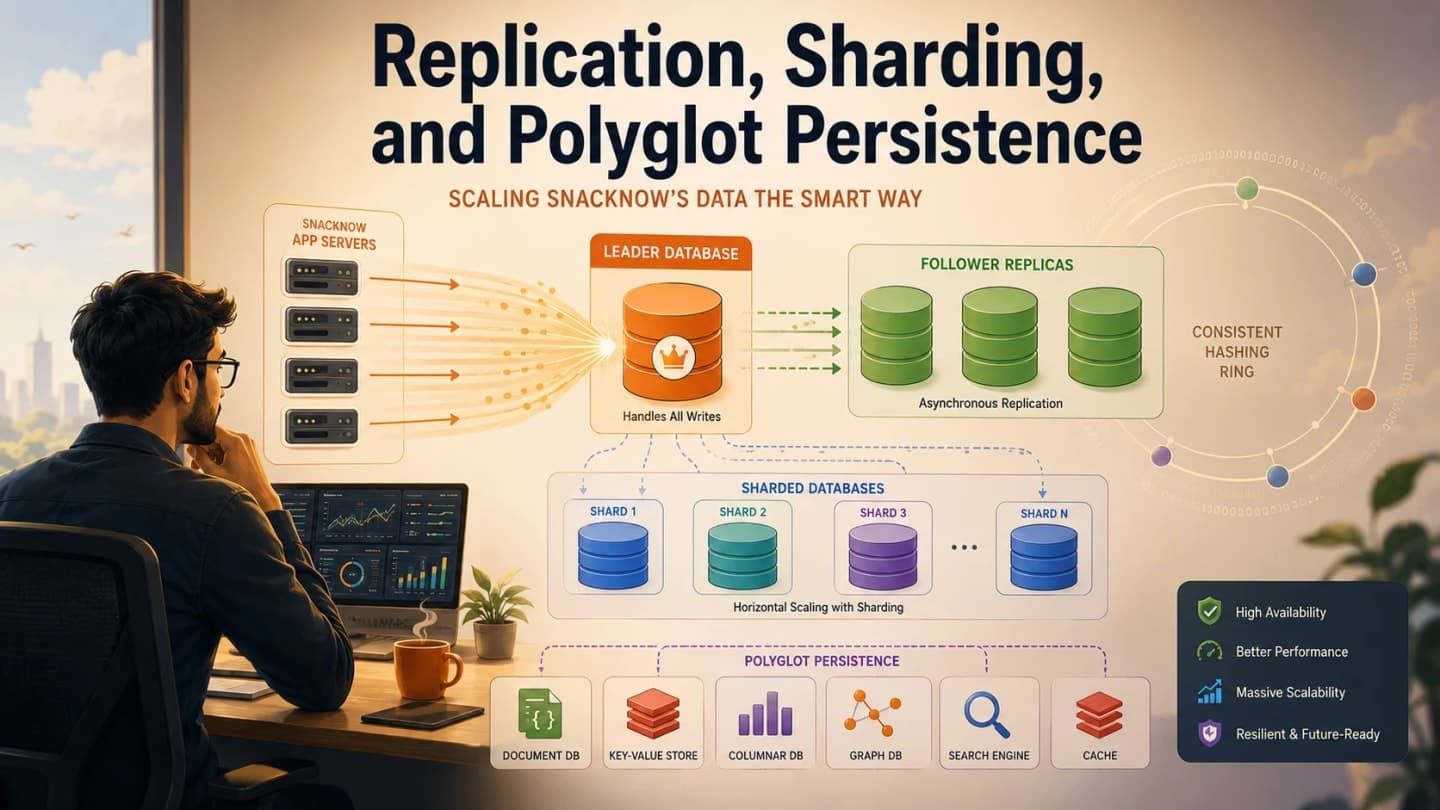
Listen to this article
Checking audio support
Storage Series Path: Now the Database Has to Scale
This scaling story builds on two earlier ideas: The App That Needed a Memory: Storage Fundamentals and CAP Theorem Explained Clearly for storage tradeoffs, and The Register or the Flexible Box: SQL vs NoSQL Explained Without the Holy War for choosing the right database model before scaling it.
SnackNow has moved from notebook memory to real databases. SQL helped orders and payments stay disciplined. NoSQL gave flexible options for catalogs, carts, analytics, and relationships. But growth brings a new problem: even a well-chosen database can get tired.
Reader promise: this piece explains replication, sharding, and polyglot persistence without turning database scaling into a math lecture.
SnackNow’s App Servers Are Fine, But the Database Is Sweating
At 7 PM, thousands of users browse menus. Riya keeps refreshing order status. Meera opens sales reports every few minutes. Delivery partners update locations. Payments and orders still need correct writes.
Aman already scaled the app servers. There are more backend instances now. But all of them still ask the same database for answers. The app layer is breathing. The database is sweating.
Symptoms appear slowly: menu reads become slow, checkout waits on database connections, report queries hurt live traffic, CPU climbs, disk I/O rises, and connection pools fill up.
Scaling app servers does not automatically scale the database.
Visual purpose: This visual helps you understand why one database can become the bottleneck even after the app layer scales.
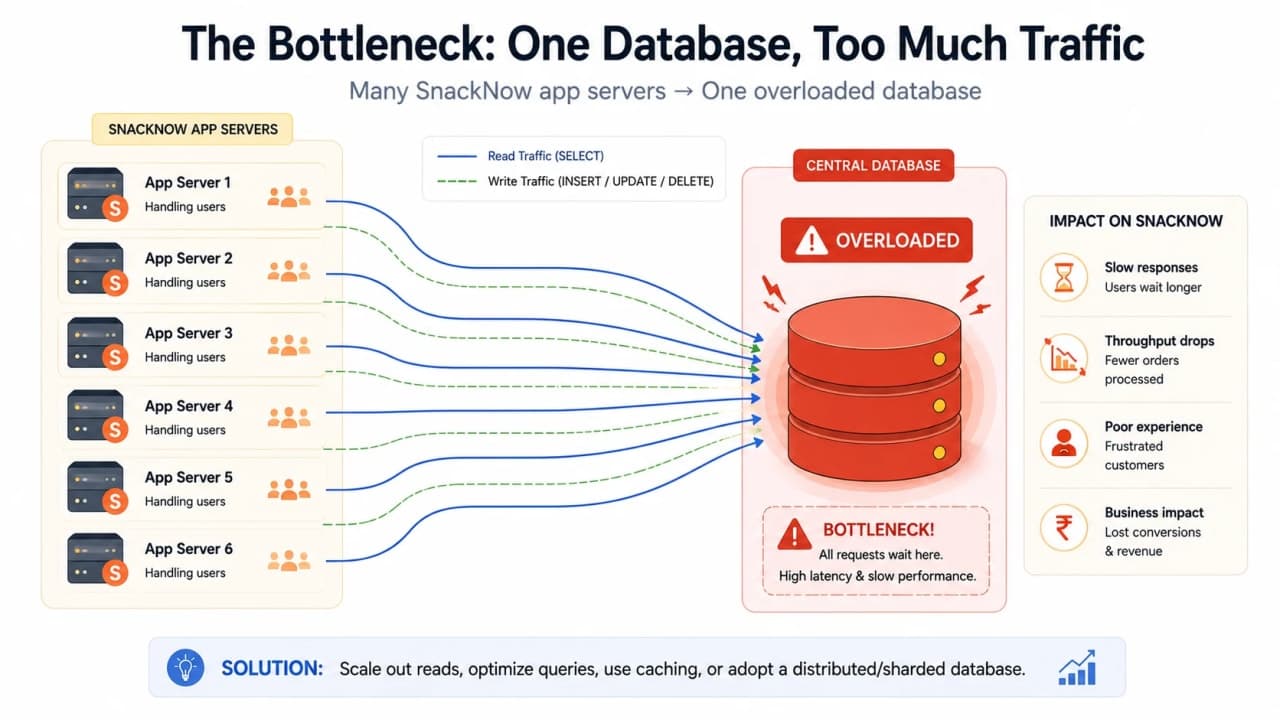
How to read this visual: many servers are not the problem by themselves. The problem is that they all funnel reads and writes into the same storage point.
The First Fix: Make the Database Bigger
Aman's first option is vertical scaling: move the database to a stronger machine. More CPU, more RAM, faster SSD, bigger instance. This is often the correct first move because it is simple and keeps the architecture easier to reason about.
Vertical DB Scaling | Helps With | Fails When | SnackNow Example |
|---|---|---|---|
More CPU | Query processing | Write volume keeps growing | Reports and filters are heavy |
More RAM | Caching indexes/data | Working set exceeds memory | Menu reads improve temporarily |
Faster SSD | Disk I/O | Traffic exceeds one machine | Order writes feel faster |
Bigger instance | Short-term capacity | Hardware/cost limit appears | Evening rush returns |
Takeaway: vertical scaling is a good early tool, not an infinite growth strategy.
Replication: Making Copies of the Register
When too many people are reading from the same register, one practical idea is to make copies. Database replication copies data from one node to another for redundancy, read performance, and availability.
Replication is useful when reads are the main pain. If 500 users create orders but 50,000 users browse menus, read replicas can carry a lot of that browsing traffic.
Interview-ready answer: Replication means copying data between database nodes so reads can scale, failures are easier to survive, and availability can improve.
Leader-Follower Replication: One Writer, Many Readers
In leader-follower replication, writes go to the leader. Followers receive copied data from the leader. Reads can often be served from followers.
For SnackNow, creating an order should go to the leader. Reading menu details or report summaries may go to followers if slight staleness is acceptable.
Visual purpose: This visual helps you understand the split between write traffic and read traffic.
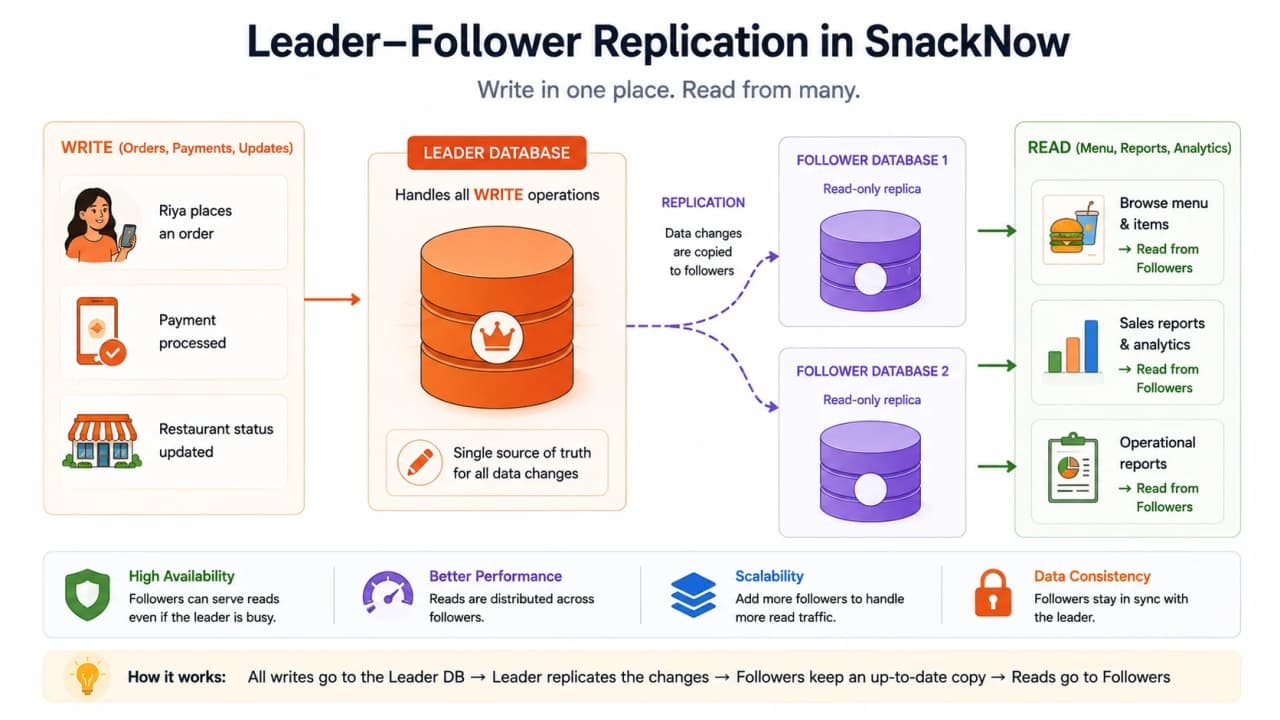
How to read this visual: the leader is the main cashier who accepts writes. Followers are copied registers used for reading. They help read-heavy workloads, not write-heavy bottlenecks.
Operation | Goes To | Why |
|---|---|---|
Create order | Leader | Must be the source of truth |
Update payment | Leader | Correctness matters |
Browse menu | Follower possible | Read-heavy and tolerates tiny lag |
View old report | Follower possible | Not critical in real time |
Check fresh order status | Leader or carefully chosen read path | User expects recent truth |
Read replicas help when reads are the problem. They do not magically make writes faster.
Replication Lag: The Copy May Be Slightly Behind
Riya places an order. The leader database saves it. SnackNow responds: order placed. Immediately, Riya opens the status page. If that page reads from a follower that has not caught up yet, it may say no order found or show an older state.
That delay is replication lag. Asynchronous replication is fast for writes but allows lag. Synchronous replication reduces lag but can slow writes because the leader waits for confirmation.
Visual purpose: This visual helps you understand why a read replica can show stale data right after a write.
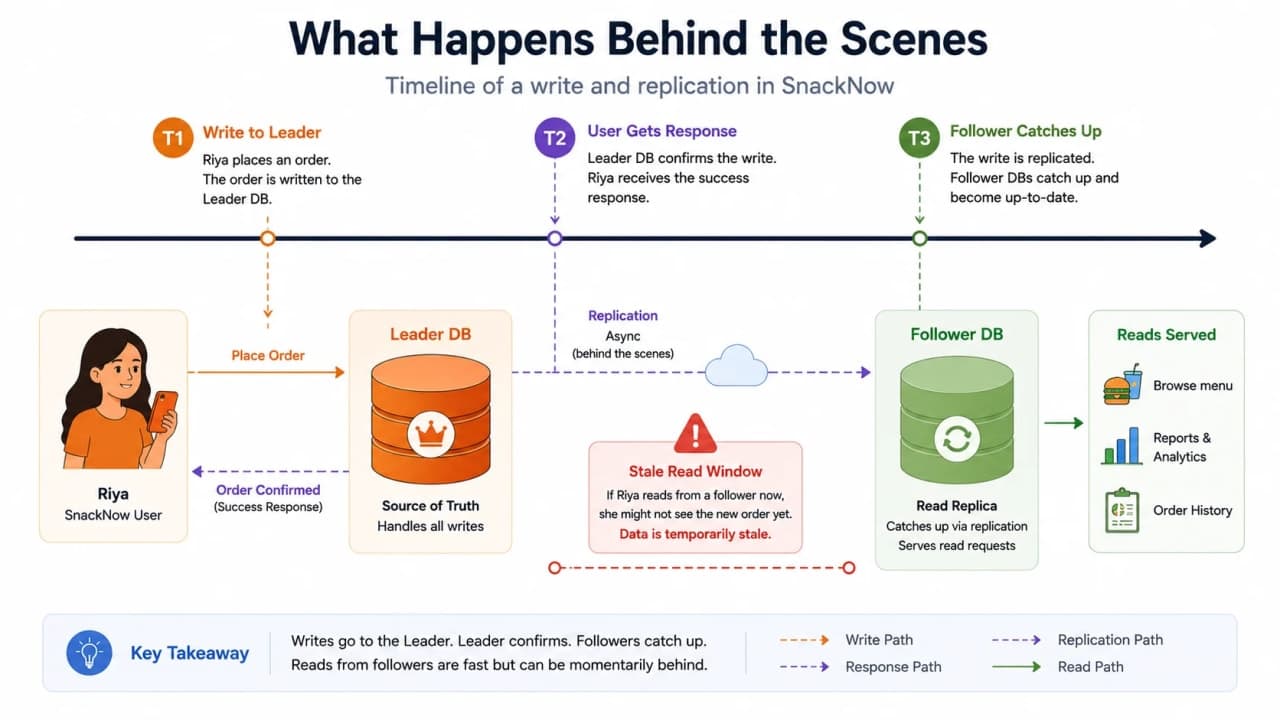
How to read this visual: the user may receive success before the follower has copied the update. That small gap creates eventual consistency for follower reads.
Replication Type | Speed | Consistency | Risk | Use Case |
|---|---|---|---|---|
Synchronous | Slower writes | Stronger | Leader waits, availability may suffer | Critical state |
Asynchronous | Faster writes | Eventually consistent | Stale follower reads | Menu reads, reports |
Takeaway: replication improves read capacity, but you must design around lag.
Failover: What If the Leader Dies?
If the leader database fails, a follower may be promoted to become the new leader. This is failover. It sounds neat, but it needs monitoring, leader election, client reconnection, and protection against split-brain situations where two nodes think they are leader.
For a beginner interview, keep it simple: replication gives you another copy, but safe failover still needs orchestration and testing.
Common mistake: assuming replicas automatically mean zero downtime. Replicas help, but failover design still matters.
Sharding: When Even One Big Register Is Too Large
Eventually, copies are not enough. If the orders table itself becomes too large or write volume becomes too high for one leader, SnackNow may need sharding.
Sharding splits data across multiple databases. Instead of one huge orders database, SnackNow might split orders by user ID, city, or region. Each shard owns a slice of the data.
Replication copies data. Sharding divides data.
Visual purpose: This visual helps you understand that sharding splits the actual dataset across nodes.
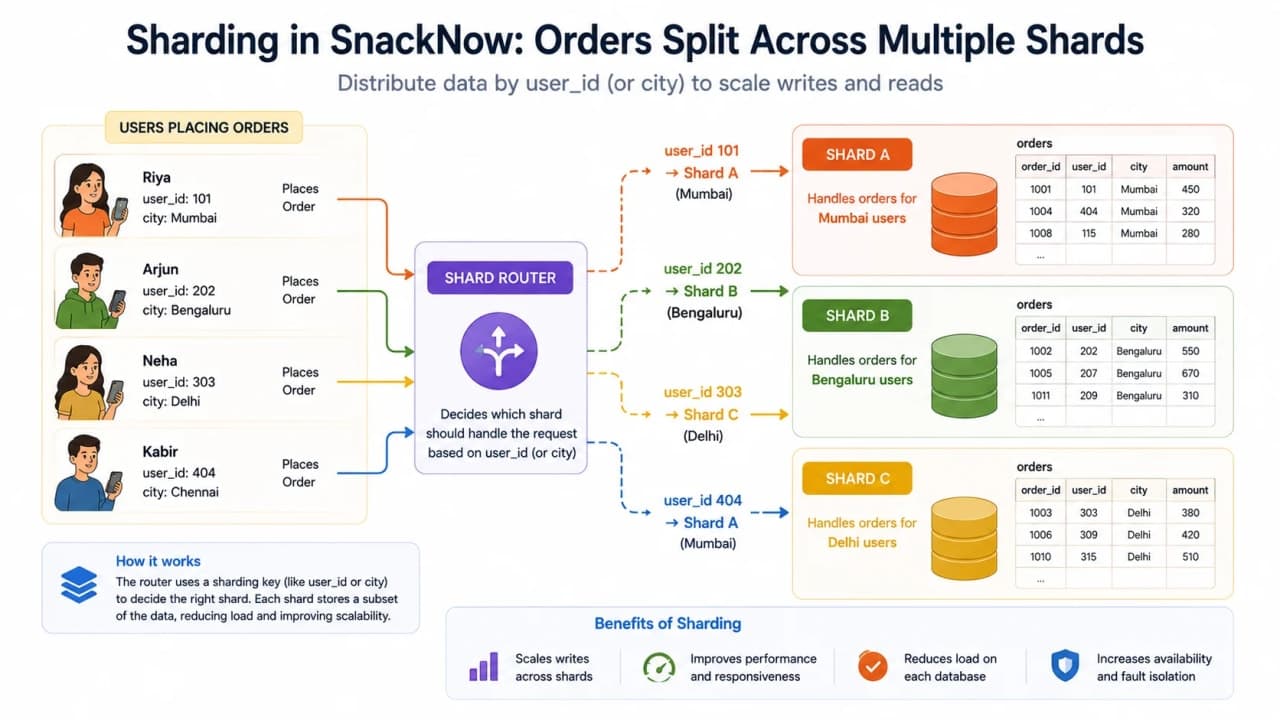
How to read this visual: the router uses a shard key to decide where a request belongs. If Riya's user ID maps to Shard B, her order reads and writes go there.
Type | What Splits | SnackNow Example | Good For | Risk |
|---|---|---|---|---|
Horizontal sharding | Rows | Orders split by user_id | Huge tables | Bad shard key creates hotspots |
Vertical sharding | Tables/functions | Orders DB, payments DB, analytics DB | Different workloads | Cross-service joins become harder |
How is it so far?
Vote with other readers
Takeaway: sharding is powerful, but it makes the system harder to query, migrate, and operate.
Range-Based Sharding: Easy, But Hot Spots Can Burn
Range-based sharding splits data by ranges. Users 1 to 1 million go to Shard A. Users 1 million to 2 million go to Shard B. This is easy to understand and supports range queries.
But hot spots can happen. If all new active users fall into the newest ID range, one shard receives most writes. The system is technically sharded, but one shard is still sweating.
Range Choice | Benefit | Risk | SnackNow Example |
|---|---|---|---|
user_id ranges | Simple routing | Newest range can be hot | New users order during launch |
date ranges | Easy time queries | Current date shard burns | All evening orders hit today's shard |
city ranges | Locality | One city may dominate | Delhi rush overloads one shard |
Takeaway: easy routing is not enough. Distribution matters.
Hash-Based Sharding: Better Distribution, Harder Range Queries
Hash-based sharding runs a key through a hash function and maps it to a shard. This usually spreads data more evenly than simple ranges.
shard = hash(user_id) % number_of_shards

If user_123 maps to Shard 2 today,
all order data for that user should go to Shard 2.
The upside is better distribution. The downside is that range queries become harder. Asking for all users from ID 1 to 10,000 may require touching many shards.
Interview-ready answer: Range sharding is easier for ordered queries but can create hot spots. Hash sharding distributes load better but makes range queries harder.
Consistent Hashing: Adding Servers Without Moving Everyone
A simple modulo hash has a nasty problem. If you change the number of shards, many keys remap. That means too much data moves during scaling.
Consistent hashing puts keys and nodes on a ring. When a node is added or removed, only nearby keys move. This improves elasticity and makes scaling less disruptive.
Visual purpose: This visual helps you understand why consistent hashing reduces remapping when nodes change.
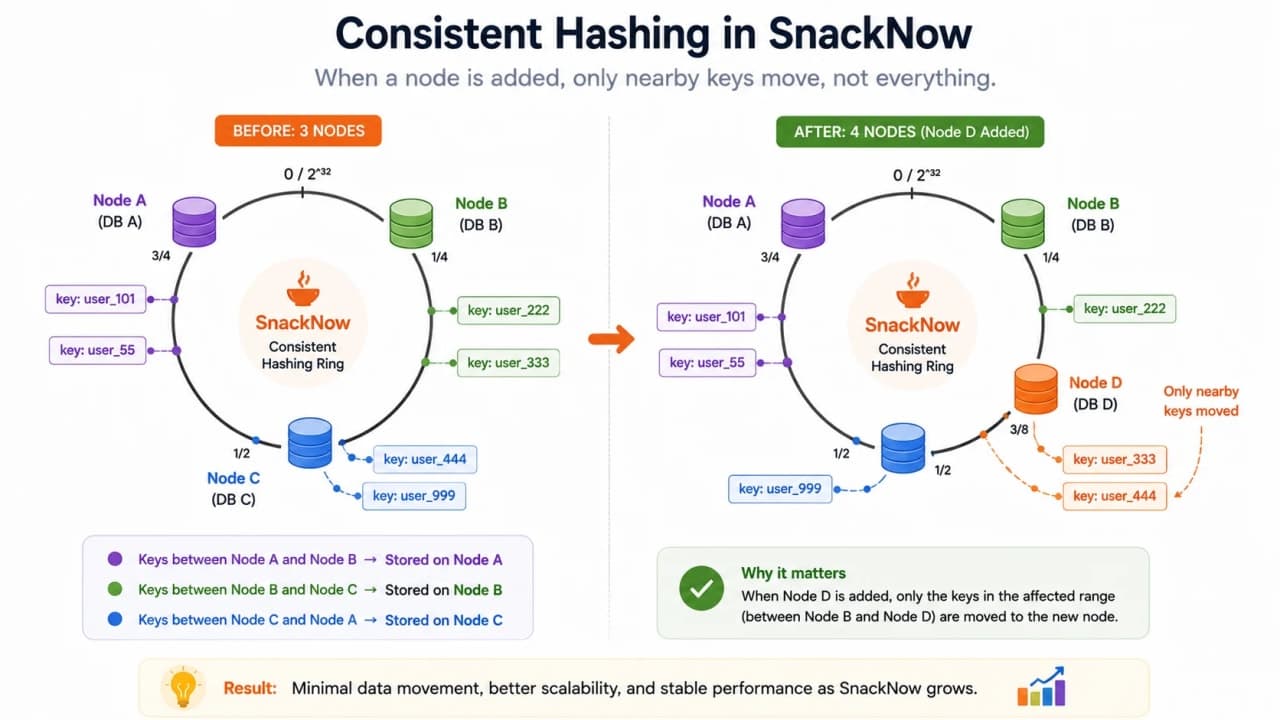
How to read this visual: keys move clockwise to the next node. When a new node appears, only keys in its nearby section move, instead of the whole system reshuffling.
Consistent hashing is about reducing movement when the cluster changes.
Geo-Based Sharding: Keep Data Close to Users
SnackNow may split data by geography. Delhi orders live near Delhi. Mumbai orders live near Mumbai. This can reduce latency and support regional compliance.
The tradeoff is cross-region complexity. If Meera wants a national sales report, the system must aggregate across regions. If Riya moves cities, the data model must handle it.
Geo Sharding Benefit | Risk | SnackNow Example |
|---|---|---|
Lower latency | Cross-region reports are harder | Delhi order served from Delhi shard |
Regional isolation | Data movement complexity | City-level operations |
Local scaling | Uneven regional load | Mumbai festival rush |
Takeaway: geography is useful when user location matters, but it makes global views harder.
Choosing a Shard Key
The shard key is the field used to decide where data goes. A good shard key spreads traffic evenly, matches query patterns, avoids hot spots, and stays stable over time.
Shard Key | Good or Bad? | Why | SnackNow Example |
|---|---|---|---|
user_id | Often good | Usually spreads users well | Order history by user |
city | Depends | Good locality but one city may dominate | Delhi gets too busy |
created_at | Often risky | Current time gets all writes | All new orders hit same shard |
status | Bad | Most rows may share active status | Active orders overload one shard |
restaurant_id | Depends | Good for restaurant views, bad for user history | Popular restaurant hot spot |
Common mistake: choosing a shard key randomly. Sharding is easy to say and hard to reverse.
Polyglot Persistence: One App, Many Storage Tools
At this point, Aman realizes SnackNow does not need one heroic database for everything. It needs the right memory tool for each job.
PostgreSQL for orders and payments.
Redis for carts, sessions, and cache.
A document database for flexible menu catalog data if needed.
OpenSearch or Elasticsearch for search.
Object storage for images and backups.
A graph database for recommendation or fraud relationships if relationships become the core problem.
This is polyglot persistence: using different storage technologies for different parts of the system. It can improve performance and fit, but it also increases operational complexity.
Storage Move | Problem Solved | New Risk |
|---|---|---|
Add read replicas | Read pressure | Replication lag |
Shard orders | Dataset/write scale | Query and migration complexity |
Add Redis | Fast cart/session access | Cache invalidation |
Add search engine | Search relevance | Index sync |
Add object storage | Large files | Access and lifecycle management |
Add graph DB | Relationship traversal | Team/tool complexity |
Takeaway: polyglot persistence is useful when each storage choice earns its complexity.
Design SnackNow’s Database Scaling Plan
Growth Stage | Pain | Storage Move | New Risk |
|---|---|---|---|
Stage 1 | One database is enough | Use SQL for core orders/payments | Single-node limit later |
Stage 2 | Database needs more capacity | Vertical scaling | Cost and hardware ceiling |
Stage 3 | Reads dominate | Read replicas | Lag and routing decisions |
Stage 4 | Dataset/write scale grows | Shard by user_id or region | Shard key mistakes |
Stage 5 | Carts/session reads are hot | Redis/cache | Invalidation and expiry |
Stage 6 | Images and files grow | Object storage | Security and egress cost |
Stage 7 | Reports hurt checkout | Analytics store/pipeline | Data quality and governance |
Takeaway: scale in stages. Do not use five databases on day one just because an architecture diagram looked impressive.
Debugging Checklist
Symptom | Likely Database Problem | What to Check | Possible Fix |
|---|---|---|---|
Reads slow | Read bottleneck | Query plans, indexes, read volume | Indexes, replicas, cache |
Writes slow | Leader write bottleneck | Locks, disk I/O, transaction size | Optimize writes, shard carefully |
Stale status | Replication lag | Read route after write | Read from leader for fresh paths |
One shard overloaded | Bad shard key/hotspot | Shard traffic distribution | Reshard or rebalance |
Reports slow checkout | Analytics on OLTP DB | Query load and locks | Separate analytics pipeline |
Failover downtime | Weak promotion process | Monitoring/election/retry | Test failover runbooks |
Interview-Ready Answers
What is the difference between vertical and horizontal database scaling?
Vertical scaling makes one database machine bigger. Horizontal scaling adds more nodes and distributes load or data. Vertical is simpler; horizontal scales further but adds complexity.
Explain leader-follower replication.
Writes go to the leader. Followers copy the leader's data and can serve reads. This improves read scalability and fault tolerance, but asynchronous followers may lag.
What is replication lag?
Replication lag is the delay before a follower receives the leader's latest write. During that delay, reads from the follower may be stale.
What is sharding?
Sharding splits data across multiple databases. A shard key decides which shard owns each record. It helps when one database cannot store or write everything.
Why is consistent hashing important?
Consistent hashing reduces how much data moves when nodes are added or removed. That makes distributed systems easier to scale and rebalance.
What is polyglot persistence?
Polyglot persistence means using different databases for different jobs. SnackNow can use SQL for payments, Redis for carts, object storage for images, and a search engine for product search.
One-Page Cheat Sheet
Concept | Simple Meaning | SnackNow Hook | Use When | Watch Out For |
|---|---|---|---|---|
Vertical scaling | Bigger machine | Upgrade DB instance | Early growth | Hardware ceiling |
Replication | Copy data | Follower registers | Read scale/failover | Lag |
Leader | Write source | Main cashier | Correct writes | Single write bottleneck |
Follower | Copied reader | Read register | Read-heavy traffic | Stale reads |
Replication lag | Copy delay | Old order status | Async replicas | Fresh reads |
Sharding | Split data | Orders across shards | Huge data/write scale | Shard key mistakes |
Shard key | Routing field | user_id/city | Data distribution | Hotspots |
Range sharding | Split by ranges | User ID blocks | Range queries | Hot new range |
Hash sharding | Hash to shard | Spread users | Even distribution | Range queries |
Consistent hashing | Less movement | Ring of shards | Elastic clusters | Operational complexity |
Geo sharding | Split by region | Delhi/Mumbai shards | Local latency | Global queries |
Polyglot persistence | Many stores | Right tool per job | Different workloads | Too much complexity |
FAQs
What is database replication?
Replication copies data from one database node to another so the system can improve read performance, availability, and fault tolerance.
Do read replicas improve write performance?
No. Read replicas mainly help when reads are the bottleneck. Writes still usually go to the leader in a leader-follower setup.
What is replication lag?
Replication lag is the delay between a write reaching the leader and that write appearing on follower replicas. During that delay, a read from a follower may show stale data.
What is sharding?
Sharding splits data across multiple databases so no single database has to store or serve everything. A shard key decides where each record belongs.
What is polyglot persistence?
Polyglot persistence means using different storage technologies for different jobs, such as SQL for payments, Redis for carts, object storage for images, and a search engine for product search.
Keep Reading the Storage Series
After database scaling, SnackNow needs storage for things that are not database rows. Continue with The Pantry for Photos, Videos, and Backups: Object Storage Explained with S3-Style Thinking.
Then move into When One Disk Is Not Enough: File Systems and Distributed Storage Explained Through SnackNow and From Orders to Insights: Big Data Storage, Batch Processing, and Streaming Explained for analytics files and large-scale data pipelines.
Final Mental Model
When SnackNow's database gets tired, Aman should not blindly add more app servers. First he checks whether the pain is reads, writes, storage size, query pattern, or geography.
Replicas help reads. Shards split data. Consistent hashing reduces movement. Polyglot persistence lets each part of the system use the storage tool that fits its job. The trick is not to add complexity early. The trick is to add the right complexity when the pain clearly asks for it.
Lock in the takeaway
Frequently asked questions
What is database replication?
Replication copies data from one database node to another so the system can improve read performance, availability, and fault tolerance.
Do read replicas improve write performance?
No. Read replicas mainly help when reads are the bottleneck. Writes still usually go to the leader in a leader-follower setup.
What is replication lag?
Replication lag is the delay between a write reaching the leader and that write appearing on follower replicas. During that delay, a read from a follower may show stale data.
What is sharding?
Sharding splits data across multiple databases so no single database has to store or serve everything. A shard key decides where each record belongs.
What is polyglot persistence?
Polyglot persistence means using different storage technologies for different jobs, such as SQL for payments, Redis for carts, object storage for images, and a search engine for product search.