
Listen to this article
Checking audio support
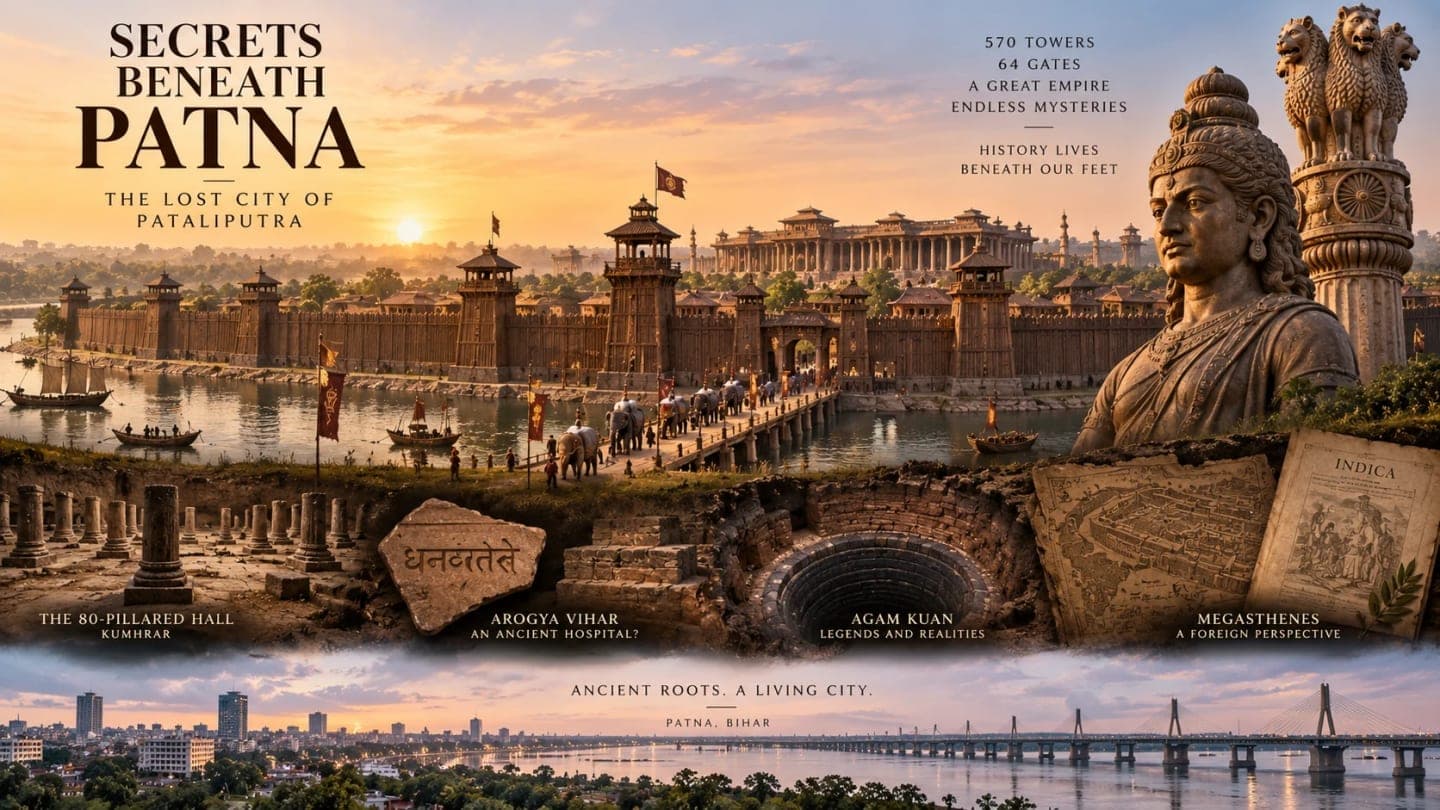
Secrets Beneath Patna
I have known Patna as my hometown—the Patna of crowded roads, familiar markets, the Ganga, temples, railway stations and neighbourhoods that have grown busier with every passing year. But the more I read about its ancient past, the stranger the city begins to feel.
Because beneath modern Patna once stood Pataliputra, the capital from which some of the most powerful rulers of ancient India governed. Chandragupta Maurya established his imperial capital here in the fourth century BCE, and Ashoka later ruled his vast empire from the same city. Patna's official history also traces the settlement further back, connecting its early development with Ajatashatru and his successors. (Patna District)
Yet the history of Pataliputra isn't a neat story where everything has been discovered and explained. It is a mixture of archaeology, ancient travellers' accounts, later traditions and interpretations that historians are still debating.
And that is where Patna becomes mysterious.
Before Pataliputra, There Was Pataligrama
Long before Chandragupta Maurya, there was a settlement known as Pataligrama. Tradition associates the development of the settlement with the Magadhan king Ajatashatru, who needed a strategically placed fortification against the Licchavis.
The location was remarkably useful. Rivers formed natural barriers around the area, making it easier to defend. Ajatashatru's successor Udayin is traditionally associated with shifting the Magadhan capital from Rajagriha to Pataliputra. The city would eventually remain an important capital through the Mauryan and Gupta periods. (Patna District)
Even the city's name has attracted different explanations. Patna's official history records names including Pataligrama, Pataliputra, Patalipattan and Kusumpur, while Greek writers rendered the city as something resembling Palibothra. One tradition connects "Patali" with the original village and another element with pattan, meaning a settlement or port. (Patna District)
There are also later traditional stories connecting the name Pataliputra with the patali flower. These explanations are better treated as traditions rather than established archaeological facts, but they show just how old the mystery surrounding the city's name is.
The City of 570 Towers and 64 Gates
Perhaps the most extraordinary description of ancient Pataliputra comes from the Greek world.
Megasthenes, an ambassador associated with the court of Chandragupta Maurya, spent time in India and wrote a work called Indica. Unfortunately, the original book has been lost. What we know of it survives mainly because later Greek and Roman writers quoted or summarised portions of it.
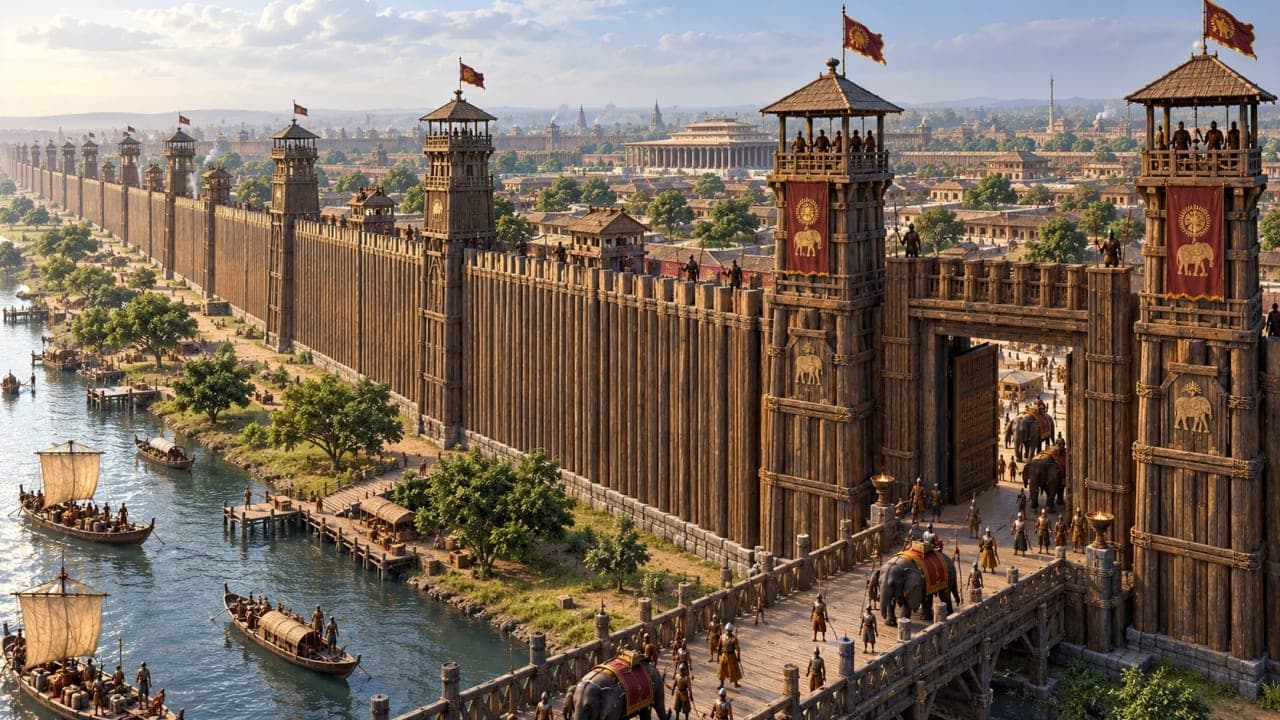
According to the account attributed to Megasthenes, Pataliputra was protected by an extraordinary system of fortifications containing 570 towers and 64 gates.
Just think about those numbers.
This wasn't being described as a small fortified settlement. It was a major imperial city whose perimeter required hundreds of defensive towers.
Outside the fortifications was another obstacle—an enormous moat.
Ancient accounts describe it as approximately 600 feet wide, although exact ancient measurements and their modern conversions should naturally be treated with some caution.
The moat wasn't necessarily just a military defence. Accounts also suggest it played a role in carrying away sewage or drainage from the city.
So Pataliputra wasn't simply impressive because of its palace or army. It appears to have been a carefully planned urban centre concerned with defence, water and sanitation.
The Wooden Wall That Sounded Almost Too Strange to Be True
There was one detail in Megasthenes' description that might have seemed particularly surprising.
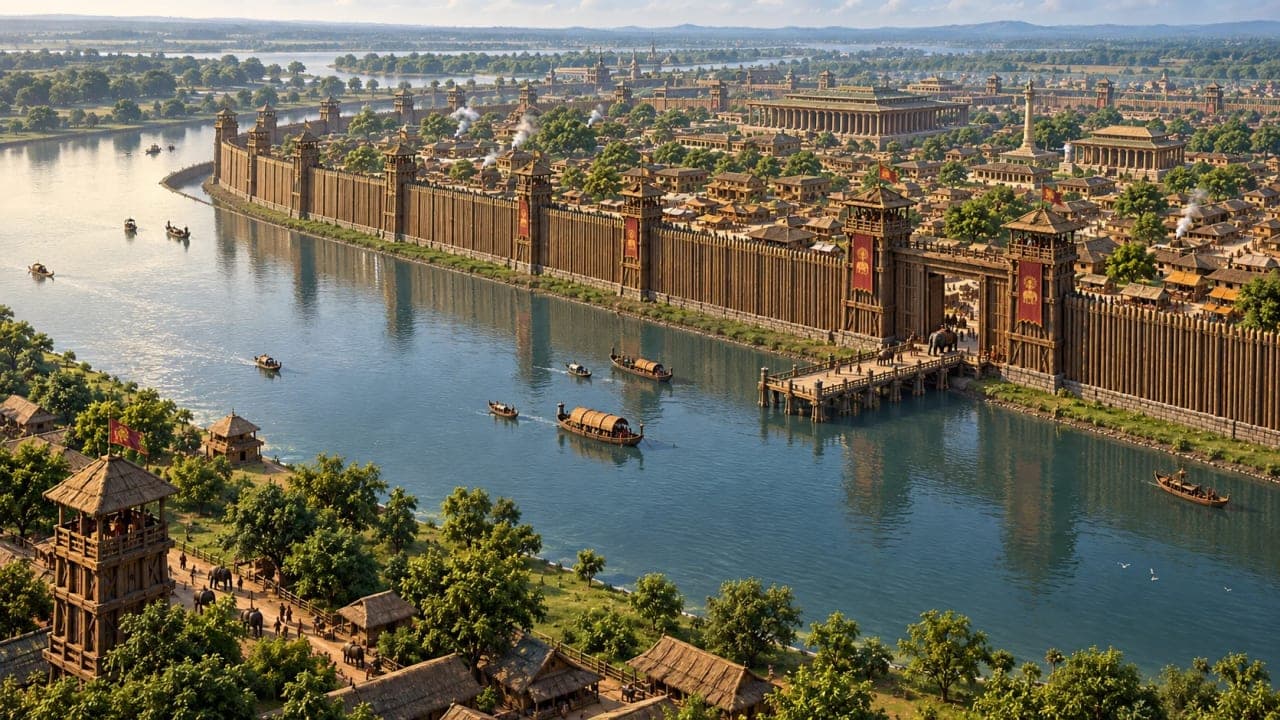
Pataliputra's enormous fortification was apparently built substantially from timber.
A wooden wall protecting the capital of the Mauryan Empire?
It sounds less impressive than stone—until you imagine thousands of massive timber posts forming a fortified palisade, reinforced with towers and openings from which defenders could fire arrows.
For centuries, this description survived through ancient texts.
Then excavations in Patna began revealing something remarkable.
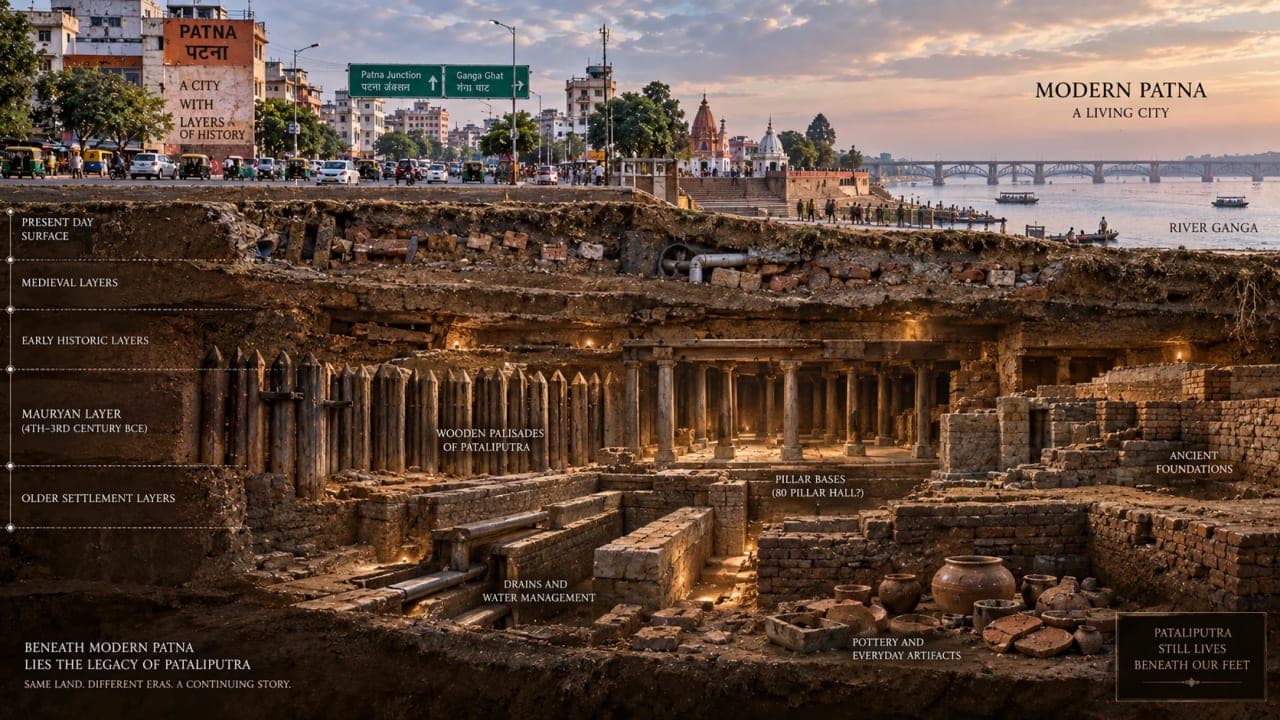
At sites associated with ancient Pataliputra, archaeologists discovered remains of wooden palisades.
The story preserved by classical writers suddenly had physical archaeological evidence to compare against it.
It doesn't mean that every tower and gate described by Megasthenes has been found. Nor can every surviving timber structure automatically be assigned to Chandragupta's exact reign.
But we do know that monumental wooden defensive construction was genuinely part of ancient Pataliputra.
The strange wooden city wasn't merely imagination.
Megasthenes and the Lost Book About India
Megasthenes himself adds another layer to the mystery.
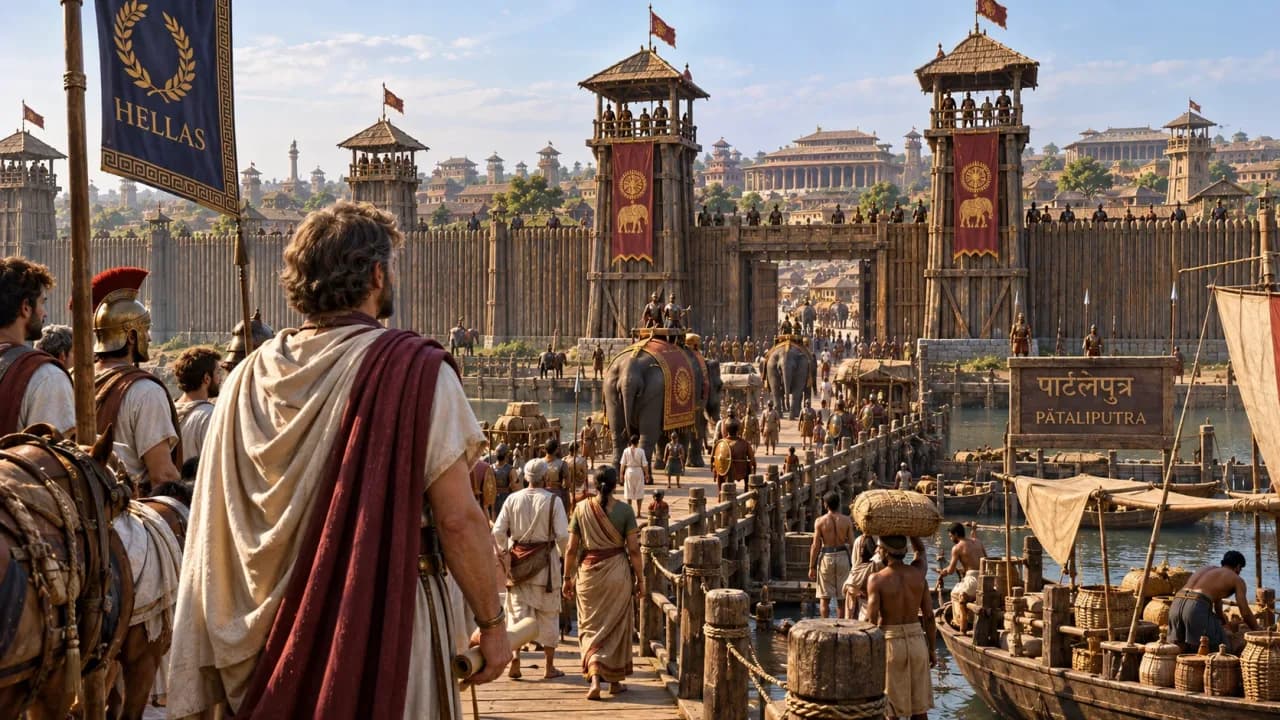
Imagine being a Greek visitor arriving at Chandragupta Maurya's capital more than two thousand years ago. He would have encountered an Indian society enormously distant from his own world.
He wrote about what he saw in Indica.
And then the book disappeared.
That means one of our best-known foreign witnesses to Mauryan India survives only indirectly.
This creates an important problem. We cannot simply treat every sentence later attributed to Megasthenes as though we were holding his original manuscript. His observations passed through later writers, and historians have to separate useful testimony from misunderstanding, exaggeration and second-hand transmission.
Still, archaeology has made his account particularly intriguing. When excavations uncover wooden fortifications in the same ancient city that classical accounts describe as protected by timber walls, text and archaeology begin speaking to each other.
Not perfectly.
But enough to make you wonder what else in the lost Indica might once have been written about Pataliputra.
Chandragupta's Lost Palace
Then there is the palace.
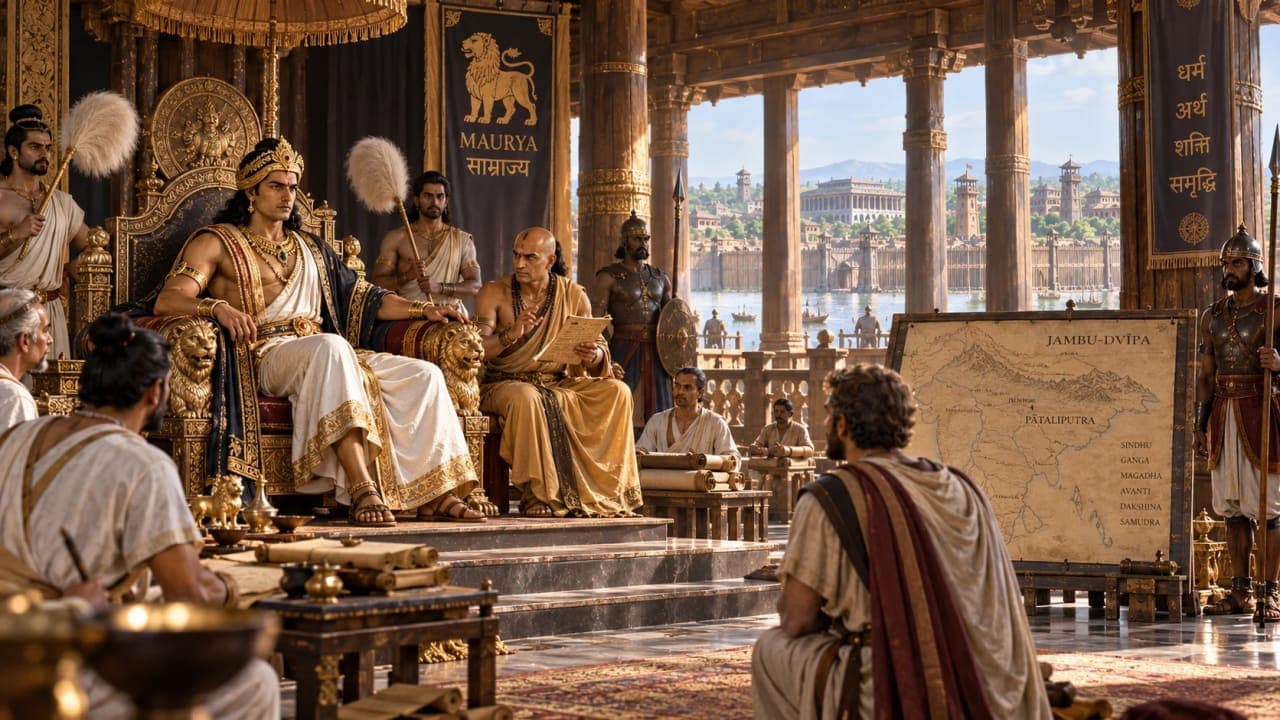
Classical traditions describe the royal complex at Pataliputra as extraordinarily magnificent. Chandragupta Maurya was ruling an empire that stretched across much of the Indian subcontinent, so his capital must have required substantial administrative and ceremonial spaces.
But where is his palace?
There is no enormous Mauryan palace standing in Patna today.
Wood may partly explain the disappearance. Timber architecture is far more vulnerable than stone to moisture, fire, insects, flooding and simple decay.
There is another intriguing possibility historians have discussed. Mauryan monumental art appeared during a period when the empire had contacts with the Hellenistic world and inherited connections to regions once controlled by the Achaemenid Persian Empire. Similarities between some Mauryan architectural forms and Persian traditions have therefore generated long-running debates over artistic influence.
That doesn't mean Pataliputra was simply copying Persia. Rather, Mauryan India appears to have absorbed outside influences while developing a distinctive imperial style of its own.
Somewhere in that cultural mixture stood Chandragupta's vanished capital.
The Mystery of Kumhrar's 80 Pillars
One of Patna's most fascinating archaeological sites lies at Kumhrar.
How is it so far?
Vote with other readers
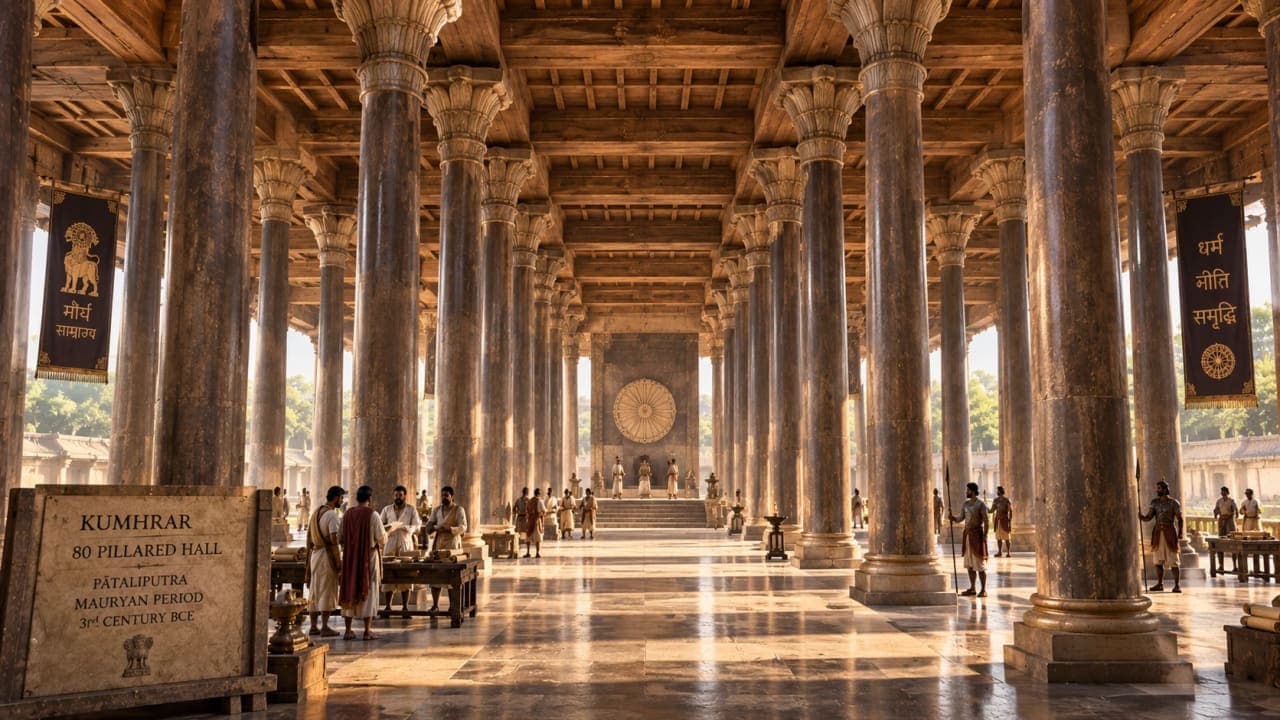
Excavations here uncovered the remains of an enormous structure supported by 80 stone pillars, along with evidence of a wooden platform.
For years, it was tempting to identify this as a royal audience hall—perhaps part of the magnificent Mauryan palace.
Imagine Ashoka sitting there while officials, ambassadors and representatives entered an enormous pillared chamber.
It makes a wonderful picture.
There is just one problem.
That interpretation has been questioned.
The Patna district government's account explains that although the structure was initially thought to have been a royal durbar, later archaeological interpretation identified it as an assembly hall for Buddhists dating to Ashoka's period. (Patna District)
That completely changes the scene.
Instead of royal ministers standing between the pillars, imagine Buddhist monks gathering there.
Was it a palace hall?
A Buddhist assembly hall?
Or did the larger Kumhrar complex change functions over time?
The safest conclusion is that the structure is real, monumental and Mauryan-period—but its precise function has been debated.
Sometimes the mystery is more interesting than a convenient answer.
Ashoka's Pataliputra and the Buddhist Tradition
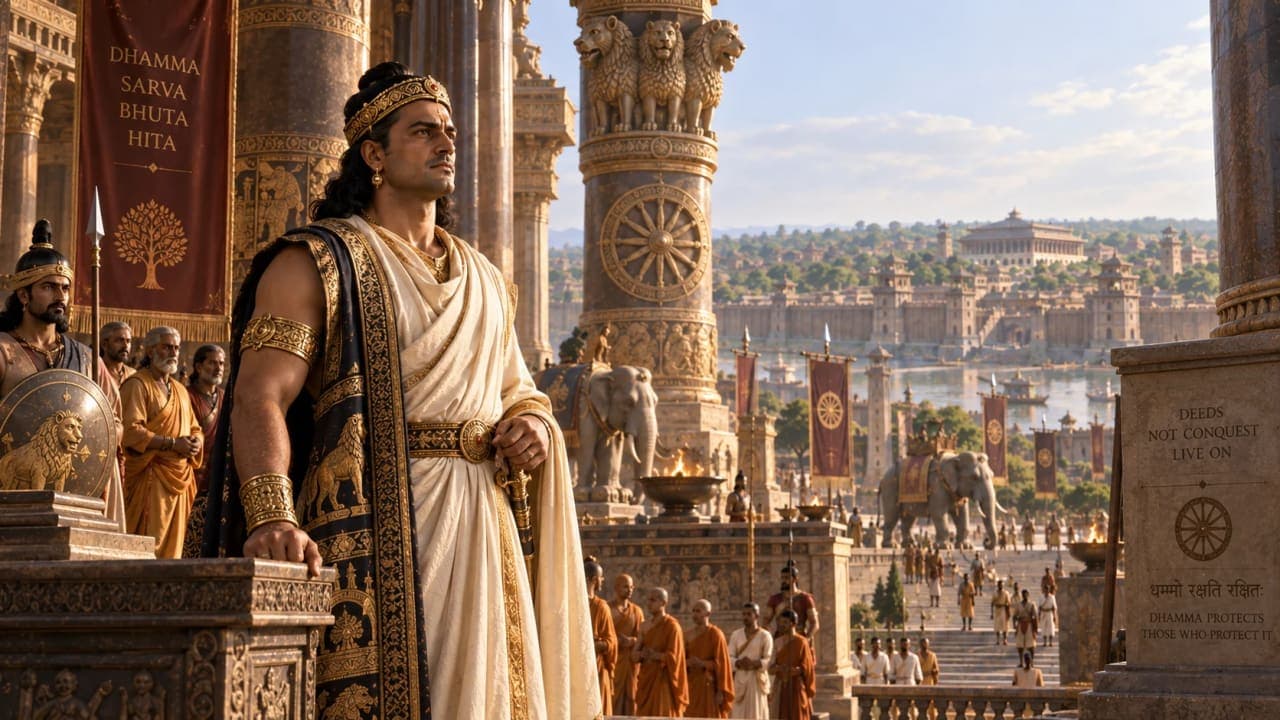
If Chandragupta transformed Pataliputra into an imperial capital, Ashoka made its name inseparable from one of the most important periods in Buddhist history.
Ashoka ruled from Pataliputra, and Buddhist tradition strongly associates his reign with the expansion of Buddhist institutions and missions.
Buddhist chronicles also connect Pataliputra with the Third Buddhist Council, traditionally said to have been held under Ashoka's patronage and associated with the monk Moggaliputta Tissa.
Here, however, history and religious tradition need to be separated carefully.
The council is important within Buddhist historical traditions, particularly the Theravada chronicles, but historians debate aspects of its historicity and exactly how the event unfolded.
That distinction makes Pataliputra even more interesting. Some of its stories exist simultaneously as religious memory and historical investigation.
Ashoka's Legendary Palace and the Spirits Who Built It
One of the most fascinating stories about Ashoka's Pataliputra comes not from archaeology but from later Buddhist tradition.
When the Chinese Buddhist pilgrim Faxian (Fa-Hien) visited India centuries after Ashoka, traditions about the Mauryan emperor were still circulating.
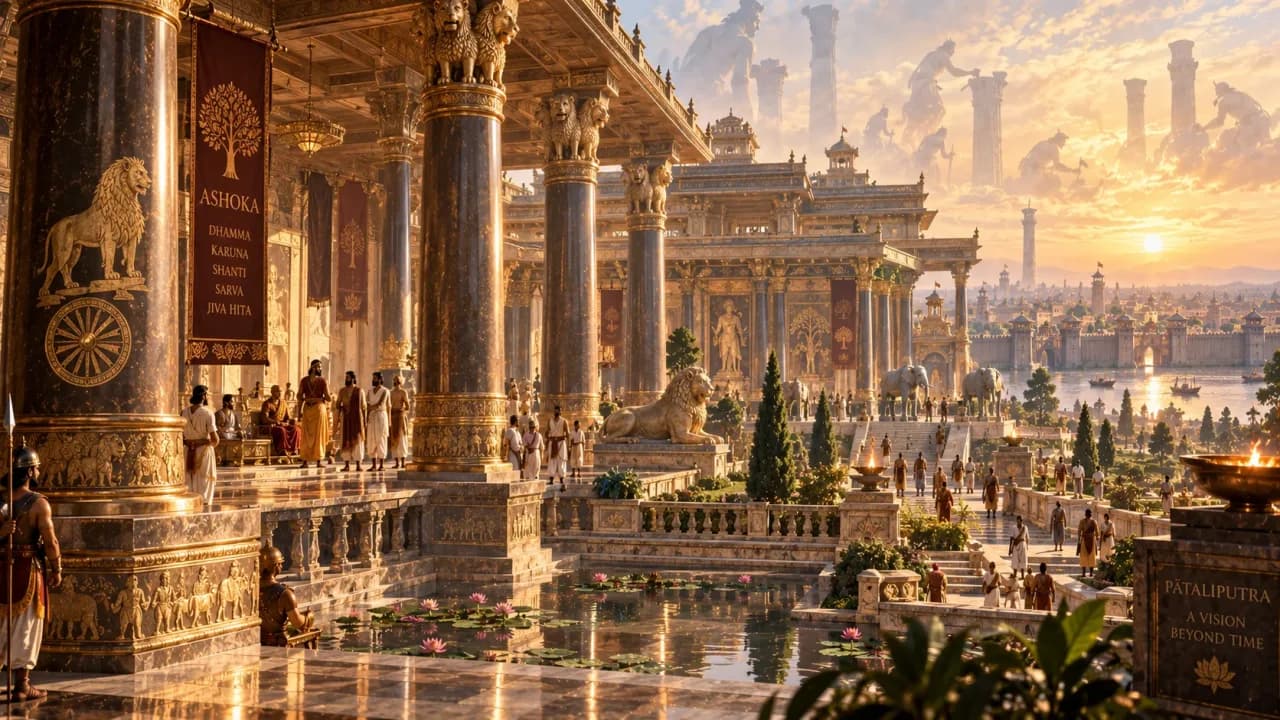
Among them was the extraordinary idea that Ashoka's palace was so magnificent that ordinary human craftsmen seemed incapable of having produced it. The palace was therefore said, in legendary tradition, to have been constructed with the assistance of spirits or supernatural beings.
Of course, that isn't an archaeological fact.
But myths can tell us something different.
If generations later people looked at the remains of Mauryan architecture and concluded that humans could hardly have built them, imagine how impressive those structures must have seemed.
The legend may not tell us who actually constructed Ashoka's palace.
It tells us something about its reputation.
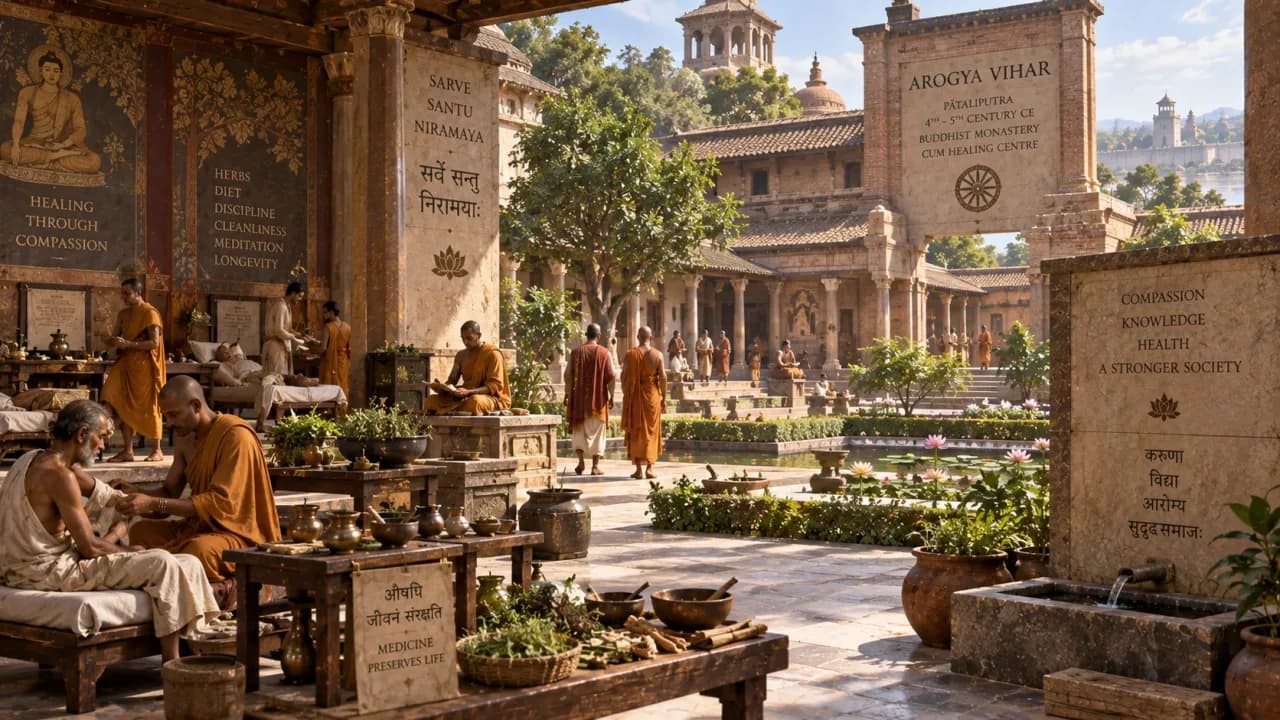
Arogya Vihar: Was There an Ancient Hospital Here?
Kumhrar produced another discovery that belongs to a much later period.
Archaeologists identified remains of a monastery-cum-hospital known as Arogya Vihar, dated roughly to the fourth or fifth century CE. (Patna District)
This is important because it shows that the area continued to matter centuries after the Mauryas disappeared.
And the most curious clue was tiny.
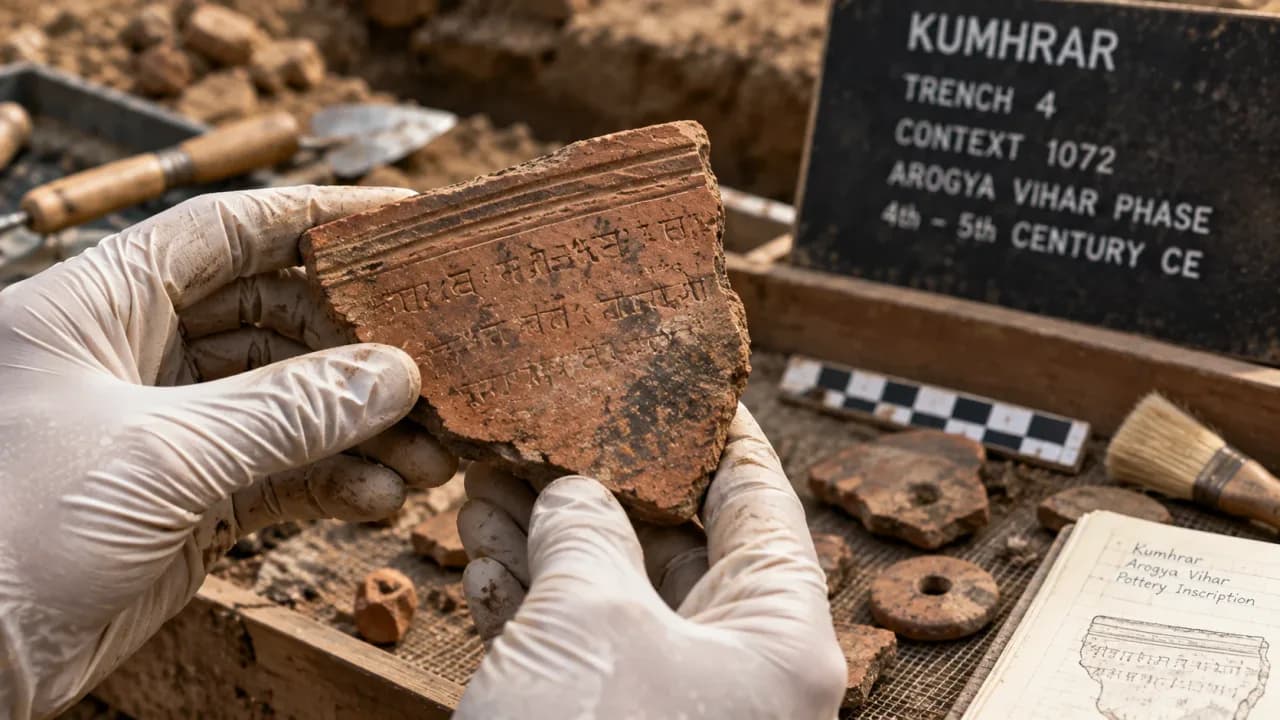
A potsherd discovered there carried an inscription rendered by the official Patna account as "Dharvantareh." It has been connected with Dhanvantari, the figure traditionally associated with medicine and healing. (Patna District)
A broken piece of pottery helping archaeologists understand an ancient medical establishment feels almost like something from a detective story.
No emperor.
No enormous monument.
Just an inscription surviving on pottery.
Agam Kuan and One of Patna's Darkest Ashokan Legends
Not every mystery of ancient Patna lies at Kumhrar.
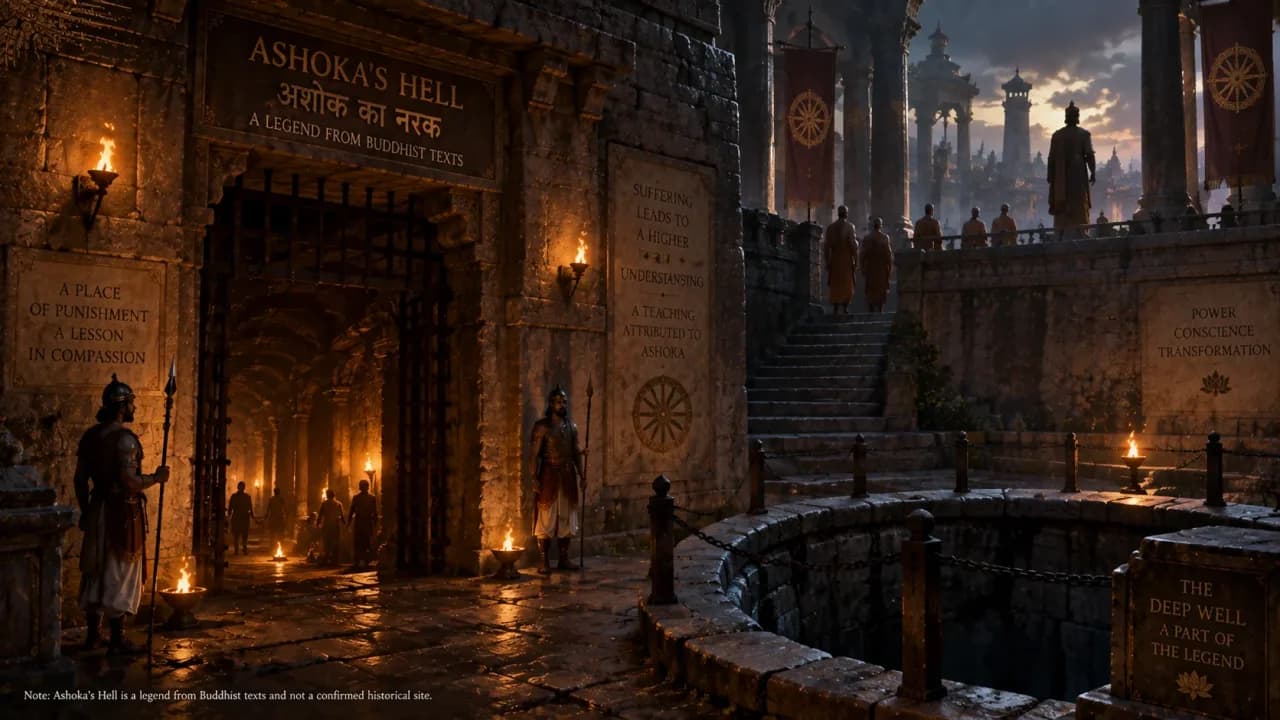
There is also Agam Kuan, traditionally associated with Ashoka.
Its name is commonly understood as the "unfathomable well." Over the centuries, legends have linked it with the darker stories surrounding Ashoka before his embrace of Buddhism.
One tradition associates the well with Ashoka's Hell, a legendary torture chamber supposedly created by the emperor during the violent period of his early rule. Other stories claim victims were thrown into the well.
These tales should not be confused with established archaeological evidence. The stories of "Ashoka's Hell" come largely through Buddhist legendary traditions designed in part to emphasise the dramatic contrast between a cruel early Ashoka—sometimes called Chandashoka—and the later Dharmashoka devoted to dhamma.
But the legend survived strongly enough that Agam Kuan remains associated with Ashoka in Patna's cultural memory. The Patna district administration itself lists Agam Kuan among sites connected with the ruins and traditions of Ashokan Pataliputra. (Patna District)
Whether the terrifying stories happened exactly as told is another question entirely.
How Did Such a Powerful City Disappear?
Perhaps Pataliputra's greatest mystery isn't how it became powerful.
It is how so much of it vanished.
There probably wasn't one dramatic night when the entire city disappeared. Political centres shifted, dynasties fell, rivers changed courses, floods affected the landscape, timber structures deteriorated and generations repeatedly rebuilt the inhabited area.
The city that had served the Mauryas and later remained important under the Guptas gradually lost its former political dominance. Patna's official historical account notes this decline in importance after the great ancient dynasties. (Patna District)
And because people continued living here, later Patna grew over earlier Pataliputra.
That makes the ancient city unusually difficult to investigate.
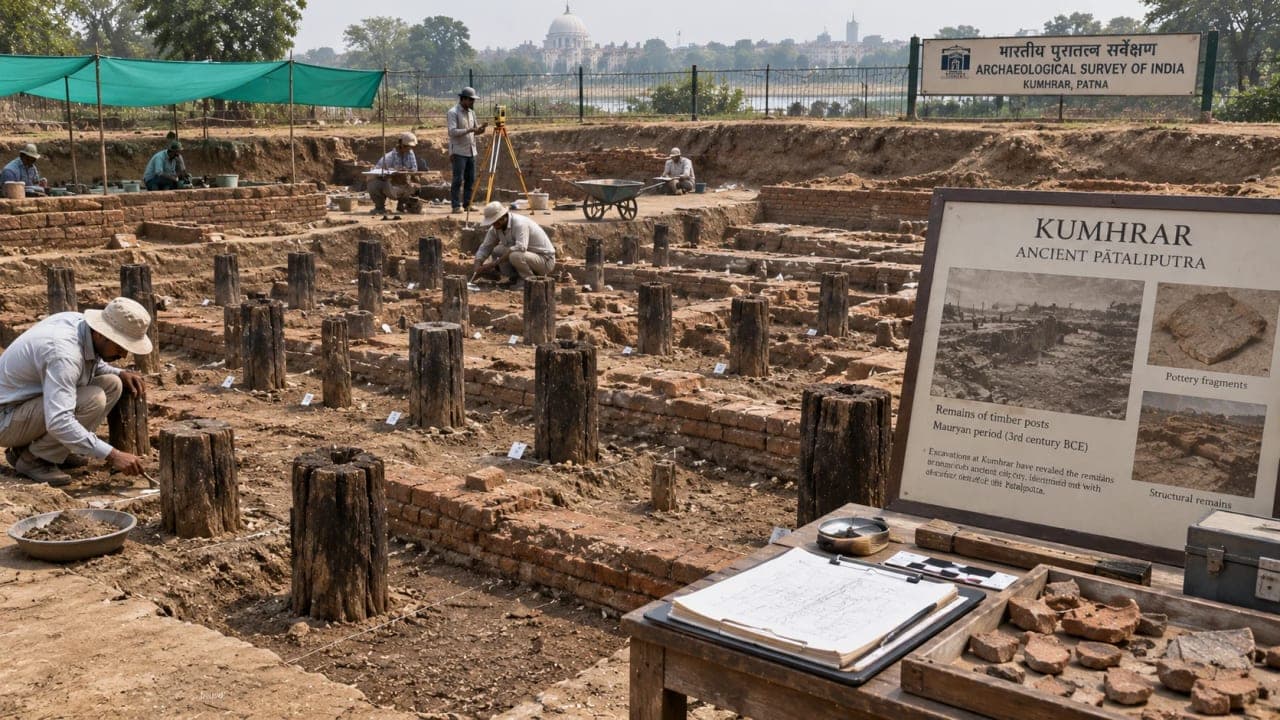
Archaeologists aren't exploring an abandoned landscape.
They are looking for an ancient capital beneath a modern capital.
The Real Mystery Is Still Under Patna
This is what fascinates me most about the story.
The 570 towers and 64 gates come to us through ancient descriptions. Archaeology has uncovered evidence of wooden fortifications. Kumhrar gave us the 80-pillared hall, only for its interpretation to change from royal court to possible Buddhist assembly space. Arogya Vihar revealed evidence of healing centuries later. Agam Kuan carries traditions about Ashoka that hover somewhere between history, religious storytelling and legend.
And then there are all the things we haven't found.
Where exactly was Chandragupta's palace?
How much of Ashoka's Pataliputra survives?
Where were those great gates?
What did ordinary houses look like?
What would we discover if modern Patna weren't covering much of the ancient settlement?
Perhaps that is the best way to understand Pataliputra.
Not as a lost city that has completely disappeared, but as a partially revealed city.
We have pieces of it.
A wooden palisade.
Stone pillars.
A potsherd.
A monastery.
An ancient well.
Accounts written by foreign visitors.
Stories preserved by Buddhist traditions.
And beneath modern Patna, there may still be chapters of the story that nobody has read yet.
That, for me, is far more mysterious than any legend.
Because the next great secret of Pataliputra may not be hidden in an ancient manuscript at all.
It may simply be waiting beneath Patna.
Lock in the takeaway
Frequently asked questions
What was Patna called in ancient times?
Ancient Patna was best known as Pataliputra. Earlier forms and names associated with the settlement include Pataligrama, while historical sources also record names such as Kusumpur. Pataliputra eventually became one of ancient India’s most important political centres.
Who founded Pataliputra?
The early development of Pataliputra is associated with the Magadhan rulers Ajatashatru and Udayin. Ajatashatru is traditionally connected with fortifying the settlement of Pataligrama, while Udayin is associated with shifting the capital of Magadha to Pataliputra.
Did ancient Pataliputra really have 570 towers and 64 gates?
Classical accounts attributed to Megasthenes describe Pataliputra as having 570 towers and 64 gates. These figures come from ancient literary accounts rather than the archaeological discovery of all 570 towers and 64 gates, so they should be understood as historical descriptions of the city.
How large was the moat around Pataliputra?
Ancient accounts describe a huge defensive moat surrounding Pataliputra, commonly interpreted as approximately 600 feet wide. It appears to have served both defensive and drainage-related purposes.
Who was Megasthenes and what did he write about Pataliputra?
Megasthenes was a Greek ambassador associated with the court of Chandragupta Maurya. His work Indica described India and Pataliputra, including its fortifications, towers, gates and moat. The original Indica has been lost, and its contents survive mainly through quotations and summaries by later writers.
Have the wooden walls described by Megasthenes actually been found?
Archaeological excavations in Patna, particularly around sites such as Bulandi Bagh, uncovered substantial wooden palisade remains associated with ancient Pataliputra. These discoveries are especially interesting because classical accounts also describe the city as having wooden fortifications.
What is the 80-pillared hall at Kumhrar?
Excavations at Kumhrar uncovered the remains of a monumental structure supported by 80 stone pillars. It was once widely interpreted as a Mauryan royal audience hall, but later interpretations have suggested that it may instead have been a Buddhist assembly hall associated with the Ashokan period. Its precise function remains debated.
What was Arogya Vihar in ancient Patna?
Arogya Vihar was a structure discovered at Kumhrar and interpreted as a monastery-cum-hospital, generally dated to around the fourth or fifth century CE. It shows that the area remained important long after the Mauryan period.
What is the connection between Dhanvantari and Kumhrar?
A pottery fragment discovered at Kumhrar carried an inscription interpreted in connection with Dhanvantari, traditionally associated with medicine and healing. The discovery is one of the clues used when discussing the medical character of Arogya Vihar.
What is the mystery of Agam Kuan?
Agam Kuan is an ancient well in Patna traditionally associated with Emperor Ashoka. Later legends connect it with the stories of “Ashoka’s Hell” and the emperor’s supposedly cruel early period. These dramatic stories belong largely to later Buddhist tradition and should not be treated as established archaeological facts.
Was Ashoka’s palace really built by supernatural beings?
No archaeological evidence shows that supernatural beings built Ashoka’s palace. However, later Buddhist tradition preserved stories suggesting that the palace was so magnificent that it appeared almost beyond human craftsmanship. The legend reflects the extraordinary reputation Mauryan architecture acquired in later centuries.
Is ancient Pataliputra still underneath modern Patna?
Archaeological remains of Pataliputra have been discovered at several locations within modern Patna, including Kumhrar and Bulandi Bagh. Because the modern city occupies much of the ancient settlement area, large portions cannot be freely excavated, leaving many questions about Pataliputra unanswered.