
Listen to this article
Checking audio support
Alleppey: Where Water Hides Stories
There are places you visit for a monument.
There are places you visit for a mountain.
And then there are places where the journey itself becomes the attraction.
Alappuzha—better known to travellers as Alleppey—belongs firmly to the third category.
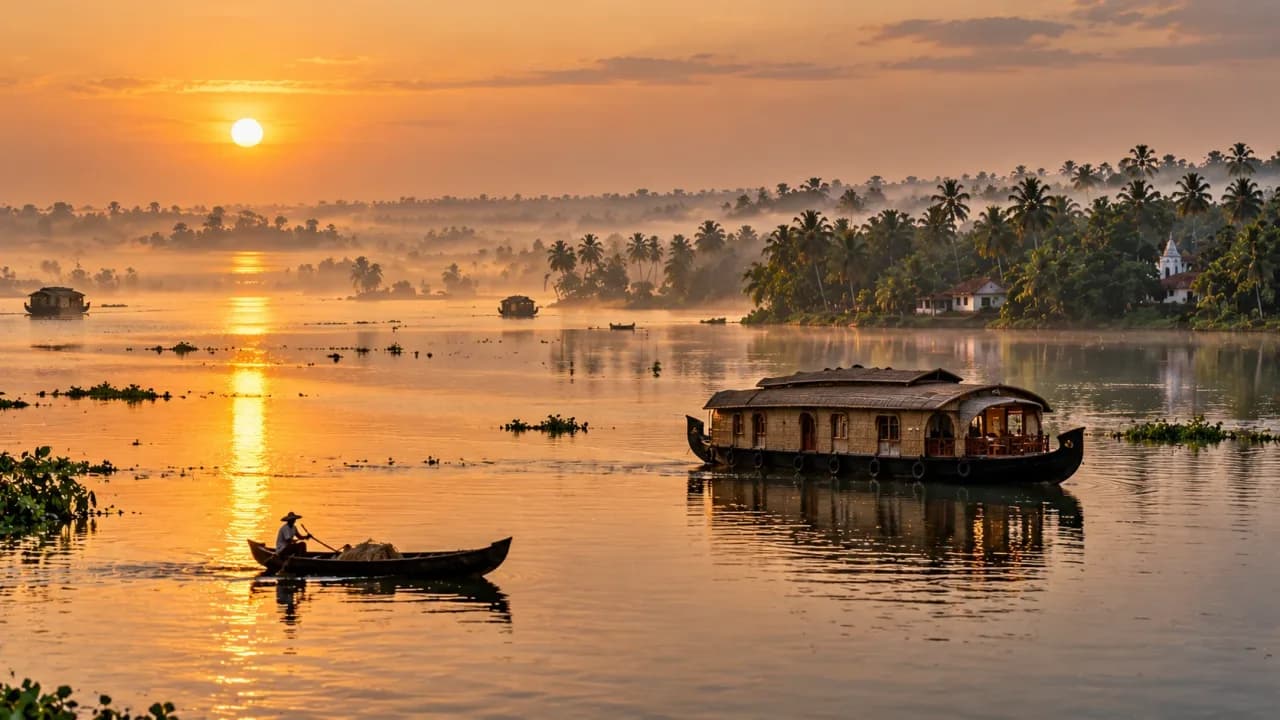
At first glance, it seems almost too peaceful to have a complicated past. Coconut palms lean over quiet canals. Boats glide through green water. Paddy fields stretch towards the horizon. Houseboats move slowly across Vembanad Lake, looking almost like floating homes.
Everything appears calm.
Almost suspiciously calm.
Because beneath that postcard-perfect landscape is a story involving ancient waterways, spice and coir trade, royal ambitions, below-sea-level farming, enormous snake boats, mysterious islands, serpent gods and temples with legends that sound as though someone sat down one evening and decided that ordinary history was simply not dramatic enough.
So what exactly is Alleppey famous for?
And what was this watery world like before houseboats and tourists arrived?
Let's take a ride through it.
First, What Exactly Is Alleppey?
The city's official name is Alappuzha, although "Alleppey" remains the name most travellers recognise.
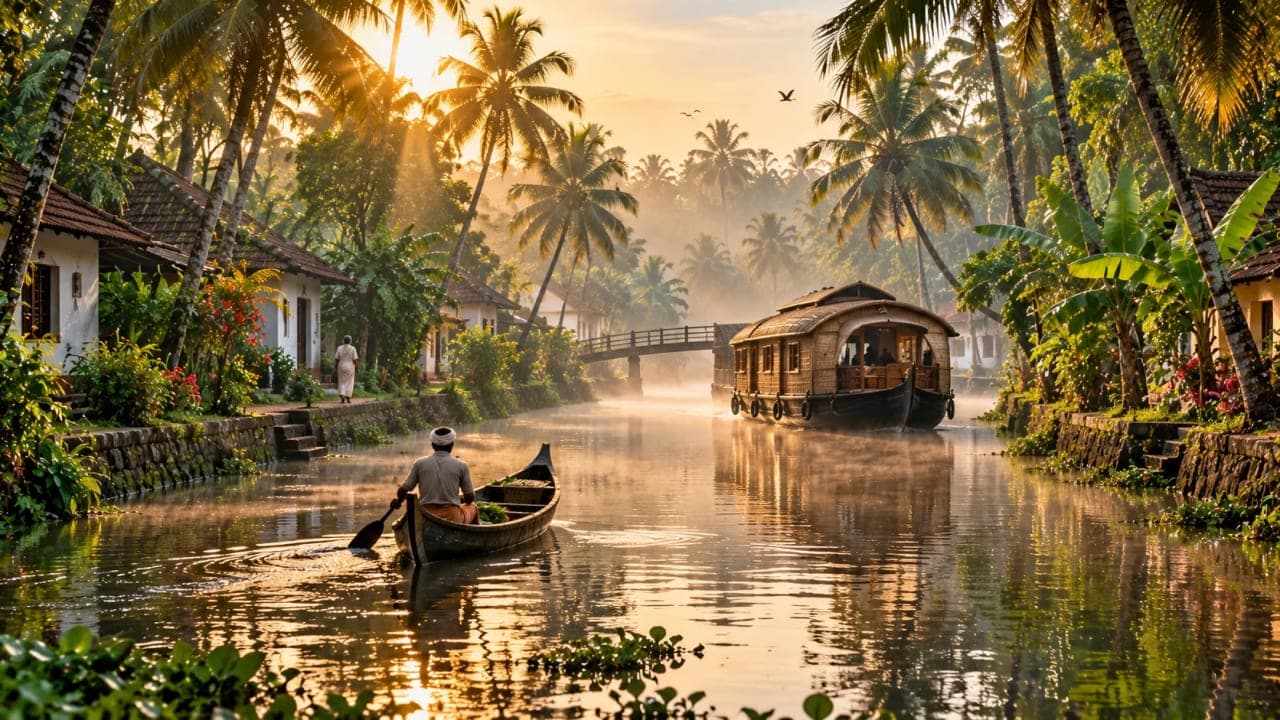
Located on Kerala's western coast, Alappuzha sits between the Arabian Sea and an extraordinary network of canals, lakes, lagoons and rivers. Kerala Tourism describes the district as being surrounded by both the sea and backwaters, which explains much of its distinctive character. Kerala Tourism
And then there is the famous nickname:
The Venice of the East.
It sounds slightly exaggerated until you actually look at a map.
Waterways run everywhere.
Some are broad enough for houseboats. Others are narrow canals where small country boats pass between houses. There are stretches of water lined with coconut trees, paddy fields, churches, temples and villages where boats have traditionally been as useful as roads.
The Kerala backwater system itself extends for more than 900 kilometres, with Vembanad Lake forming its largest and most prominent stretch. Kerala Tourism
But calling these waterways a tourist attraction is only half the story.
For centuries, they were infrastructure.
They were roads.
Before Houseboats, the Waterways Were the Highways
Imagine living here before modern roads became common.
Suppose you needed to travel from one village to another.
You could walk, certainly.
But why struggle along muddy paths when a boat could take you through the water?
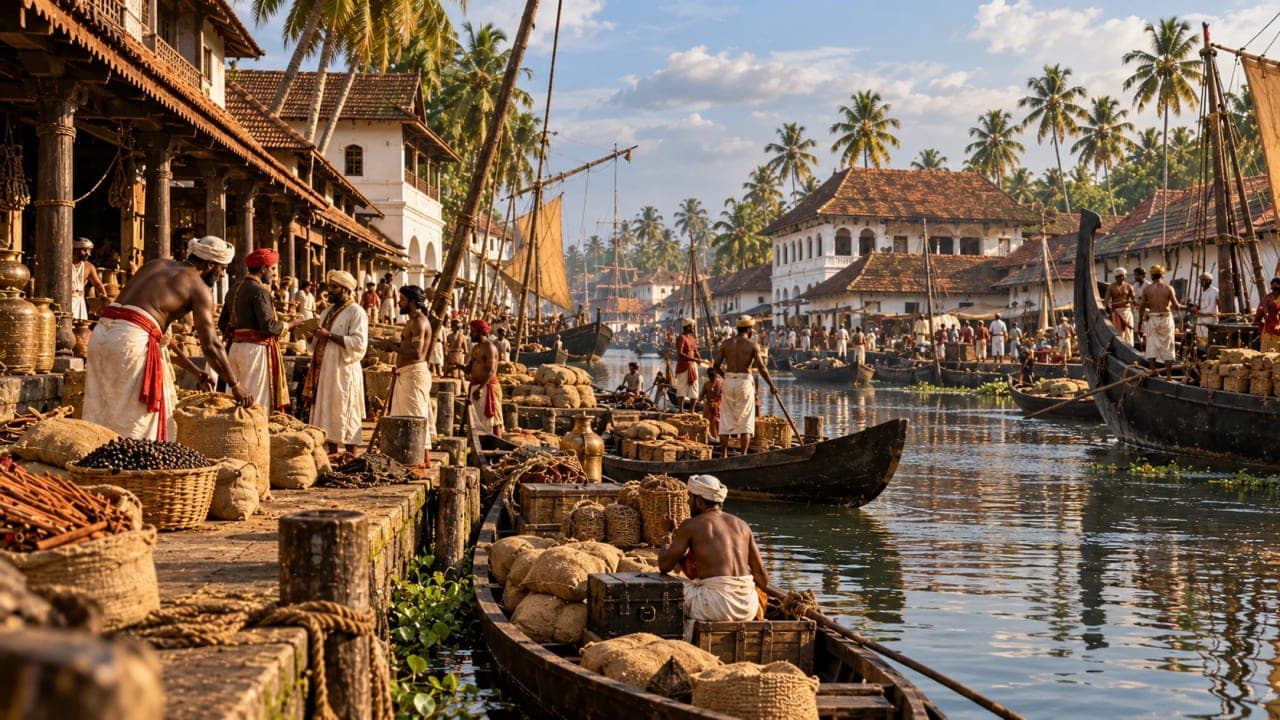
For generations, the waterways of Alappuzha and Kuttanad carried people, rice, fish, coconuts, spices and other goods.
Kerala Tourism notes that the backwaters served as important routes for transportation, trade and fishing, while Kuttanad's waterways were once the principal means of getting around the region. Kerala Tourism
This changes the way you look at a houseboat cruise.
Today, sitting on a deck with lunch and coconut water feels like a holiday.
For the people who lived here historically, that waterway could be the equivalent of a highway.
Except their highway had ducks on it.
And occasionally a snake.
And probably considerably fewer traffic jams.
The Man Who Built a Town Around Water
Alappuzha as a modern town owes much of its development to Raja Kesava Das, the Diwan of Travancore.
In the late eighteenth century, he developed Alappuzha as a planned trading centre, taking advantage of its strategic position between the sea and the inland waterways.
Canals were constructed to connect the town with the surrounding water network and facilitate the movement of goods. Kerala Tourism specifically credits Raja Kesava Das with establishing Alappuzha as a hub for traders and developing its canal network. Kerala Tourism
And this is where the city's older identity begins to appear.
Alappuzha wasn't built simply to look pretty.
It was built to move things.
Goods arrived.
Traders followed.
Markets developed.
Boats carried cargo.
The town became increasingly connected to Kerala's maritime economy.
In other words, the peaceful backwater destination we know today was once a rather busy commercial experiment.
Alleppey Was Once a Town of Trade
Long before Instagram discovered Kerala's houseboats, Alappuzha was known for its trade, coir industry and maritime connections.
The city's proximity to the Arabian Sea made it an important centre for commerce.
Coir became particularly significant.
Coconut husks were processed into fibre, which was then used to make ropes, mats and other products. Alappuzha eventually became one of the major centres associated with Kerala's coir industry.
And this is one reason the city's history cannot be separated from the humble coconut.
The coconut tree was not merely something making the landscape look tropical.
Its fruit provided food.
Its husk provided fibre.
Its shell had uses.
Its leaves and wood had practical value.
And the waterways provided the means to transport these products.
So the same landscape that now sells you a relaxing houseboat cruise once supported an entire network of production and trade.
The tourist postcard was, essentially, an industrial landscape with better lighting.
And Then There Is Kuttanad — The Land Below the Sea
If there is one geographical fact about the Alappuzha region that sounds made up, it is this:
People farm below sea level.
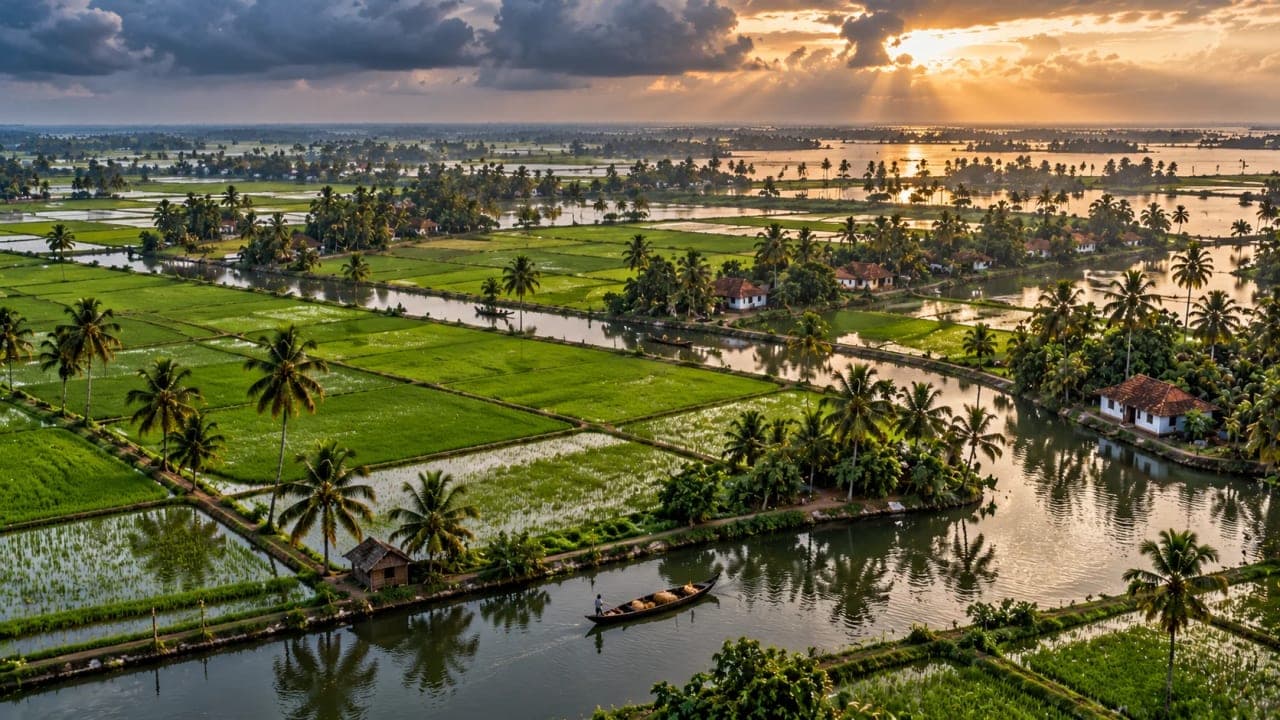
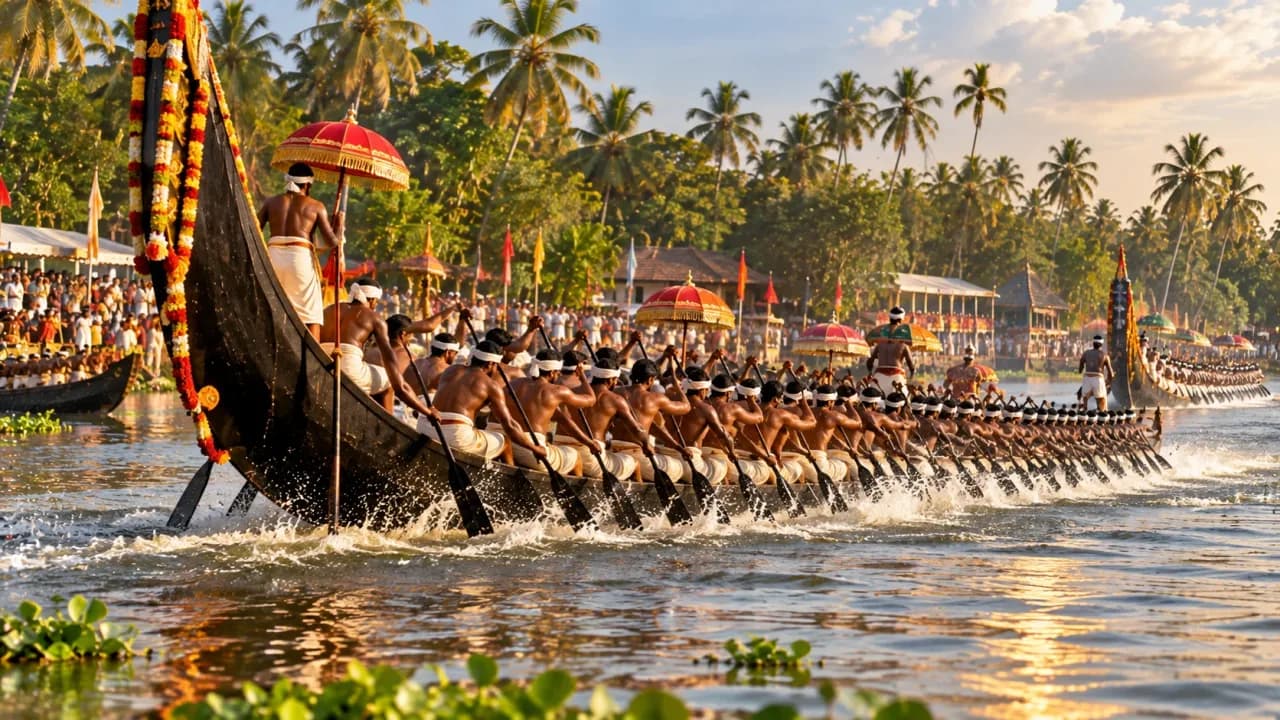
Kuttanad, often called the Rice Bowl of Kerala, contains extensive paddy fields lying below sea level. Some areas are roughly two metres or more below sea level, and the land is protected by systems of embankments and dykes. Kerala Tourism
Think about that.
You are standing in a rice field.
The sea is technically higher than you.
And yet there is farmland below it.
Kuttanad's landscape is not simply the result of nature. Generations of farmers have worked with water management, bunds and reclaimed land to cultivate rice.
The Pamba, Achankovil and Manimala rivers feed the region, while canals and waterways weave between the fields. Kerala Tourism
This is why the backwaters aren't just scenery.
They are part of a carefully adapted human landscape.
Water is simultaneously the region's biggest obstacle and its greatest resource.
Very Kerala.
The Lake That Controls the Mood
At the heart of the backwater experience is Vembanad Lake, the largest lake in Kerala.
It stretches across Alappuzha and Kottayam districts and covers roughly 2,033 square kilometres according to Kerala Tourism. Several rivers feed into it, while its western connection ultimately reaches the Arabian Sea. Kerala Tourism
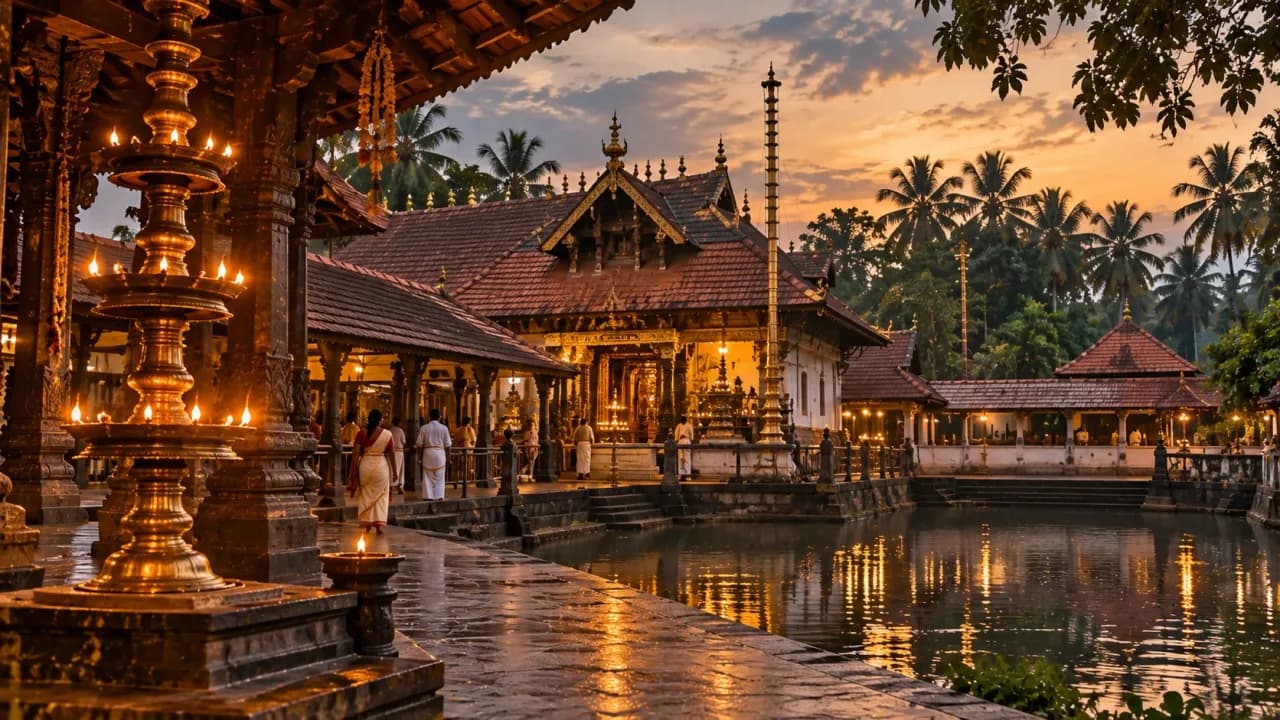
This huge waterbody changes character throughout the day.
In the morning, it can look almost silver.
At noon, the sunlight makes the water sparkle.
By evening, the entire surface can turn golden.
And when the wind disappears, the lake becomes a giant mirror.
But Vembanad is not merely decorative.
It supports fishing, transport, agriculture, tourism and village life.
And every year, it also becomes an enormous sporting arena.
Because this is where things suddenly stop being peaceful.
When the Calm Water Turns Into a Battlefield
Enter the snake boats.
Kerala's famous chundan vallams are long, narrow racing boats designed to carry large teams of rowers.
During major boat races, dozens of rowers move in extraordinary coordination, producing a rhythm that makes the entire boat appear almost alive.
The most famous event is the Nehru Trophy Boat Race, held on the Punnamada backwaters.
But the boat-racing tradition is older and more complicated than a modern sporting event.
The Champakulam boat race, for example, is connected with a temple legend involving the transportation of a Krishna idol.
And the story gets wonderfully dramatic.
How is it so far?
Vote with other readers
The Krishna Idol That Travelled by Boat
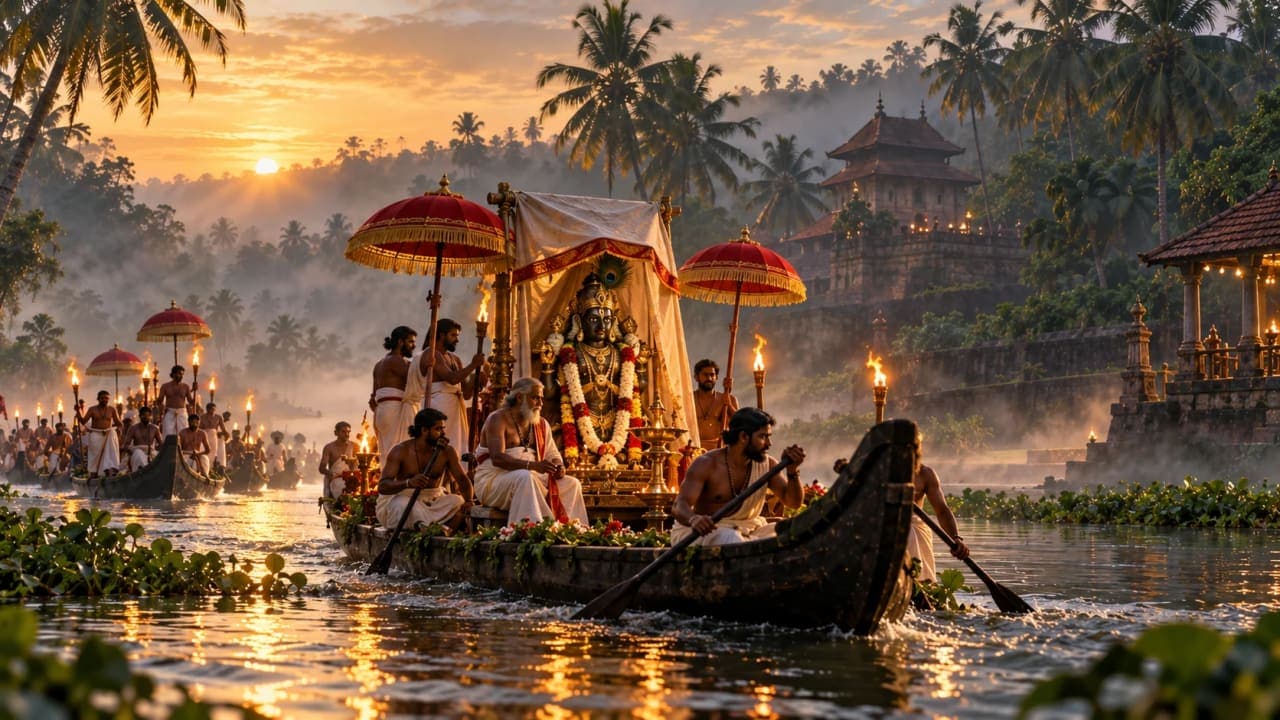
According to the traditional account, the ruler of Chembakassery wanted to install an idol of Krishna at the Ambalappuzha temple.
But the first idol selected was considered unsuitable.
So a group was sent to find another.
They eventually obtained an idol associated with the Kurichi Valiya Mattom family and began transporting it by boat towards Ambalappuzha.
Night came.
The group stopped at Champakulam.
The local family welcomed them.
The next day, the idol continued its journey amid celebrations.
The procession even received a ceremonial welcome from the nearby Kalloorkad church.
Today, the Champakulam Snake Boat Race commemorates that traditional water journey. Kerala Tourism
Now, whether every detail happened exactly as the story tells us is a question for historians.
But that is precisely what makes folklore interesting.
The waterway wasn't merely carrying an idol.
It became part of the story.
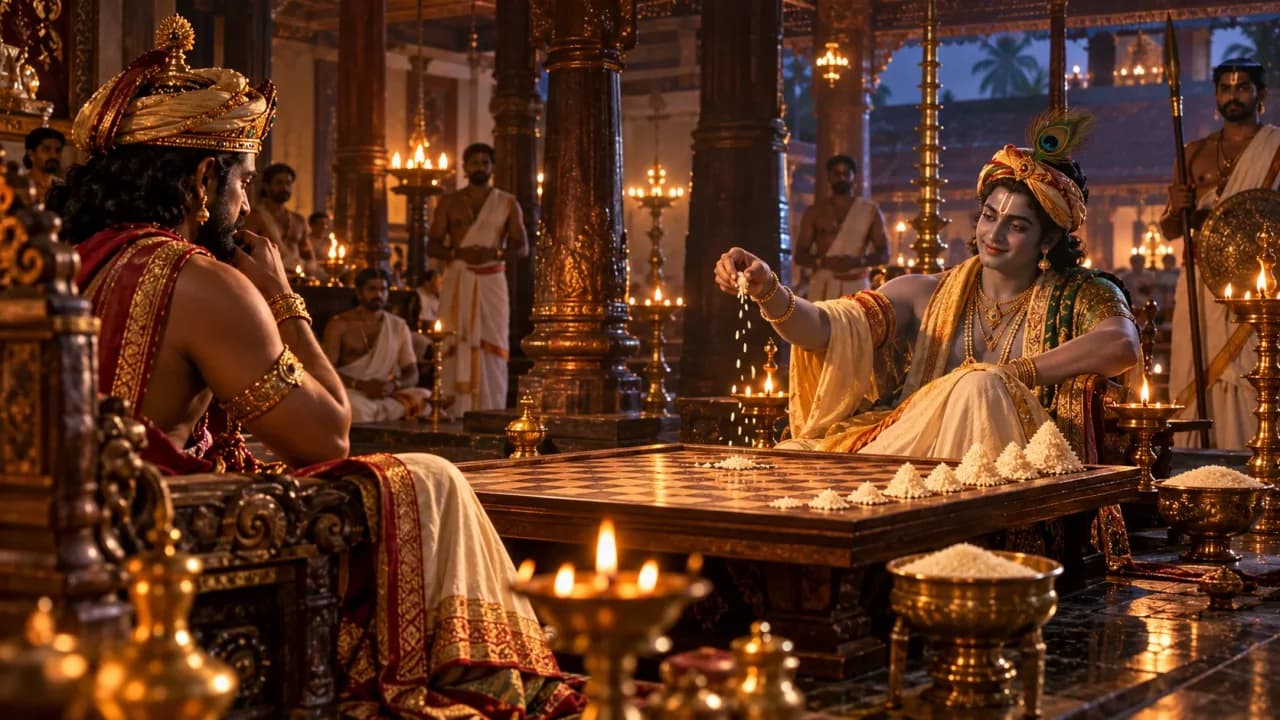
And Then Krishna Apparently Beat a King at Chess
The story of Ambalappuzha Sree Krishna Temple gets even better.
The temple is dedicated to Lord Krishna in the form of Parthasarathy, the charioteer of Arjuna.
It is also famous for one of Kerala's best-known temple offerings:
Ambalappuzha Palpayasam.
A sweet rice-and-milk pudding.
Delicious?
Apparently.
But according to legend, its origin involves a rather clever game.
A mysterious sage challenged the king to a game of chess.
The king loved chess, so naturally he accepted.
The sage proposed an unusual prize: rice, with the amount doubling according to the squares of the chessboard.
The king agreed.
Big mistake.
As the game progressed, the amount of rice supposedly became astronomically large.
The king realised he had been outplayed.
Then came the reveal.
The mysterious sage was Lord Krishna.
Rather than demanding an impossible quantity of rice, Krishna asked the king to offer palpayasam to devotees at the temple.
That legend is traditionally associated with the origin of the famous offering. Incredible India
So, somewhere in the spiritual history of Alappuzha, we apparently have a god who used mathematics and chess to negotiate a better food offering.
Honestly, Krishna had a strategy.
The Temple Where a God Is Said to Come for Dessert
The Ambalappuzha temple has another beautiful belief.
Devotees believe that Guruvayoorappan, another form of Krishna, comes to the temple each day to taste the palpayasam.
Yes.
A divine dessert visit.
The temple's connection with Guruvayoor became particularly significant when the idol of Guruvayoorappan was brought to Ambalappuzha for safekeeping during the threat posed by Tipu Sultan's invasion in 1789. Kerala Tourism
The temple also has a fascinating cultural connection.
It is traditionally associated with the first performance of Ottanthullal, a satirical Malayalam performance art associated with poet Kunchan Nambiar.
So this wasn't merely a place of worship.
It became a place where religion, food, literature and performance all met.
But Alappuzha Has an Even Stranger Temple
If Krishna's chess game wasn't mysterious enough, travel towards Haripad in Alappuzha district and you'll encounter something completely different.
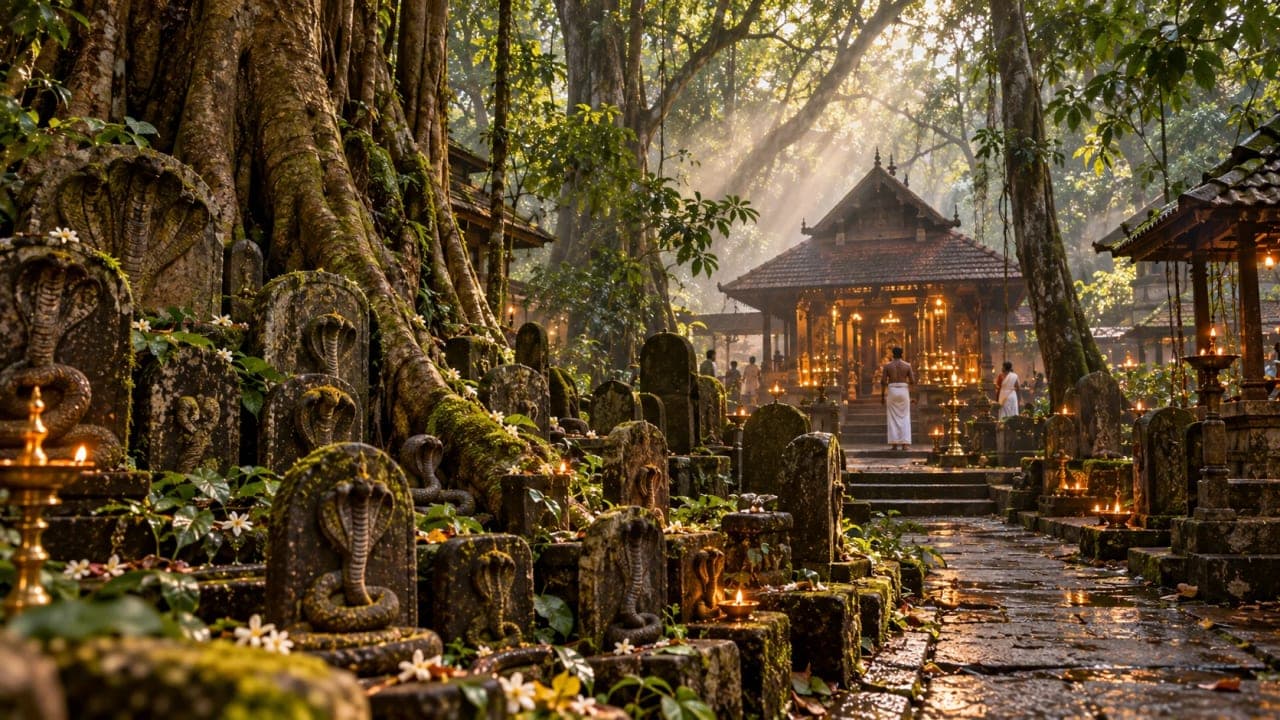
Mannarasala Sree Nagaraja Temple.
This is a temple dedicated to serpent worship.
And it doesn't look like the sort of temple you might imagine from a textbook.
It sits within a thick, forest-like grove.
Trees surround the pathways.
And thousands upon thousands of serpent images are found throughout the sacred area.
The temple is dedicated to Nagaraja, the serpent king, and is particularly unusual because the temple is headed by a female priest known as Mannarasala Amma. Kerala Tourism
Now comes the legend.
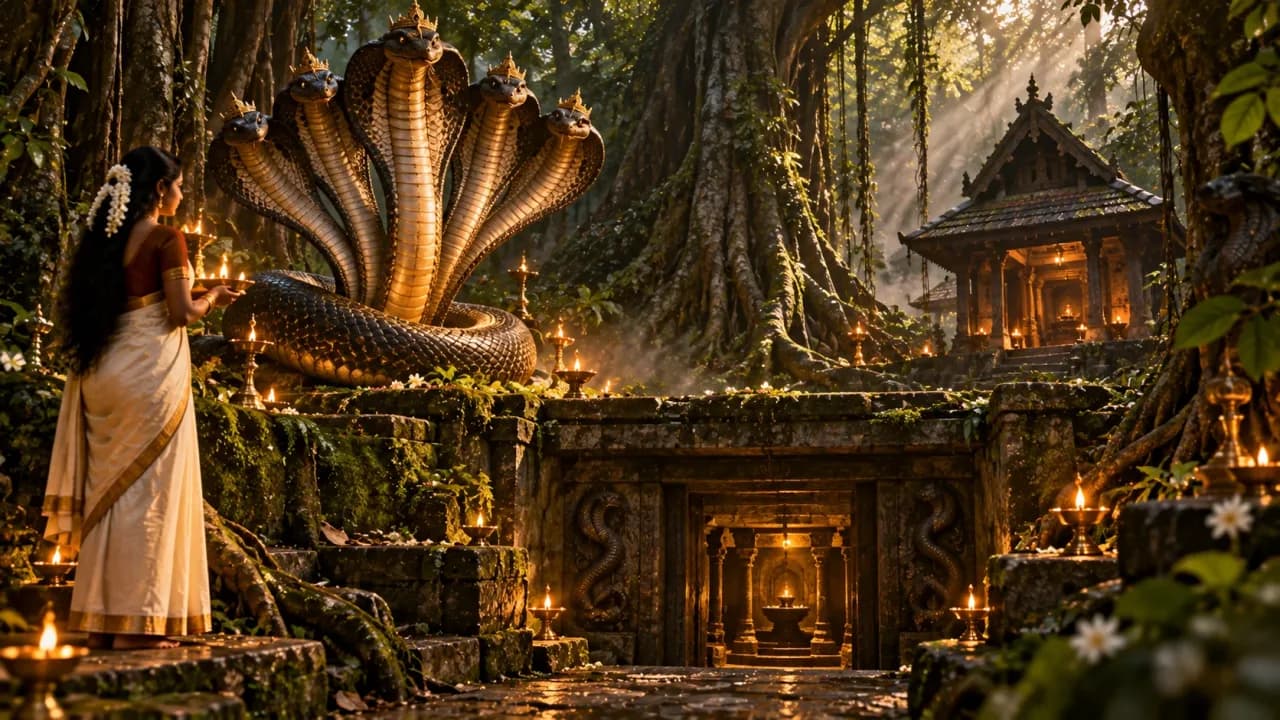
The Five-Headed Serpent in the Underground Cellar
According to the temple tradition, the story begins with Parashurama, who is believed in Hindu mythology to have created Kerala by reclaiming land from the sea.
But the newly created land was infertile and troubled by serpents.
Parashurama sought the help of Nagaraja.
The serpent deity eventually became associated with Mannarasala.
Another part of the temple legend tells of a devastating forest fire in which many snakes were injured.
A Brahmin woman is said to have cared for the injured serpents using milk, turmeric, honey and tender coconut water.
Nagaraja was pleased by her compassion.
The legend says she eventually gave birth to two children: one human and one five-headed serpent.
That serpent child later entered an underground cellar, where he is believed to remain in meditation. Kerala Tourism
Now, is there an underground serpent deity living beneath the temple?
That belongs to faith and tradition, not something archaeology can verify.
But the fascinating part is that the ritual traditions surrounding the story continue.
And the temple still has a female priesthood associated with the legendary mother of Nagaraja.
That is considerably more interesting than simply calling it "an old temple."
What About Devils?
Here is where I had to disappoint the devil-hunting part of the story.
I couldn't find a reliable historical source establishing a specific devil legend unique to the Alappuzha backwaters.
And perhaps that's for the best.
Because Alappuzha doesn't really need a devil.
It already has serpent gods.
A five-headed snake.
A divine chess player.
A magical island.
A lake filled with legends.
And an entire agricultural region living below sea level.
That is enough supernatural seasoning for one district.
There are, of course, countless local stories, folk beliefs and oral traditions connected with spirits, serpents, sacred groves and supernatural beings throughout Kerala. But they should not all be casually labelled as "devil stories" simply to make a travel article sound mysterious.
The truth is much more interesting.
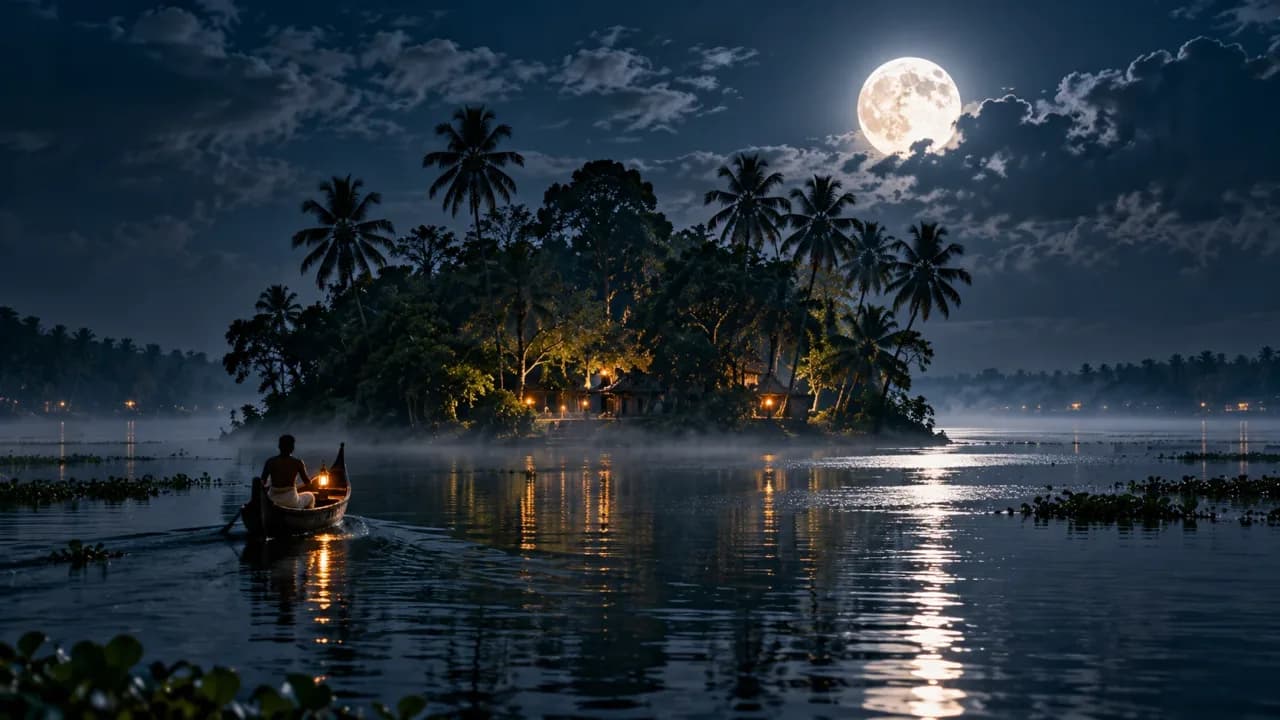
The Island That Appeared at Midnight
Take Pathiramanal, a small island in Vembanad Lake.
Its name literally means "midnight sand."
And yes, there is a legend explaining that rather dramatic name.
According to local tradition, the legendary sage Vilwamangalam Swamiar was travelling by boat across Vembanad at night when he needed to stop.
Through supernatural power, he is said to have created an island from the lake.
Thus came the name Pathiramanal—midnight sand. Kerala Tourism
History, however, has a considerably less magical explanation.
The island was once privately owned, later passed through different hands and eventually came under government control after land reforms.
Today, it is also known for migratory birds.
So there are two Pathiramanals.
One appeared through magic at midnight.
The other emerged through ordinary land ownership records.
Take your pick.
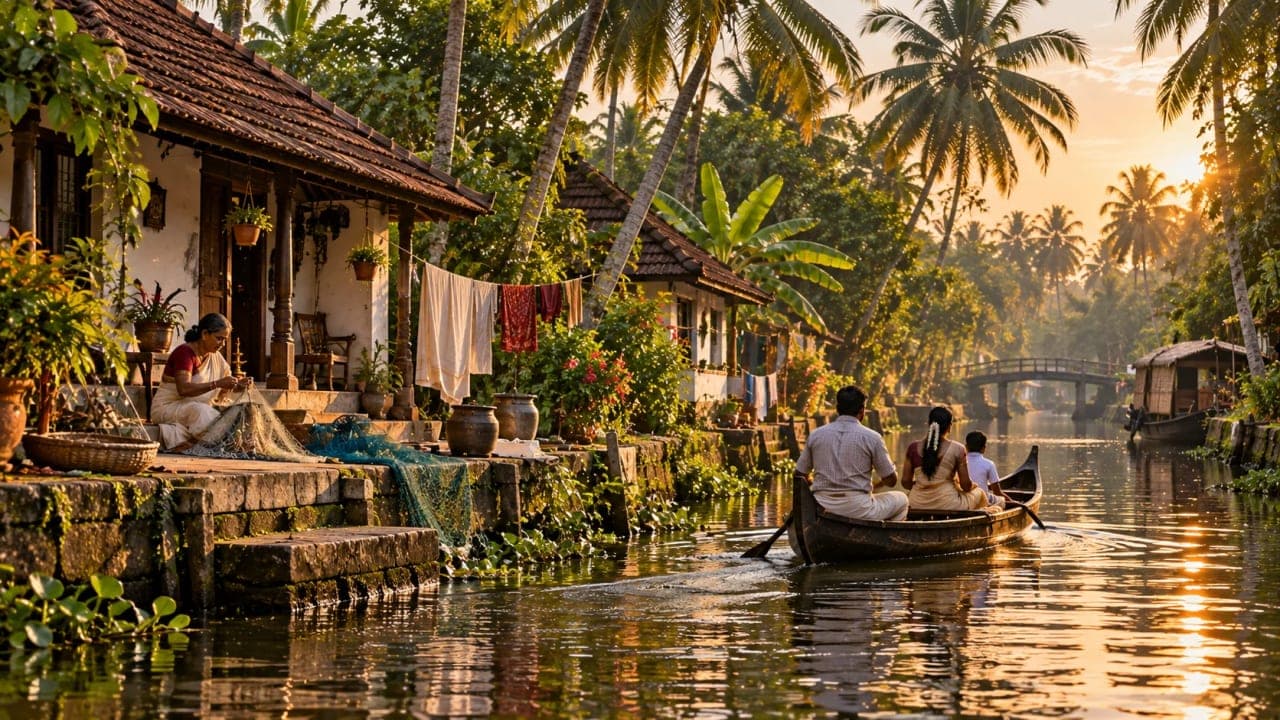
The Backwaters Are More Than a Pretty Boat Ride
This is perhaps the biggest misconception about Alleppey.
People think of backwaters and immediately imagine a luxury houseboat.
And yes, you should absolutely experience one.
But the real story is much larger.
The backwaters were transportation routes.
They supported fishing communities.
They moved agricultural produce.
They enabled trade.
They shaped settlements.
They helped create the economy of Alappuzha.
And today, they remain deeply connected to everyday life.
Even now, you can see children travelling by boat, fishermen working along the banks and villages arranged around waterways rather than highways. Kerala Tourism describes this continuing relationship between the waterways and local life as one of the defining features of an Alappuzha canal journey. Kerala Tourism
The houseboat is simply the newest chapter.
The Real Mystery of Alleppey
After reading about Alappuzha's history, I think its greatest mystery isn't one particular temple or legend.
It is the fact that water has shaped almost everything here.
It shaped where people lived.
It shaped how they travelled.
It shaped how they farmed.
It shaped trade.
It shaped festivals.
It even became part of religious stories.
A boat carried Krishna's idol.
A lake supposedly gave birth to an island at midnight.
A temple hides among trees with legends of a five-headed serpent.
Farmers cultivate rice below sea level.
And enormous boats race across the same waterways that once carried ordinary goods from one village to another.
That is what makes Alleppey so fascinating.
The scenery isn't separate from the history.
The scenery is the history.
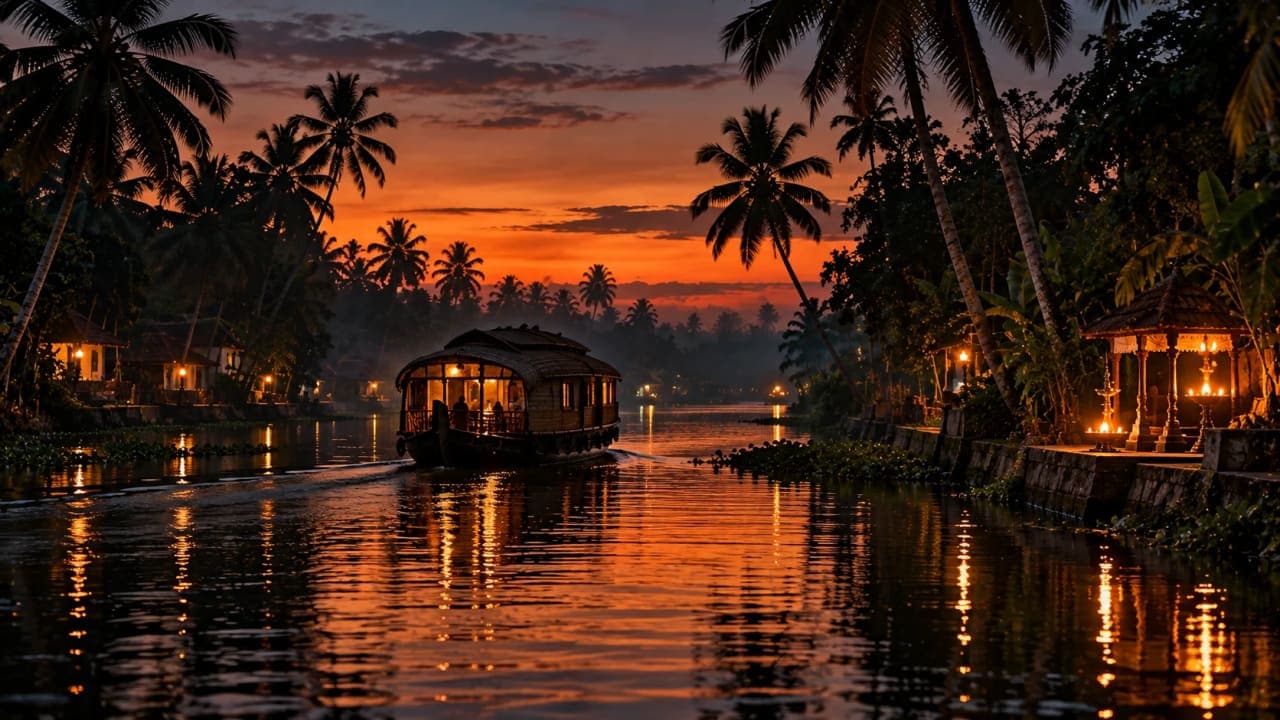
And That Is Why Alleppey Feels Different
Alappuzha isn't a place where you have to search very hard for the past.
It is floating beside you.
Look at a canal and you're looking at an old transportation route.
Look at a paddy field and you're looking at generations of engineering and farming.
Watch a snake boat and you're watching a tradition that grew out of local communities and temple-linked stories.
Visit Ambalappuzha and you're walking into legends about Krishna, chess and palpayasam.
Visit Mannarasala and suddenly the forest itself becomes part of a sacred world of serpent worship.
And then there is the water.
Always the water.
Quietly moving past everything.
Perhaps that is the most suspicious thing about Alleppey.
It looks as though nothing is happening.
But underneath those coconut trees and beyond those slow-moving houseboats is a place that has been trading, farming, praying, racing and telling stories for centuries.
So yes, come to Alleppey for the backwaters.
Take the houseboat.
Watch the sunset.
Eat the local food.
But while you're floating through those quiet canals, remember this:
You aren't simply travelling through Kerala's scenery.
You are travelling through one of its oldest living stories.
Lock in the takeaway
Kerala Travel Stories

Frequently asked questions
What is Alleppey famous for?
Alleppey, officially known as Alappuzha, is famous for its backwaters, houseboats, Vembanad Lake, canals, coconut-lined landscapes, Kuttanad's paddy fields, coir industry and traditional boat races.
Why is Alleppey called the Venice of the East?
Alleppey is popularly called the Venice of the East because of its extensive network of canals and waterways running through the town and surrounding villages.
What are the Alleppey backwaters?
The Alleppey backwaters are part of Kerala's interconnected network of lakes, lagoons, rivers and canals. They have historically been used for transportation, fishing, farming and trade and are now a major tourism attraction.
What is Vembanad Lake famous for?
Vembanad Lake is Kerala's largest lake and is one of the central features of the state's backwater system. It is famous for houseboat cruises, fishing, birdlife, scenic villages and traditional boat races.
What was Alleppey famous for in the past?
Before becoming a major tourist destination, Alleppey was known for trade, inland water transportation, coir production, fishing, agriculture and its connection to Kerala's maritime economy.
Who developed Alleppey as a major trading centre?
Raja Kesava Das, the Diwan of Travancore, played an important role in developing Alappuzha as a planned commercial centre during the late eighteenth century. Canals were developed to improve transportation and trade.
Why is Kuttanad famous?
Kuttanad is famous for its extensive paddy cultivation and unusual below-sea-level farming. It is often called the Rice Bowl of Kerala and has a complex system of canals, bunds and waterways.
Is there a temple in Alleppey associated with serpent worship?
Yes. Mannarasala Sree Nagaraja Temple near Haripad is one of Kerala's best-known serpent-worship temples. It is dedicated to Nagaraja, the serpent deity, and is surrounded by a sacred grove containing numerous serpent images.
What is the mystery of Mannarasala Temple?
Temple tradition includes the story of a five-headed serpent associated with Nagaraja who is believed to reside in an underground cellar. This is a religious belief and legend rather than an archaeologically verified claim.
Are Alleppey's backwaters natural or man-made?
The backwater system is a combination of natural waterways and human-modified canals, embankments and agricultural landscapes. People have shaped and adapted these waterways for transportation, farming and settlement for generations.
Why are Alleppey backwaters historically important?
The waterways once functioned as major transportation and trade routes, carrying rice, fish, coconuts, coir and other goods between villages, markets and coastal trading centres.