
Listen to this article
Checking audio support
Ardhanarishwar Temple, Chandasi: The 108-Foot Secret I Found Near Patna
I was born and brought up in Patna. I have spent years of my life here, travelled through its familiar roads countless times and visited many of its well-known temples.
And yet, during my recent visit home, I discovered something that made me wonder:
How did I not know about this place before?
A little away from the busy streets of Patna, in Chandasi village near Gaurichak, stands something enormous — quite literally.
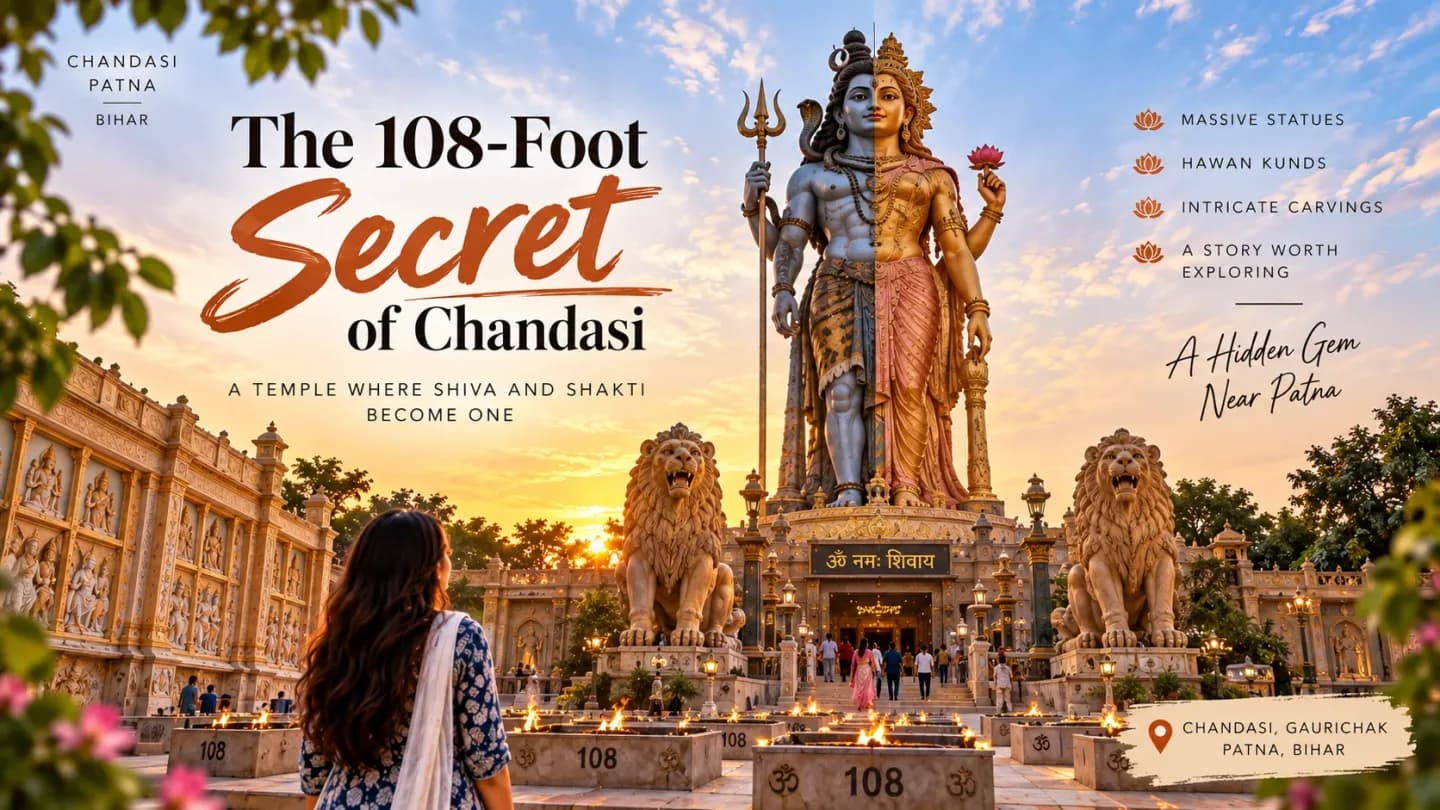
A 108-foot-tall Ardhanarishwar, the extraordinary form in which Lord Shiva and Goddess Parvati become one.
But strangely, the gigantic statue was not the only thing that caught my attention.
There were hundreds of hawan kunds.
There were enormous lions guarding the entrance.
There were gigantic statues of Ganesha and Kartikeya.
There were walls filled with gods, goddesses, flowers and intricate patterns.
And then there was that enormous hand.
The more I walked around, the more the temple felt like a place designed to make you keep looking for the next detail.
So, let me take you along with me.
A Rakshabandhan Visit That Turned Into a Discovery
I had gone to Patna around Rakshabandhan and, while I was there, I visited the Ardhanarishwar Temple with my mother, father and brother.
It was one of those family outings that begins simply — get into the car, visit a temple, offer prayers and come back.
At least, that was what I thought.
As we approached Chandasi, the surroundings felt very different from the crowded central areas of Patna. The temple is located in Chandasi village in the Gaurichak area of Patna district, roughly 25–30 km from central Patna.
We were able to park our car surprisingly close to the temple — perhaps just 10–20 metres away.
And even before entering, there was already that familiar atmosphere that surrounds popular Indian temples.
Small stalls had appeared around the entrance selling flowers, prasad, sweets and other puja items.
There was colour, movement and devotion everywhere.
But nothing outside quite prepared me for what I saw after entering.
The First Surprise Wasn't the 108-Foot Statue
When you hear about Chandasi's Ardhanarishwar Temple, you naturally expect the first thing to capture your attention to be its gigantic statue.
But that wasn't how our visit unfolded.
The first thing that caught our attention was something spread across the ground:
hawan kund after hawan kund.
There seemed to be so many of them that my immediate question was:
Why would one temple need this many?
The answer lies in the temple's recent history.
Before the grand Pran Pratishtha ceremony in June 2026, the temple hosted a 1008-kund Mahayagya. The religious programme ran from June 17 to June 25, followed by the Pran Pratishtha on June 26. Reports from the event also mention thousands of devotees participating in the associated Kalash Yatra.
Suddenly those hawan kunds did not look like random structures anymore.
Imagine 1,008 sacred fires burning together, Vedic mantras being recited and an entire ground filled with people gathered for the same ceremony.
I had arrived after that great event.
But the hawan kunds were still there — almost like footprints left behind by it.
And that was only the beginning.
The Lions at the Entrance — Decoration or Something More?
Moving further inside, another massive structure demanded attention.
The lions.
These aren't tiny decorative figures that you might casually pass at a temple entrance. They are enormous sculptural elements, designed to make the gateway itself feel monumental.
Contemporary reports about the temple's construction describe the entrance as being decorated with large sculptures of a lion and serpent, while elephants with mahouts were also incorporated into the grand entrance design.
But why a lion?
In Hindu iconography, the lion is strongly associated with power, courage and divine protection, and it is famously connected with Goddess Durga as her vahana.
Standing beside such a huge lion makes you feel very small.
Perhaps that is partly the point.
Before you even reach the central divine figure, the scale of the surroundings has already changed your perspective.
And then you look upwards.
That is when the real scale of Chandasi reveals itself.
108 Feet of Shiva and Shakti
At the heart of the complex stands the reason this place is becoming one of Patna's most fascinating new religious landmarks:
the 108-foot Ardhanarishwar statue.
It is difficult to understand what 108 feet actually looks like until you are standing below it.
Photographs can show you the statue.
Numbers can tell you its height.
But neither quite communicates the feeling of looking upwards from its base.
Ardhanarishwar is one of Hinduism's most fascinating forms — Lord Shiva and Goddess Parvati represented as one being, one half masculine and the other feminine.
It isn't simply Shiva standing beside Parvati.
They are one body.
Shiva and Shakti.
Consciousness and energy.
Masculine and feminine.
Neither complete without the other.
Recent reports describe Chandasi's main Ardhanarishwar figure as 108 feet tall and among the largest — and often reported as the tallest — Ardhanarishwar statues of its kind. Some reports give the complete height including its base as approximately 143 feet, which explains why you may come across both numbers when reading about the temple.
But this raised another question for me.
Why exactly 108?
Why not 100 feet?
Why not 110?
Why was 108 chosen?
The Mystery of 108
If you have spent enough time around Hindu temples, rituals or spiritual traditions, you have probably encountered 108 before.
A traditional japa mala commonly contains 108 beads.
Mantras are frequently chanted 108 times.
Many Hindu traditions speak of 108 names of a deity.
The number repeatedly appears in Indian spiritual practice and has come to represent sacred completeness and the relationship between the individual and the divine.
That makes the choice of a 108-foot statue particularly meaningful.
At Chandasi, 108 isn't merely a measurement.
It connects the sheer physical scale of the statue to a number that devotees have counted on prayer beads for generations.
There is also another fascinating number connected with the complex: 1,008 — the number of hawan kunds used for the Mahayagya preceding the Pran Pratishtha.
So when you walk past those kunds and then look upwards at the 108-foot deity, numbers suddenly become part of the temple's story.
How is it so far?
Vote with other readers
And Then I Noticed Ganesha and Kartikeya
The main Ardhanarishwar figure is so dominant that it would be easy to assume everything else would look small beside it.
Not here.
On either side are enormous representations of Lord Ganesha and Lord Kartikeya.
Construction reports describe Kartikeya's statue as approximately 40 feet tall, with Ganesha placed on the other side, creating a monumental representation of the Shiva family around the central Ardhanarishwar form.
And suddenly the arrangement makes more sense.
You aren't simply looking at one giant deity.
You are looking at the idea of a family.
Shiva and Parvati exist together as Ardhanarishwar, while their sons Ganesha and Kartikeya accompany them.
Nearby representations associated with Shiva and Shakti, including Nandi and the lion, add another layer to that symbolism.
Every time I thought I had understood the main composition, another detail appeared.
That Giant Hand
And then there is one feature that is almost impossible to ignore once you notice it:
the enormous hand sculpture.
Among all the gigantic deities and elaborate carvings, seeing a hand at such a huge scale feels unusual.
You instinctively stop.
You look at it from one angle.
Then another.
And perhaps that is one of my favourite things about this temple.
It doesn't reveal itself through one single view.
The monumental elements are so large that you have to physically move around them to understand their proportions.
A hand that would simply be one detail on an ordinary idol becomes a sculpture in its own right when everything is created at this scale.
It reminds you how much craftsmanship is hidden inside something we normally see only as a complete statue.
Don't Just Look at the Statues — Look at the Walls
After staring at the gigantic idols, it is very easy to forget to look around.
Don't.
The walls deserve your attention too.
They are covered with embedded designs, floral patterns, traditional motifs and sculptural details. Construction accounts specifically mention intricate flower patterns, chandelier-like carvings and other traditional decorative elements incorporated into the architecture.
As I moved through the temple, I kept finding small images and forms of different gods and goddesses worked into the surroundings.
There are depictions associated with the Shiva family, forms connected with Durga, Hanuman and other familiar Hindu deities across the complex.
Some are obvious.
Others are the kind of details you notice only after looking closely.
That is what makes walking around Chandasi interesting.
Your eyes naturally go towards the giant Ardhanarishwar first.
Then Ganesha.
Then Kartikeya.
Then the lions.
But slowly your attention moves from the gigantic to the tiny.
A face hidden in a wall.
A flower.
A deity.
A pattern.
A small carved figure.
It becomes almost like a visual treasure hunt.
Why Does the Temple Look Like It Was Carved From Stone?
One of the things that made the complex look different from many colourful modern temples I have visited was its colour.
The dominant appearance is a stone-like brown finish.
And apparently, that effect was intentional.
Artisans working on the project said that the structure was planned with a stone-finish brown colour so that the temple and monumental sculptures would appear as though they had been carved from one enormous piece of stone.
Once you know that, look at the temple again.
The colour begins to make sense.
Instead of individual structures competing with each other, the similar earthy tones visually connect everything.
For a relatively new temple complex, it creates an unexpectedly ancient feeling.
From a distance, it looks monumental.
Up close, it becomes intricate.
A Temple Built by More Than One Pair of Hands
Another fact I found interesting after my visit was just how much work went into creating this place.
Reports surrounding the June 2026 consecration said the religious complex cost around ₹11 crore and took years of work, with artisans and craftspeople from states including Bihar, Uttar Pradesh, Maharashtra and Karnataka contributing to it.
Think about that the next time you look at one of its carvings.
Someone designed it.
Someone shaped it.
Someone worked on those tiny details knowing that, once completed, most visitors would first be staring 108 feet into the sky.
Yet those small details were created anyway.
Perhaps that is what traditional temple craftsmanship has always understood:
devotion exists in the details too.
From Chandasi Village to a New Landmark of Patna?
What fascinated me most was the contrast.
This isn't an ancient monument that has stood here for hundreds of years.
It is a new landmark whose story is unfolding right now.
And yet it has been built using some very old ideas.
Shiva and Shakti.
108.
Yagya.
Nandi.
The lion.
Ganesha.
Kartikeya.
Sacred geometry, sculpture and symbolism.
Old traditions have been expressed here at a completely modern, monumental scale.
And all of this stands in Chandasi village, not in the middle of Patna's most famous tourist circuit.
Perhaps that is why visiting it felt like discovering something before everyone else had heard the story.
What I Thought Would Be a Simple Temple Visit
When I went to Chandasi with my mother, father and brother around Rakshabandhan, I expected a family temple visit.
Park the car.
Buy prasad.
Have darshan.
Take a few photographs.
Return home.
Instead, I came back with questions.
Why 108 feet?
Why were there so many hawan kunds?
Why were the lions so enormous?
How big were Ganesha and Kartikeya?
Why did the entire temple look like stone?
How many gods and goddesses were hidden among those carvings?
And perhaps the biggest question:
How had a place this extraordinary appeared so close to my hometown without me knowing much about it?
That is what I love about exploring places.
Sometimes travel isn't about going hundreds or thousands of kilometres away.
Sometimes the story you have been looking for is hiding just outside your own city.
Before You Leave, Look Back Once
If you visit Ardhanarishwar Temple in Chandasi, don't rush.
Walk past the hawan kunds.
Look closely at the lions.
Stand beneath Ganesha and Kartikeya.
Find the giant hand.
Look for the smaller gods and goddesses on the walls.
Notice the flowers and patterns carved into the architecture.
And finally, stand somewhere from where you can see the Ardhanarishwar statue properly.
Then look upwards.
108 feet.
Half Shiva.
Half Shakti.
One form.
Maybe that is the real secret of Chandasi.
The temple impresses you with its size first.
But when you begin looking closer, you realise that its story isn't really about how enormous everything is.
It is about two halves becoming one whole.
And perhaps that is why, out of everything I saw there, the 108-foot figure stayed with me the most.
I had gone there thinking I was visiting another temple near Patna.
I returned feeling that I had discovered one of Patna's newest stories.
And this one is only beginning.
Lock in the takeaway
Patna Travel Stories

Frequently asked questions
Where is Ardhanarishwar Temple in Patna?
Ardhanarishwar Temple is located in Chandasi village in the Gaurichak area of Patna district, Bihar. It is outside central Patna and can be reached conveniently by road.
Why is Ardhanarishwar Temple in Chandasi famous?
The temple is best known for its enormous 108-foot Ardhanarishwar statue representing Lord Shiva and Goddess Parvati in one form. The complex also features huge statues, hawan kunds, entrance sculptures and detailed carvings.
How tall is the Ardhanarishwar statue at Chandasi?
The main Ardhanarishwar figure is reported to be 108 feet tall. Some reports mention an overall height of around 143 feet when the base or supporting structure is included.
Why is the Ardhanarishwar statue 108 feet tall?
The number 108 has deep significance in Hindu spiritual traditions. Japa malas traditionally contain 108 beads, mantras are often chanted 108 times, and many deities are worshipped through their 108 names.
What does Ardhanarishwar mean?
Ardhanarishwar is a combined form of Lord Shiva and Goddess Parvati, represented as one body—one half masculine and the other feminine. The form symbolises the inseparability of Shiva and Shakti.
Which other gods and goddesses can be seen at Chandasi Temple?
Along with the central Ardhanarishwar, the complex prominently features Lord Ganesha and Lord Kartikeya. Visitors can also notice representations and sculptural elements associated with other Hindu deities throughout the temple complex.
Why are there so many hawan kunds at Ardhanarishwar Temple?
The temple hosted a 1008-kund Mahayagya before its Pran Pratishtha ceremony in June 2026. The large number of hawan kunds is therefore connected to the major religious ceremonies held during the temple's consecration.
What is special about the architecture of Chandasi Ardhanarishwar Temple?
Apart from its monumental statues, the temple features huge lion sculptures, an enormous hand sculpture, floral and traditional patterns, deity carvings and a distinctive stone-like brown finish.
Is Chandasi Ardhanarishwar Temple worth visiting from Patna?
It offers an unusual combination of religious significance, monumental sculpture and detailed architecture. For visitors exploring temples and lesser-known places around Patna, Chandasi can be an interesting addition to the itinerary.
How much time should I keep for visiting Ardhanarishwar Temple?
Around one to two hours should give you enough time for darshan and to explore the statues, hawan kunds, wall carvings and other architectural details without rushing.