
Listen to this article
Checking audio support
Robber’s Cave, Dehradun: Mysteries of Guchhupani
Sometimes a day refuses to follow the plan you made for it.
Our long weekend had already proved that.
My husband and I had originally wanted to go somewhere in the mountains, but that plan didn't work out, so we stayed in Dehradun. We decided to make the most of it and visited FRI with my husband and my in-laws. After exploring FRI, our next destination was supposed to be Robber’s Cave.
That didn't work out either.
What should have been roughly a 10-minute remaining drive turned into around one to one-and-a-half hours of sitting in traffic. We waited, moved a little, stopped again, waited some more—and eventually realised that reaching Robber’s Cave that day was probably not going to happen.
So we took a U-turn.
But going straight back home after spending so much time outside didn't feel right either.
We were already out. It was a long weekend. Surely the day couldn't end with a traffic jam?
That was when we decided on another destination:
Buddha Temple.
And this time, thankfully, we actually reached it.
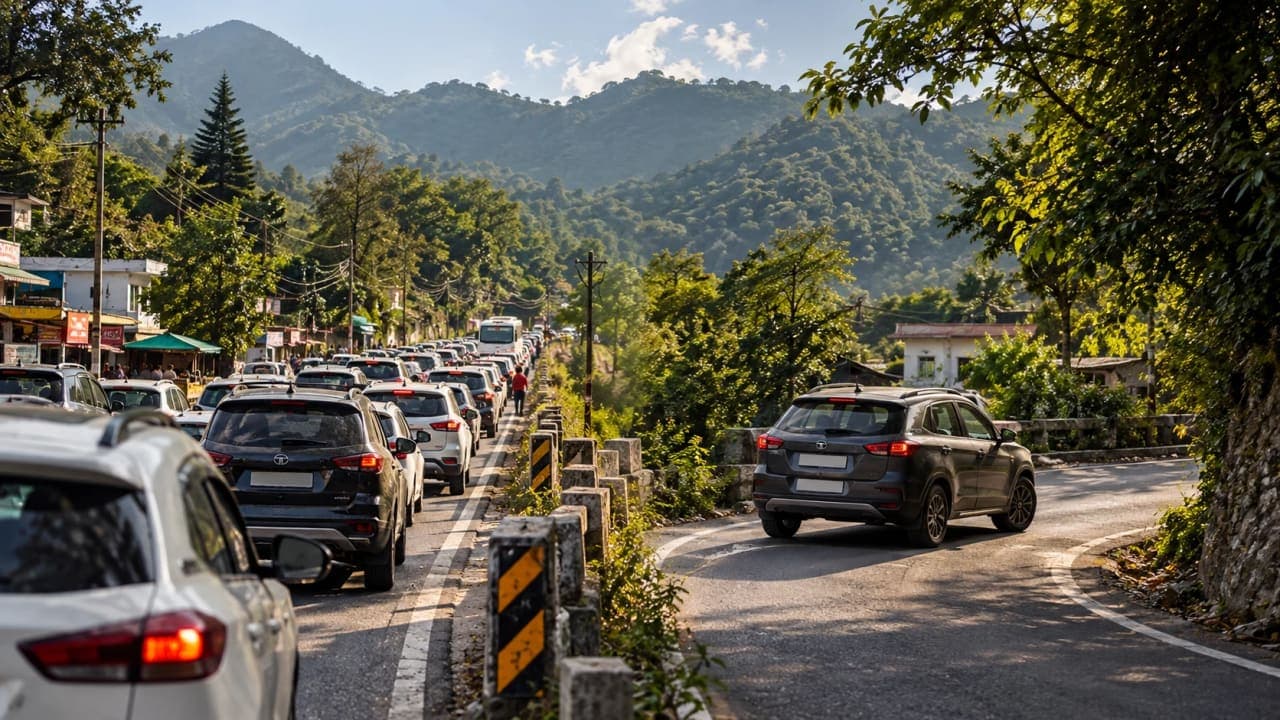
The Traffic Was Getting Worse Behind Us
Once we turned away from Robber’s Cave and started driving towards Buddha Temple, we noticed something that made us feel slightly better about our decision.
The queue of cars heading towards Robber’s Cave had become even longer.
More vehicles kept joining the line.
At that point, turning back no longer felt like giving up. It felt like we had probably saved ourselves from spending another hour staring at the car in front of us.
We headed towards Clement Town, where Dehradun's famous Buddha Temple complex is located.
Traffic wasn't completely done with us, though.
We still encountered plenty of it on the way.
But slowly, we moved closer to Clement Town.
And then the atmosphere began to change.
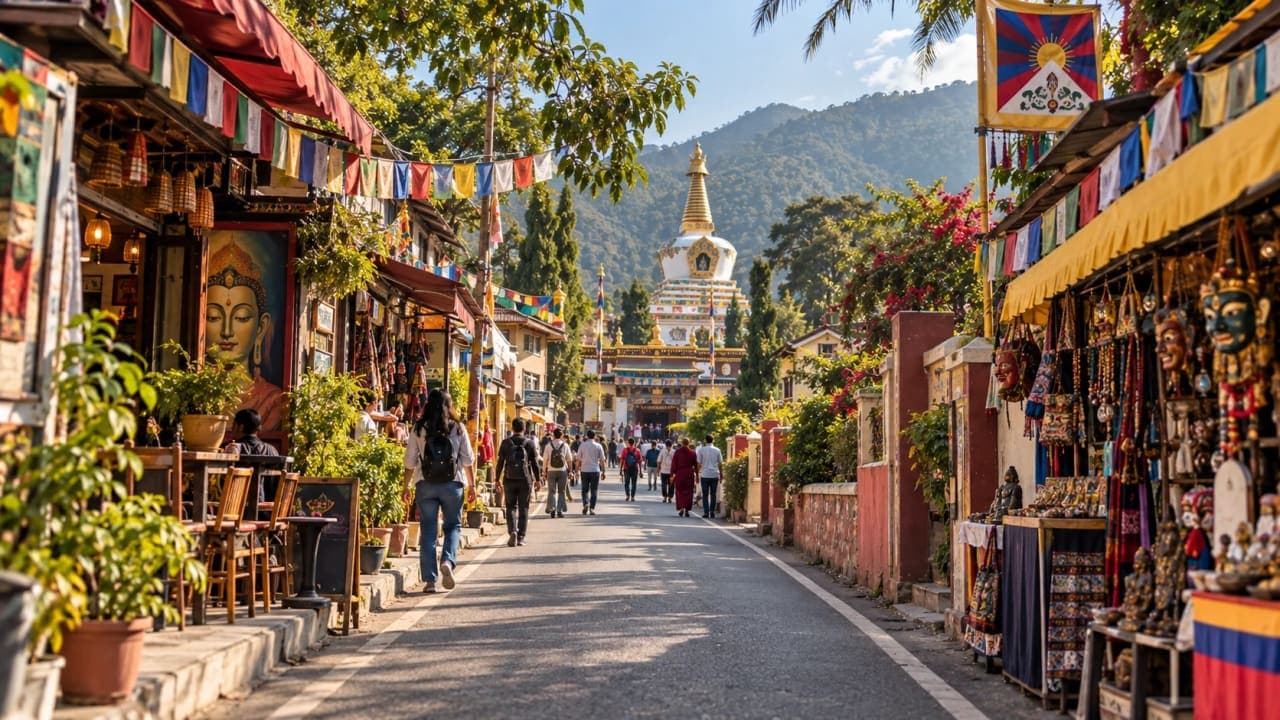
That Little Road Before the Temple
This is actually one of the things I remember most clearly about arriving there.
Before you reach the temple complex, you travel through a relatively narrow road lined with small cafés, shops and Tibetan influences.
And I loved the vibe.
After spending so much time surrounded by traffic, this little area felt completely different.
There were places to eat, little shops to browse and signs of the Tibetan community that has become such an important part of Clement Town.
The atmosphere almost felt like a small pocket of Tibet had appeared within Dehradun.
That isn't accidental.
The Buddha Temple that most visitors refer to is part of the Mindrolling Monastery complex, located in Clement Town alongside a Tibetan refugee settlement. The monastery's official history explains that the life of its monastic community is closely intertwined with the neighbouring Tibetan community. Mindrolling
As we continued along that road, we finally caught our first glimpse of the temple complex.
After everything that had happened that day, it felt worth reaching.
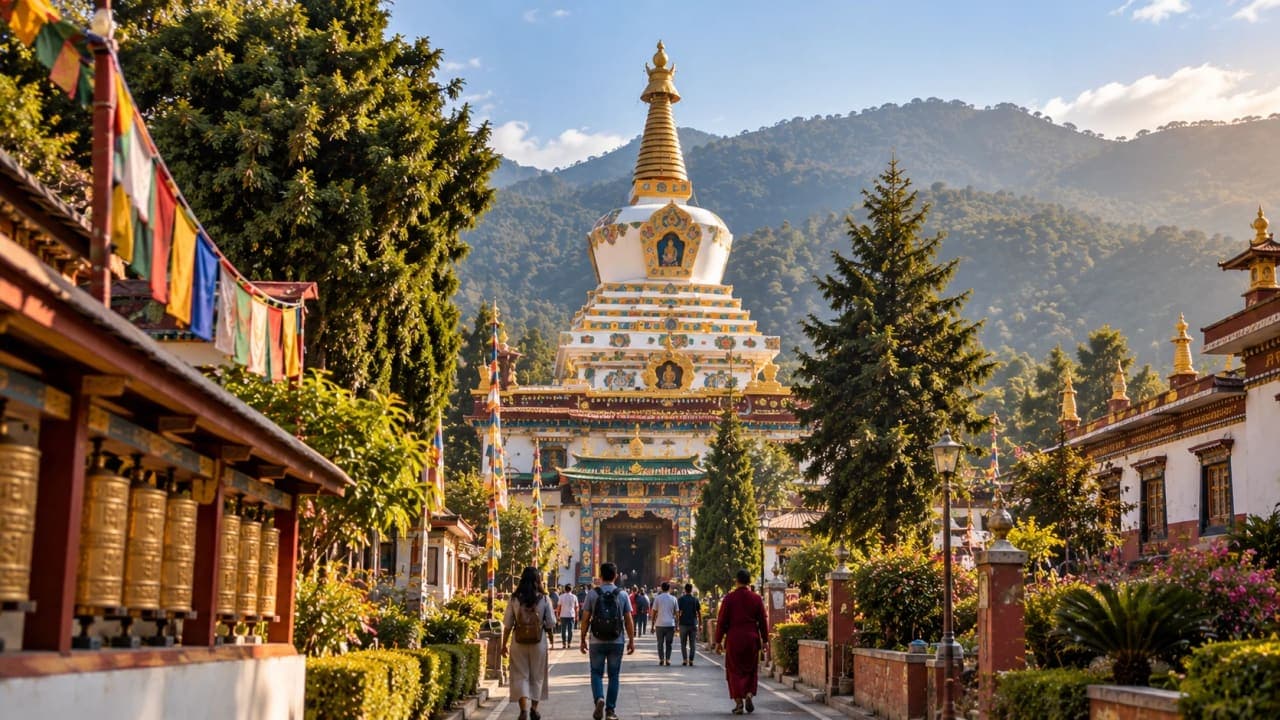
Buddha Temple Is Actually Mindrolling Monastery
Most tourists in Dehradun simply call the place Buddha Temple.
Its fuller identity is much more interesting.
We were visiting Mindrolling Monastery, one of India's major centres of Tibetan Buddhism, located at 3 Buddha Temple Road, New Basti, Clement Town, Dehradun, Uttarakhand 248002. Google
Mindrolling belongs to the Nyingma tradition, one of the principal schools of Tibetan Buddhism.
And although the Dehradun monastery dates from the twentieth century, Mindrolling's history doesn't begin in India at all.
Its story begins hundreds of years earlier in Tibet.
A Monastery Whose Story Began in Tibet in 1676
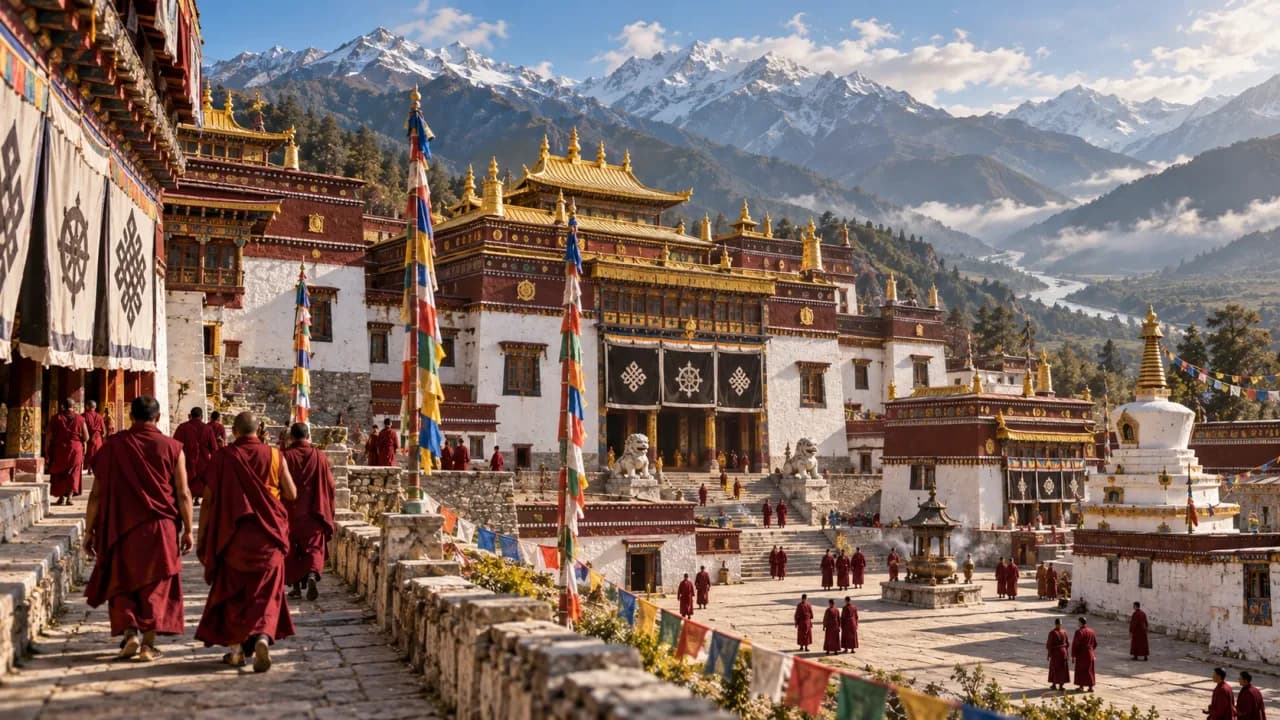
The original Mindrolling Monastery was established in 1676 in Tibet's Drachi Valley by the great Buddhist master Terdag Lingpa. Over time, it became an important centre for the study and practice of the Nyingma tradition. Mindrolling
Then came 1959.
Political upheaval in Tibet forced many Tibetan Buddhist teachers and monks into exile. Among them was the XIth Mindrolling Trichen, Trichen Gyurme Kunzang Wangyal, along with Khochhen Rinpoche and other members of the monastic community. Mindrolling
Eventually, they began rebuilding Mindrolling in India.
The official monastery history gives a particularly precise date: 16 January 1965, when Mindrolling was re-established in Dehradun. Mindrolling
Think about that for a moment.
When you walk into Buddha Temple today, you're not simply entering a tourist attraction built to look Tibetan.
You're entering the continuation of a religious tradition whose original institutional history stretches back to seventeenth-century Tibet.
That made the atmosphere we noticed outside suddenly make much more sense.
We Parked and Walked Down Towards the Temple
After reaching the area, we parked our car and started walking towards the complex.
There is a slope leading down towards the visitor area, and we followed it along with everyone else.
Before going further, we needed to leave our footwear.
There was a shop where visitors' shoes and slippers were being kept. We handed ours over and were charged ₹12 for the service during our visit.
Shoes safely deposited, we were finally ready to head towards the temple.
Except there was now another problem.
We were hungry.
Very hungry.
Remember, the canteen at FRI had been closed.
Then we had spent ages sitting in traffic trying to reach Robber’s Cave.
By the time we reached Buddha Temple, history, spirituality and architecture could wait for a few minutes.
Food couldn't.
So Naturally, We Went to Eat First
There are small shops and places to eat around the visitor area, connected with the Tibetan community surrounding Mindrolling. The wider Mindrolling complex itself has long included community-run facilities such as shops, restaurants and cafés. khenchenrinpoche.org
We found somewhere to sit and ordered food.
And because we were hungry, we made the classic mistake of ordering almost everything at once.
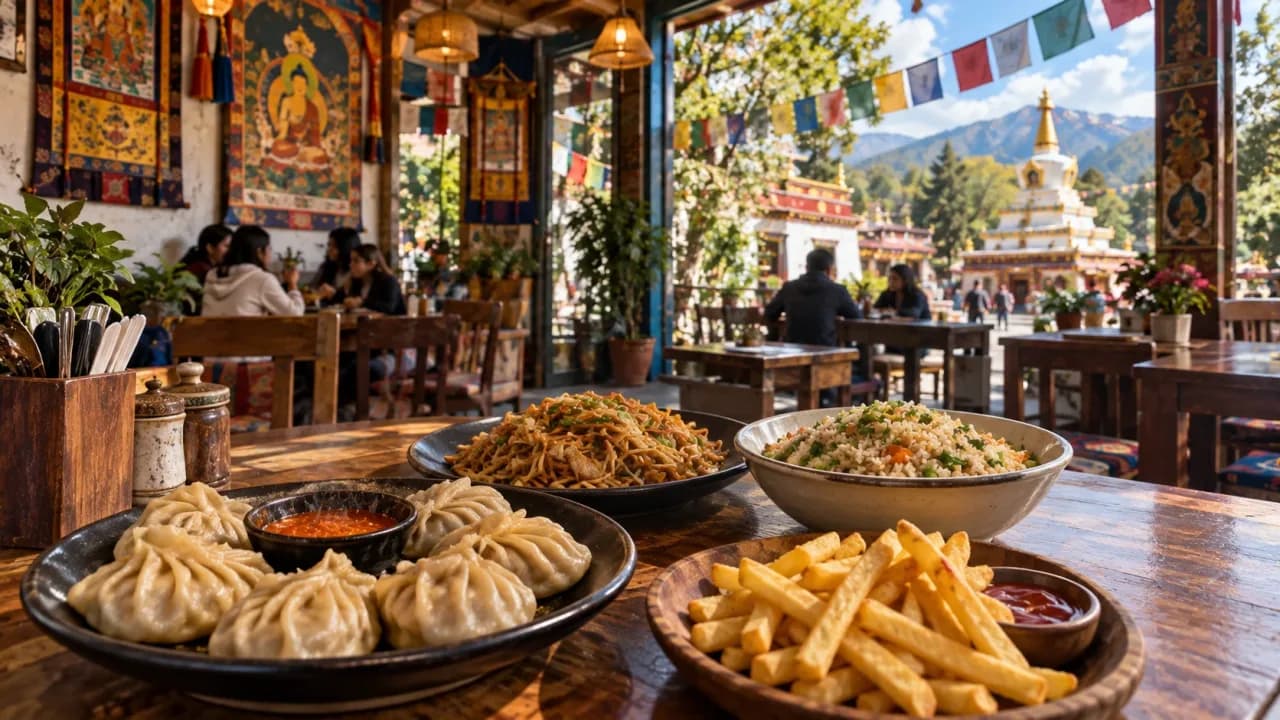
We ordered noodles, fried rice, momos and fries.
It sounded like a wonderful idea when we ordered it.
Then the food arrived.
Let's just say...
It wasn't amazing.
Actually, it wasn't even near amazing.
But there are moments when hunger removes your right to be a food critic.
We had already ordered everything.
We were hungry.
So we ate.
Noodles? Finished.
Fried rice? Finished.
Momos? Finished.
Fries?
At this point, commitment mattered more than taste.
Not every travel story comes with “the best food we have ever eaten.”
Sometimes the review is simply:
We were hungry, so we ate it.
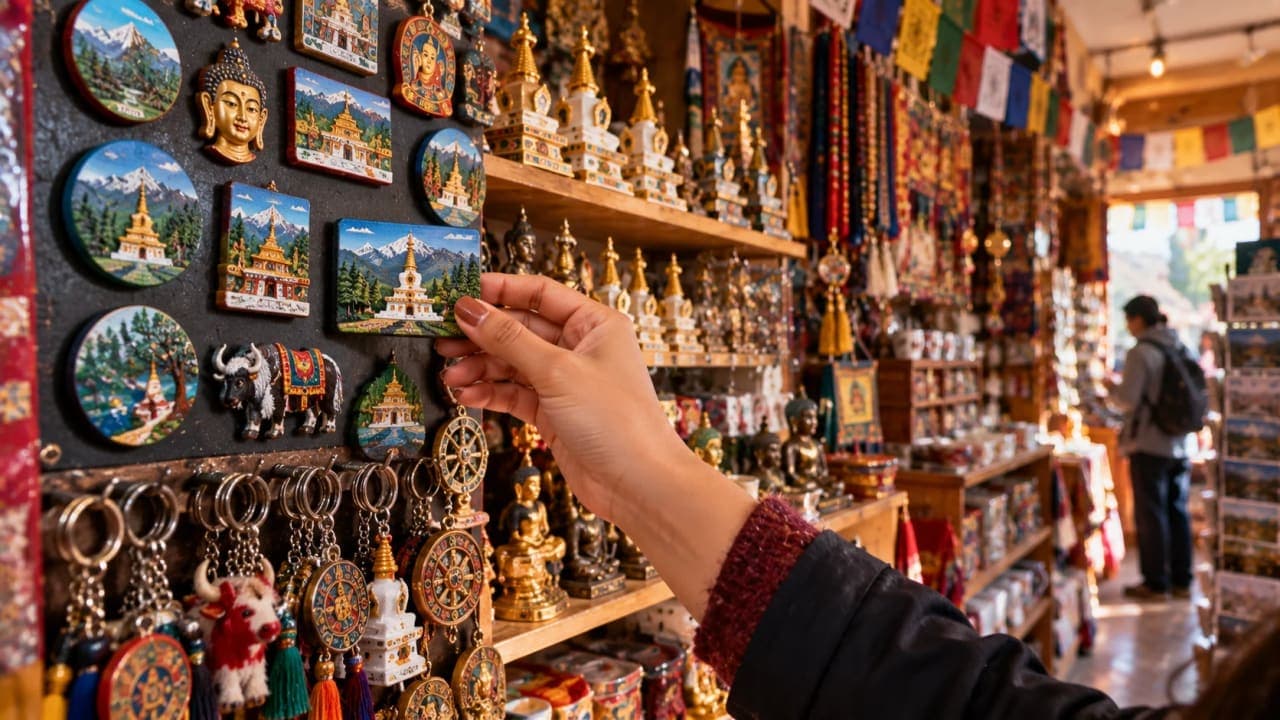
And Then Came Our Travel Tradition: Fridge Magnets
After eating, we started looking around the small shops.
And of course, there was one thing we were going to buy.
A fridge magnet.
This has become something we regularly do while travelling. Whenever possible, we pick up a magnet from the places we visit.
They're small.
They're inexpensive.
They don't occupy half the suitcase.
And once you put them together, the refrigerator slowly turns into a very strange map of your travels.
So Buddha Temple joined the collection.
Food may have disappointed us.
The souvenir mission did not.
How is it so far?
Vote with other readers
We Apparently Explored Buddha Temple Backwards
Most visitors seemed to be moving through the complex in one direction.
We somehow managed to do almost the opposite.
We ate first.
Then shopped.
Then finally headed towards the actual temple.
It wasn't intentional.
That was simply how our visit unfolded.
And perhaps because we had spent so much of the day in cars, crowds and traffic, walking into the quieter temple space felt even more noticeable.
Then Everything Became Quiet
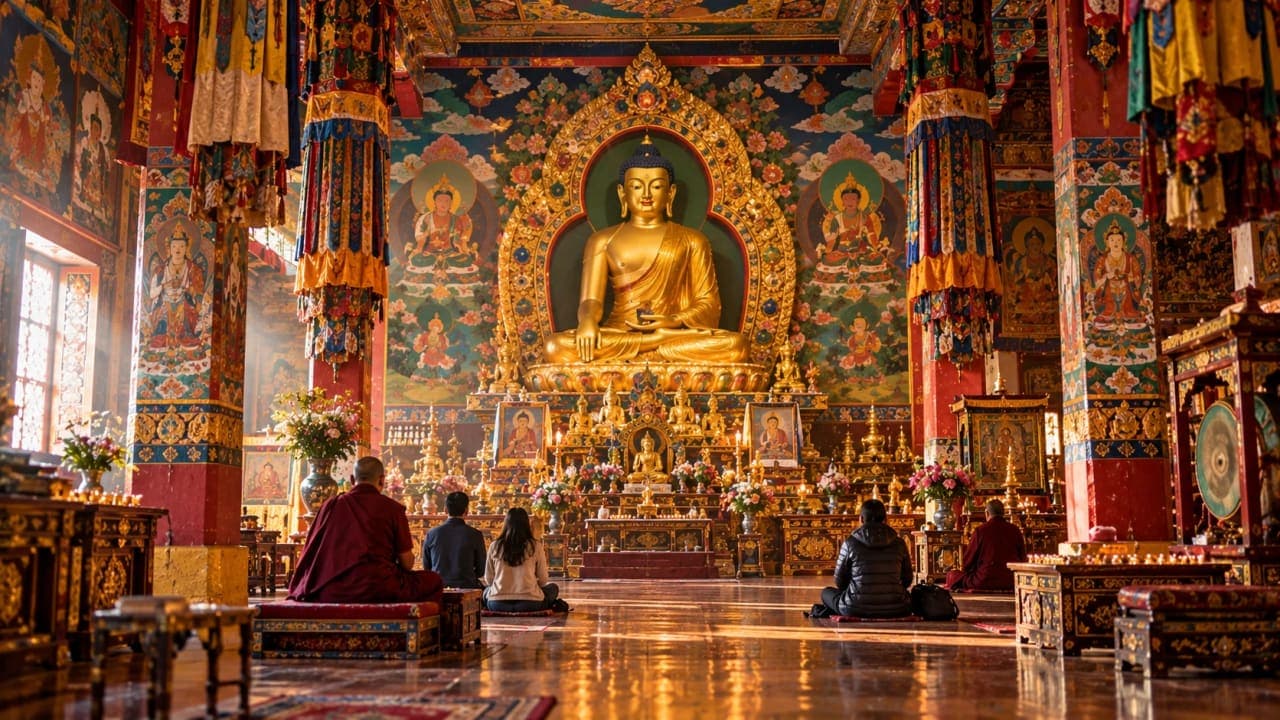
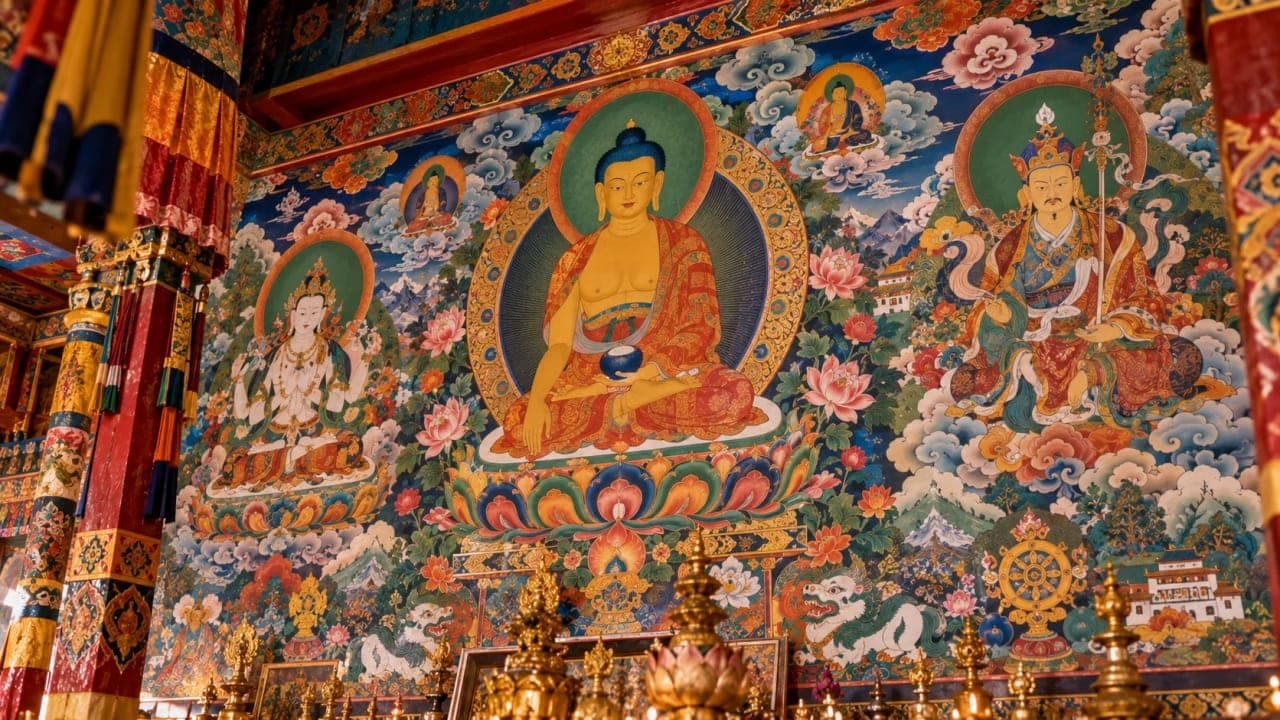
We entered the temple.
And for a while, we simply sat there.
This was probably my favourite part of the entire visit.
Outside there had been roads, shops, people, food, cameras and movement.
Inside, everything slowed down.
The atmosphere was calm.
There was a kind of silence that didn't feel empty.
It felt peaceful.
Mindrolling is not simply a monument. It remains an active centre of Buddhist learning and practice. The monastery includes its main practice centre, Ngedon Gatsal Ling, as well as the Ngagyur Nyingma College, schools, shrine rooms and spaces used by monks for study, ritual and meditation. Mindrolling
Knowing that explains why the place doesn't feel like a set created for tourists.
People actually study and practise here.
We sat quietly for some time.
No rushing.
No checking what attraction was next.
Just sitting.
After the chaos of Robber’s Cave traffic, it felt almost like the day had deliberately sent us somewhere quieter.
The Great Stupa: The Giant Structure Everyone Notices
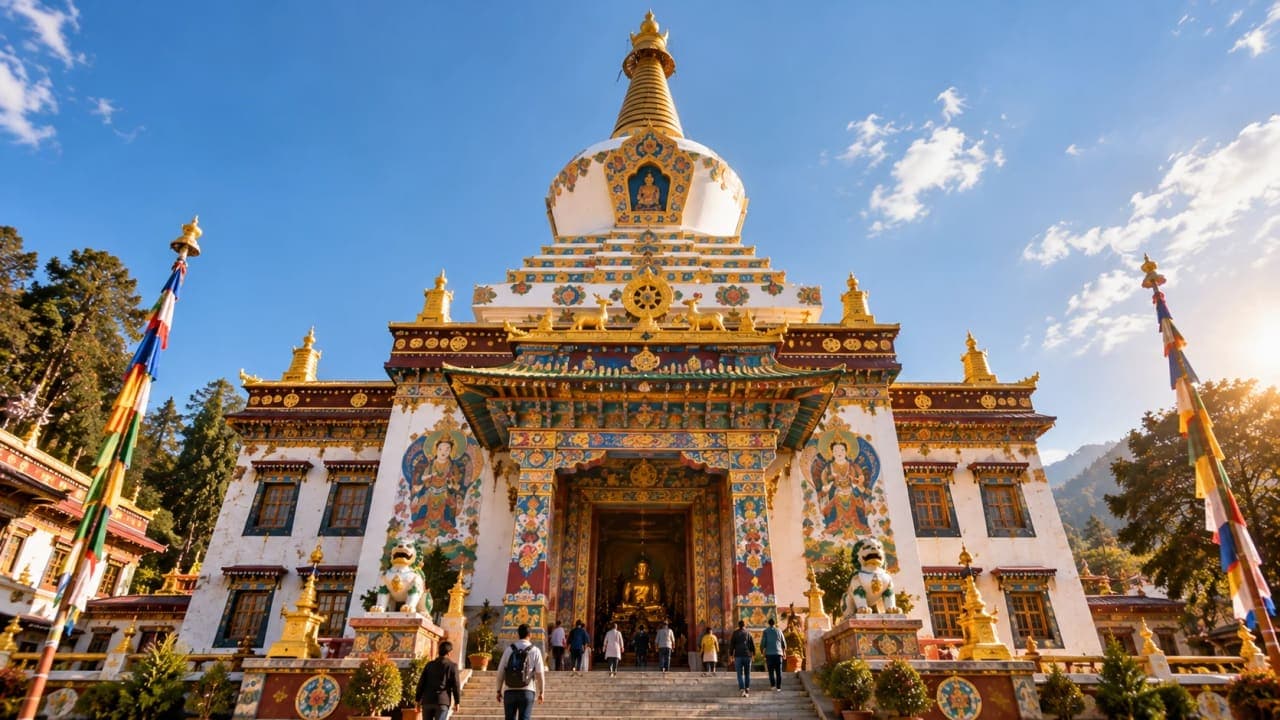
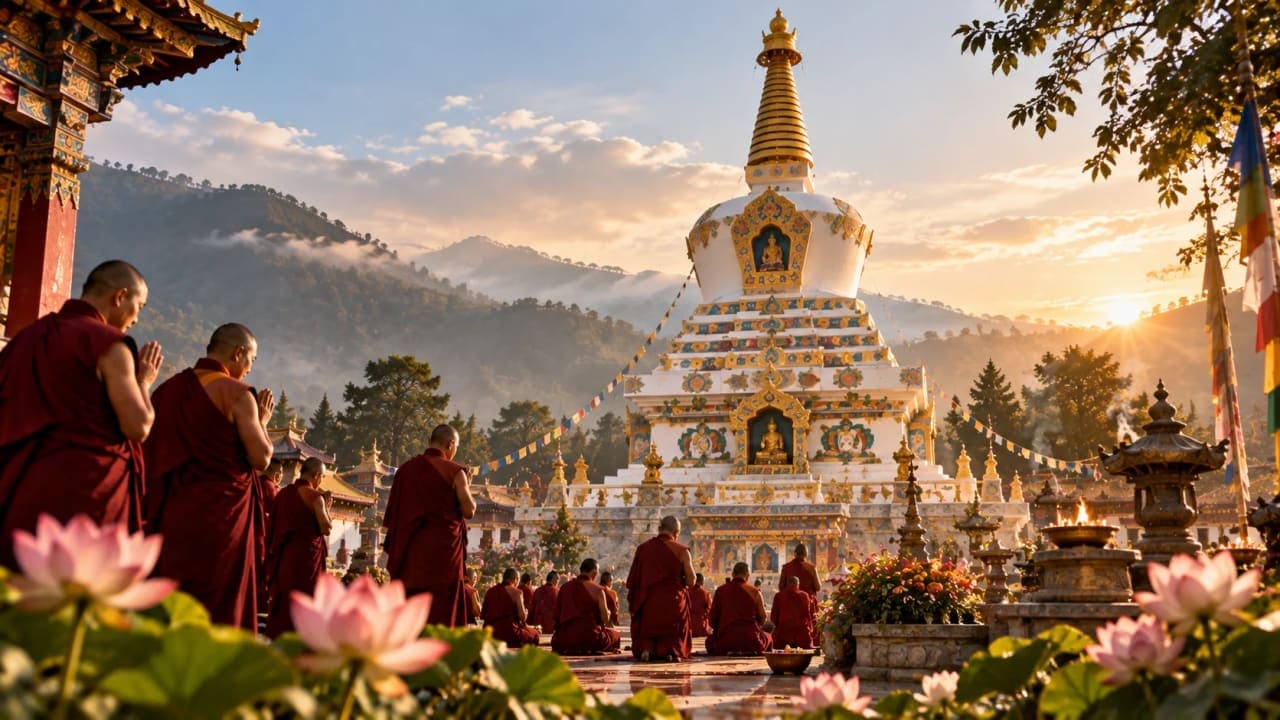
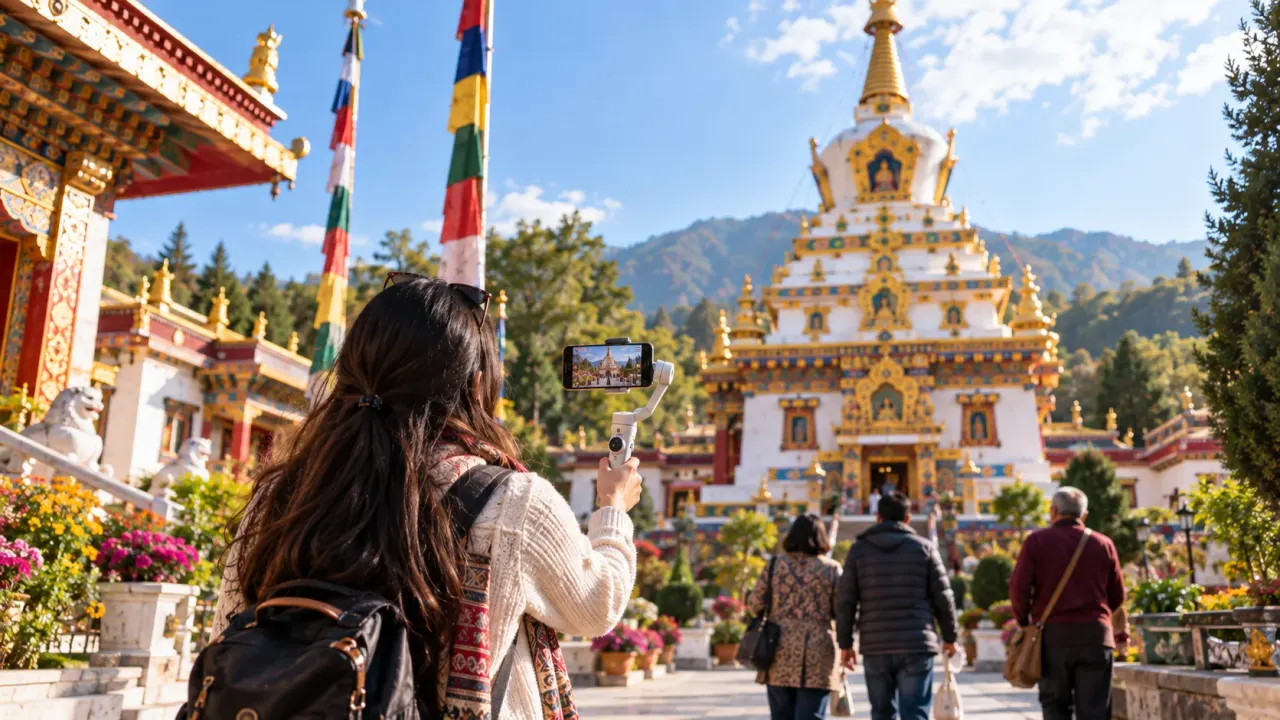
One of Mindrolling's most remarkable structures is the Great Peace Stupa, formally the Great Stupa of Descent from Devaloka.
And here I found an important correction worth making.
Some tourism sources describe the stupa as over 200 feet tall, but Mindrolling's own official website gives its height as 185 feet, with a width of 100 square feet. I would use the monastery's own figure in the article. Mindrolling
The stupa stands within a landscaped garden of approximately two acres and contains several shrine rooms decorated with elaborate Tibetan Buddhist murals. Sacred relics are also housed within it. Mindrolling
Its façade depicts Maitreya, the future Buddha, while another representation shows Buddha Shakyamuni descending the steps. Mindrolling
But this enormous structure is surprisingly recent.
Its foundation was laid on 29 April 2000, construction began later that year, and it was inaugurated on 28 October 2002 in the presence of the 14th Dalai Lama. Mindrolling
The stupa was dedicated to world peace.
And the story behind its construction is unusually moving.
An Earthquake in Taiwan Led to a Stupa in Dehradun
In September 1999, a devastating earthquake struck Taiwan, killing thousands.
According to Mindrolling's official history, the Buddhist teacher Venerable Master Ti Ching asked Mindrolling Trichen what could be done in memory of those who had died and to help pacify natural disasters.
He was advised to construct the largest stupa possible.
Building it in Taiwan wasn't feasible, so Master Ti Ching sponsored its construction at Mindrolling in Dehradun instead. Mindrolling
Suddenly, the Great Stupa isn't simply an impressive structure.
It is also a memorial born from tragedy and dedicated to peace.
That is the kind of detail I wish more visitors knew before taking a photograph and moving on.
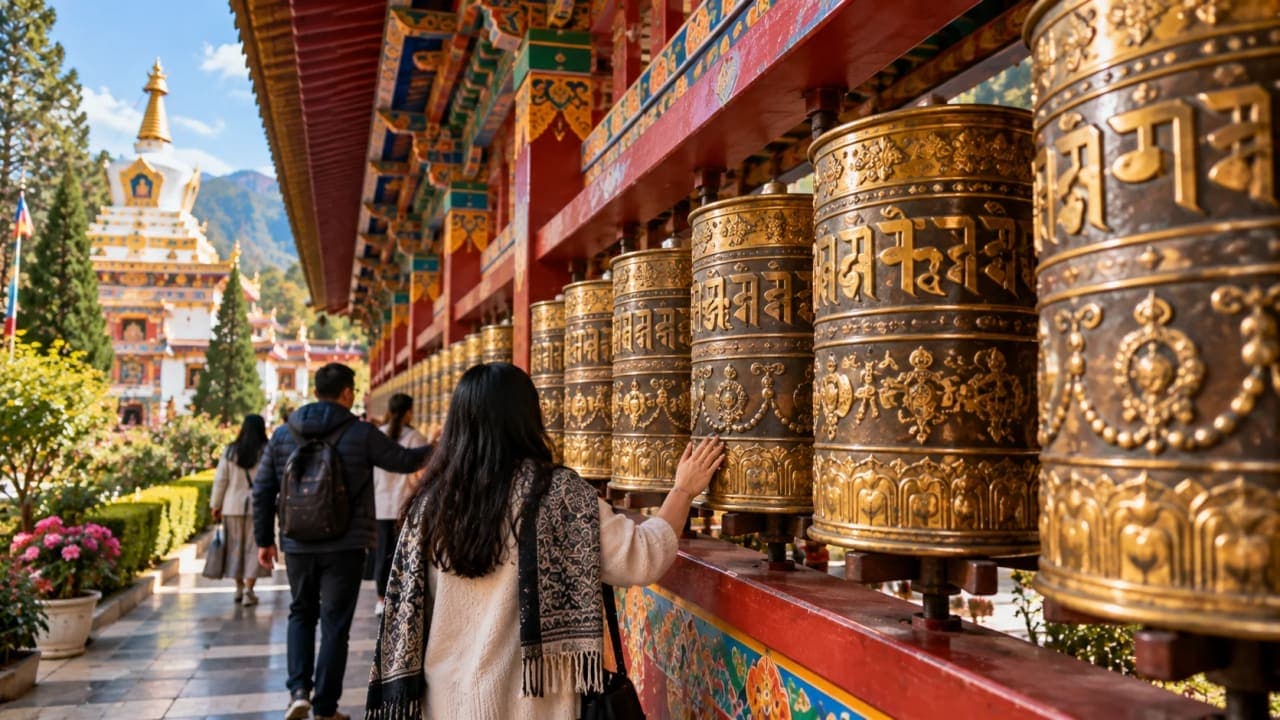
And Then We Found the Prayer Wheels
After spending time around the temple, we came outside again.
We clicked pictures.
Then more pictures.
Then videos.
And yes, the Insta360 Flow 2 Pro came out again.
FRI had been its first proper public outing earlier that day, and now Buddha Temple became another place for us to experiment with it.
The architecture, colourful details and open spaces gave us plenty to record.
While moving around, we learned about another part of the complex:
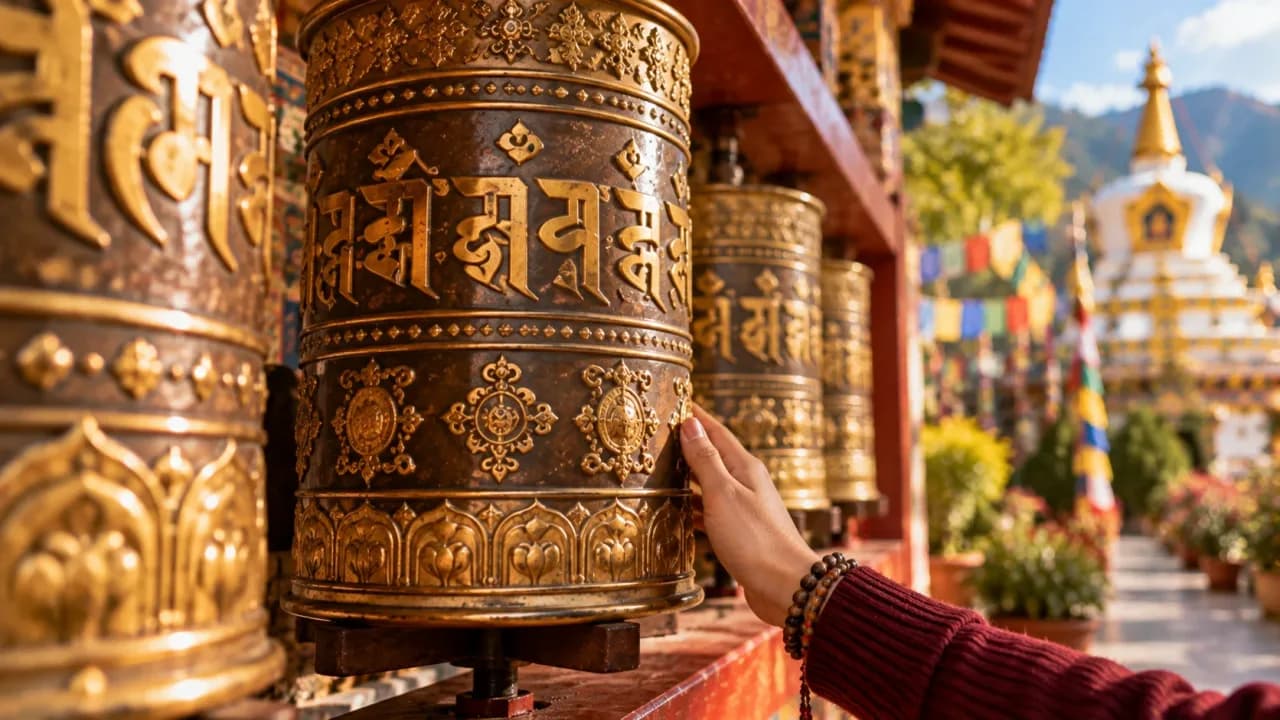
the prayer wheels.
These were the “spin wheels” we had heard about.
And there is an important correction here too.
I couldn't verify that there are exactly 108 prayer wheels at Mindrolling from a reliable official source, so I would not put that number in the article as fact.
Mindrolling's official site says there are several large prayer wheels on the grounds surrounding the Great Stupa for monks and lay practitioners. Mindrolling
The correct name is simply prayer wheels, or mani wheels in common Tibetan Buddhist usage.
But Why Do Buddhists Spin Prayer Wheels?
This is where the practice becomes much more meaningful than simply spinning something because every other visitor is doing it.
A Buddhist prayer wheel contains written prayers or mantras.
According to Mindrolling, the purpose of a prayer wheel is to spread blessings and positive wishes for all beings. Thousands of written prayers can be placed inside, and spinning the wheel symbolically sends those blessings outward. Mindrolling
Practitioners traditionally rotate prayer wheels clockwise.
So we went towards them and started turning the wheels.
At first, naturally, it was fun.
One wheel.
Then another.
And another.
But after learning what they represent, I liked the idea behind them even more.
You aren't simply rotating a decorated cylinder.
The action itself is connected with prayer, merit and wishes for the well-being of others.
That gives such a simple movement a completely different meaning.
Is 108 Important Here?
Although I couldn't confirm that Mindrolling has exactly 108 prayer wheels, 108 certainly appears within the monastery's Buddhist art and traditions.
For example, the Padmasambhava shrine room inside the Great Stupa includes murals connected with the 108 chapters of the Crystal Cave Chronicles, as well as representations of the 108 Mahasiddhas of India and 108 great tertöns. Mindrolling
The number 108 also has deep significance across several Indian religious traditions, including Buddhism.
So the number itself isn't out of place here.
I just wouldn't turn “108 prayer wheels” into a fact unless the monastery itself confirms the count.
The Buddha Temple Is Much More Than One Temple
This is another thing I didn't fully appreciate initially.
Visitors often say:
“Let's go to Buddha Temple.”
But Mindrolling is an entire monastic and educational complex.
There is the main monastery and practice centre.
There is the Great Peace Stupa.
There are multiple shrine rooms.
There is Ngagyur Nyingma College, where monks undertake advanced Buddhist studies.
There are schools for younger monks.
There is a library.
There are retreat facilities.
There are prayer wheels.
There is the Tibetan community prayer hall.
There are gardens, shops and places to eat.
And in 2016, a Padmasambhava statue and shrine rooms were also inaugurated. Mindrolling
Mindrolling's own account says it has grown into one of the largest Buddhist centres in existence today. Mindrolling
So this isn't simply somewhere to spend half an hour taking photographs.
There is an entire living Buddhist community behind what tourists see.
Are There Myths About Buddha Temple?
Unlike Robber’s Cave, Mindrolling isn't really a place built around mysterious local legends.
Its stories are primarily religious traditions and Buddhist teachings, which shouldn't be treated as spooky myths.
One particularly beautiful tradition is represented by the Great Stupa itself.
Its design commemorates the Buddha's descent from Trayastrimsa heaven. Buddhist tradition holds that Buddha travelled there to teach the Dharma to his mother, who had died shortly after giving birth to him and had been reborn in a heavenly realm. He later descended back to the human world at Sankasya. Mindrolling
Whether someone approaches that account through faith, symbolism or Buddhist tradition, it explains why this particular form of stupa was chosen.
And it connects a modern structure in Dehradun with a story preserved for centuries.
From Traffic to Silence
Eventually, we had explored enough.
We had eaten.
Bought our fridge magnet.
Visited the temple.
Sat quietly for a while.
Walked around the campus.
Clicked photographs.
Made videos.
Tested the gimbal some more.
And spun the prayer wheels.
Then it was time to leave.
We collected our footwear and started making our way back towards the car.
And when I think about the entire day, the contrast still makes me smile.
We had started with completely different mountain plans.
Those failed.
So we visited FRI.
Then we tried Robber’s Cave.
That failed too.
We spent around an hour to an hour and a half in traffic and eventually took a U-turn.
At that point, going home would have been the easiest thing to do.
Instead, we said:
Let's go somewhere else.
And that somewhere else became Buddha Temple.
Maybe This Was the Place We Needed That Day
I wouldn't pretend that Buddha Temple had secretly been our destination all along.
It wasn't.
We reached it because another plan failed.
But sometimes that's how travelling works.
You keep adjusting.
You change the route.
You remove one destination.
You add another.
And occasionally, the place you hadn't planned for gives you exactly the kind of experience you needed.
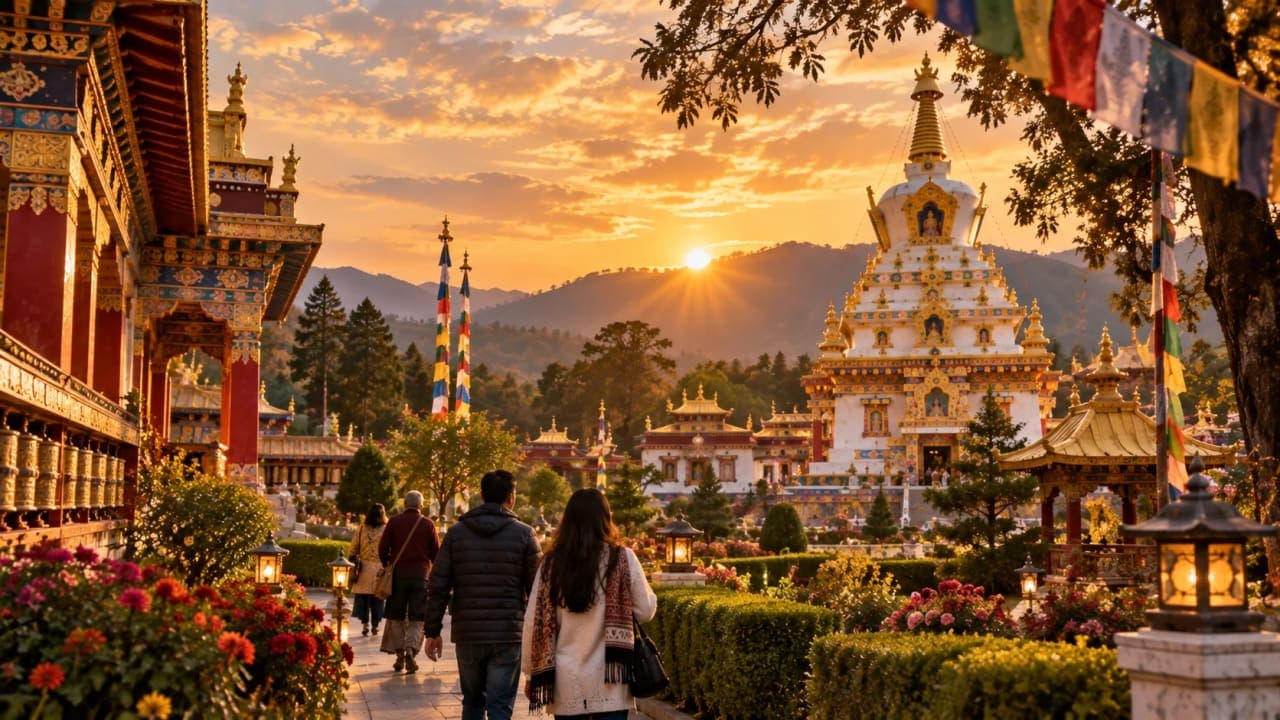
After hours of traffic, Buddha Temple gave us quiet.
After staring at lines of cars, we were suddenly looking at Tibetan Buddhist architecture.
After sitting impatiently inside the car, we sat peacefully inside the temple.
Even the narrow road outside—with its cafés, shops and Tibetan atmosphere—felt like entering a different little corner of Dehradun.
The food?
Let's not romanticise everything.
That can remain exactly where it belongs in the story:
not amazing.
But the place itself?
I loved it.
And perhaps my strongest memory isn't the photographs or even the giant stupa.
It is simply sitting inside for a while and feeling how peaceful everything became.
Our long weekend still hadn't gone according to plan.
But by the time we left Mindrolling and started driving home, I didn't mind quite as much.
Because sometimes a U-turn doesn't mean the trip is over.
Sometimes it simply sends you somewhere better than going home.
Lock in the takeaway
Dehradun Travel Stories
Frequently asked questions
Where is Buddha Temple located in Dehradun?
Buddha Temple, popularly known as Mindrolling Monastery, is located on Buddha Temple Road in Clement Town, Dehradun, Uttarakhand – 248002. It is situated within a Tibetan community area known for its monasteries, cafés and shops.
What is Buddha Temple Dehradun famous for?
Buddha Temple is famous for its Tibetan Buddhist architecture, peaceful surroundings, Great Peace Stupa, beautiful murals, prayer wheels and spiritual atmosphere. It is also an important centre of Buddhist learning and practice.
Is Buddha Temple and Mindrolling Monastery the same place?
Yes. The popular tourist attraction called Buddha Temple in Clement Town is part of the Mindrolling Monastery complex, which belongs to the Nyingma tradition of Tibetan Buddhism.
When was Mindrolling Monastery established in Dehradun?
The original Mindrolling Monastery was founded in Tibet in 1676 by Terdag Lingpa. Following the Tibetan exile, the monastery was re-established in Dehradun on 16 January 1965.
Who founded Mindrolling Monastery in India?
Mindrolling Monastery was re-established in India under the leadership of the XIth Mindrolling Trichen, Trichen Gyurme Kunzang Wangyal, together with Khochhen Rinpoche and members of the Tibetan Buddhist community.
How tall is the Great Peace Stupa at Buddha Temple?
According to Mindrolling Monastery's official information, the Great Peace Stupa stands approximately 185 feet tall. It is one of the complex's most recognisable structures and was inaugurated on 28 October 2002.
Why was the Great Peace Stupa constructed?
The Great Peace Stupa was built as a symbol of world peace. Its construction was inspired partly by the devastating 1999 Taiwan earthquake and was supported by Venerable Master Ti Ching.
What are the spinning wheels at Buddha Temple called?
They are called prayer wheels, also known as mani wheels. They contain written Buddhist mantras or prayers and are traditionally rotated clockwise as an act of spiritual practice.
Are there 108 prayer wheels at Buddha Temple Dehradun?
The monastery confirms that several large prayer wheels are installed around the Great Stupa, but the exact count of 108 could not be verified from its official information. The number 108 is spiritually significant in Buddhism, but it should not be presented as the confirmed number of wheels at this temple.
What does spinning a Buddhist prayer wheel mean?
Spinning a prayer wheel is a traditional Buddhist practice associated with prayers, blessings, compassion and the accumulation of spiritual merit. The wheels usually contain mantras, and clockwise rotation is customary.
What can visitors see inside Buddha Temple Dehradun?
Visitors can explore designated areas around the Great Peace Stupa, Buddhist shrines, colourful murals, prayer wheels, landscaped gardens and surrounding Tibetan shops. Some areas are reserved for monks and religious activities.