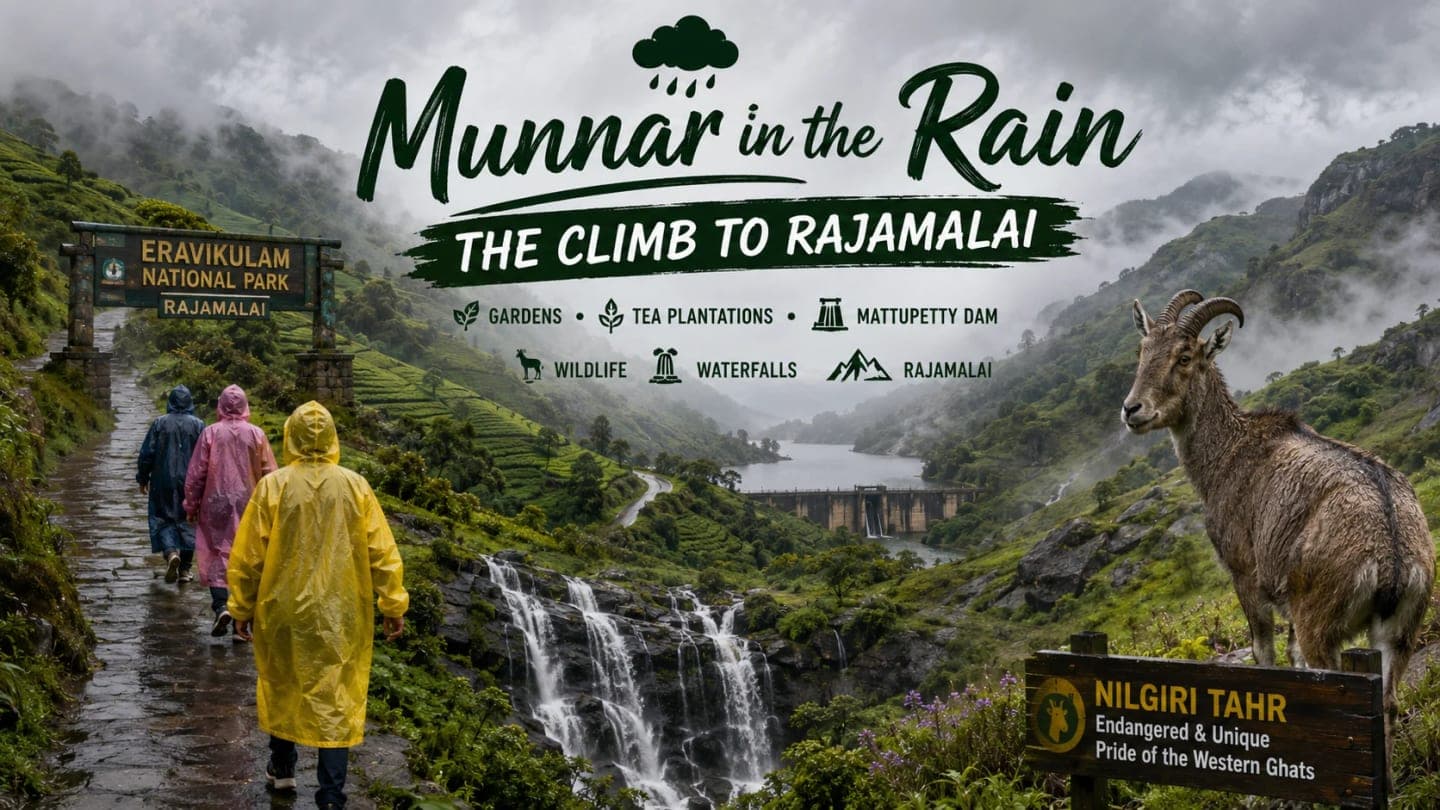
Listen to this article
Checking audio support
Rain, Tea Gardens & Nilgiri Tahrs: Our Most Adventurous Day in Munnar
The next morning began much like every other morning of our Kerala trip. We woke up early, got ready, packed whatever we needed for the day and prepared ourselves for another long round of exploring Munnar.
There was, however, one thing we were particularly looking forward to that morning—
Hot water.
After the previous night's struggle with an immersion rod, we had been told that hot water would be available in the morning. So naturally, we expected a nice warm bath before leaving.
Unfortunately, Munnar had another surprise waiting.
The water was still chilling cold.
We were disappointed, but there wasn't much time to spend complaining about it. Another full day was waiting outside, and we certainly weren't going to sacrifice that because of a cold shower.
Somehow, we got ready, headed for breakfast and prepared to leave.
For the First Time, We Locked Our Hotel Rooms
Unlike the previous days, we weren't checking out that morning.
For the first time during this Kerala trip, we actually locked our hotel rooms and left our luggage behind.
It felt slightly unusual. Until now, practically every morning had meant packing everything, loading the luggage into the cab and moving to another hotel.
Today, we were coming back.
When we stepped outside, our driver bhaiya wasn't quite ready yet. Instead of standing around waiting, we decided to use those few extra minutes wisely.
And by wisely, I obviously mean—
Photos.
The surroundings of the hotel were beautiful, so we started clicking pictures. What could have been boring waiting time turned into another small photography session.
Soon our driver was ready, we settled into the car, and another day in Munnar officially began.
In Munnar, Even the Road Makes You Stop
We hadn't travelled very far before the scenery began distracting us again.
There were places where we simply had to stop.
Misty mountains, tea-covered slopes, narrow roads disappearing into greenery and clouds hanging so low that they almost seemed within reach.
We'd stop.
Get out.
Take photographs.
Record videos.
Get back inside.
Drive a little farther.
And repeat.
By now we'd accepted that travelling through Munnar without stopping for pictures was practically impossible.
Eventually, however, we reached our first proper destination of the day.
Government Botanical Garden, Munnar
Our next stop was the Government Botanical Garden in Munnar.
And guess who arrived with us?
Rain.
Again.
At this point, putting on our raincoats had become almost automatic.
The garden gave us a completely different setting from the wild forests and waterfalls we'd explored earlier. There were landscaped sections, ornamental plants, colourful flowers and beautifully maintained green spaces.
But we weren't going to let the rain turn it into a five-minute visit.
Raincoats on, phones protected as much as possible, and off we went.
We walked around the garden, clicked photographs, recorded videos and even made reels—all while wearing raincoats.
Did the raincoats ruin the carefully planned travel outfits?
Perhaps.
Did we care anymore?
Not really.
Kerala's monsoon had clearly decided our raincoats were going to appear in half our photographs anyway.
So we embraced it.
Finally, the Tea Gardens We'd Been Waiting For
From the botanical garden, we moved towards something no Munnar trip feels complete without—
a tea plantation.
Tea is almost inseparable from Munnar's identity. The hills are covered with carefully maintained rows of tea bushes that create those beautiful green patterns we've all seen in photographs.
But standing inside a plantation feels completely different.
Green hills seemed to continue forever.
Mist moved across the slopes.
Clouds hung above us.
And, naturally, the camera came out immediately.
We clicked plenty of photographs ourselves, but there was also an opportunity to dress in local-style costumes and have pictures taken by a photographer.
Obviously, we couldn't resist.
Costumes selected.
Poses decided.
Photographer ready.
And for a little while, even the rain seemed willing to cooperate.
The pictures turned out beautifully.
Then, almost as if Kerala had realised we'd been dry for too long, the rain returned with greater enthusiasm.
Raincoats On. Tea Garden Exploration Continues.
By the time our photo session ended, the rain had become considerably heavier.
There were two choices.
Run back to the car.
Or put on the raincoats and continue enjoying the tea garden.
By now, you can probably guess which one we chose.
Raincoats went back on.
We continued walking through the plantation, enjoying the weather and taking more pictures. Even our driver bhaiya joined us and helped us capture photographs and videos.
Honestly, the rain added something special to the tea gardens.
The leaves looked brighter.
Clouds descended closer to the hills.
Everything felt fresh.
There was only one disappointment.
No drone shots.
We had really wanted aerial footage of Munnar's tea-covered hills, but the weather simply wasn't suitable.
That thought stayed with us even after leaving the plantation.
Maggie, Corn and Tea in the Rain
After spending so much time outside, everyone was hungry.
Not full-lunch hungry yet.
More like—
"We need something hot right now."
So we stopped for some classic hill-station comfort food.
Maggie. Corn. Tea.
And honestly, there are few combinations better than hot tea and Maggie while standing somewhere cold and rainy in the mountains.
The rain continued.
We ate.
Talked.
Watched the clouds.
And planned our next stop.
But that drone-shot thought still hadn't disappeared.
One Last Attempt at the Drone Shot
While travelling again, we spotted another place where drone photography was available.
For a moment, we became excited.
Maybe we'd finally get those shots.
Unfortunately, the person operating the drone was already busy with several other visitors.
We could have waited.
But waiting meant losing time.
And this day had a lot left in it.
So reluctantly, we abandoned the idea once again.
Sometimes you have to choose between capturing the perfect shot and actually experiencing the destination.
We chose to keep moving.
Mattupetty Dam
Our next stop was Mattupetty Dam, one of Munnar's best-known sightseeing attractions.
Located amid the hills, the reservoir created by the dam is surrounded by greenery and tea plantations, making the area popular for scenic views and boating.
By the time we reached, the monsoon weather had once again turned the landscape into layers of clouds, water and green hills.
We walked around, admired the view and, naturally, clicked more photographs.
By now, however, it was getting well into the afternoon.
Everyone was hungry.
And we still had two major places left on our plan.
This was where the day's itinerary became slightly complicated.
Five Hungry Travellers and One Important Decision
Our driver bhaiya recommended a restaurant nearby, and all five of us—my husband, my mother-in-law, my father-in-law, our driver and I—sat down for lunch.
The food was excellent.
But while the kitchen was preparing it, we realised we had a problem.
We still wanted to visit two places.
One was a museum.
The other was Rajamalai and Eravikulam National Park.
It was already close to 3 PM.
So we started calculating.
Lunch would take roughly another half hour.
Reaching Eravikulam would take additional time.
Then we'd have to leave our car, enter the visitor area, take the park transport uphill and walk farther into Rajamalai.
The park closed in the evening.
The museum also closed around the same time.
Technically, we might have been able to rush through both.
But what's the point of travelling somewhere only to spend the entire visit looking at your watch?
I didn't want that.
If we were going to Eravikulam, I wanted enough time to actually experience it.
How is it so far?
Vote with other readers
So we made our choice.
The museum would have to wait.
Rajamalai won.
And looking back, I'm very glad it did.
Rajamalai and Eravikulam National Park
Before continuing our story, it's worth understanding exactly where we were going.
Eravikulam National Park lies around 13–15 km from Munnar and spreads across approximately 97 square kilometres of Kerala's Western Ghats. Rajamalai is the tourism zone of the park—the section visitors are permitted to explore. (Kerala Tourism)
The landscape is very different from the dense tropical forests people often imagine when hearing the words "national park."
Much of Eravikulam consists of spectacular high-altitude grasslands interspersed with shola forests, with its main plateau sitting around 2,000 metres above sea level. Numerous streams originate in these high ranges and flow through the slopes and valleys. (Kerala Tourism)
And somewhere within those mountains stands a giant.
Anamudi.
At 2,695 metres, Anamudi is the highest peak in South India and lies within Eravikulam National Park. (Kerala Tourism)
But mountains aren't the biggest reason people come here.
That honour belongs to a rather special animal.
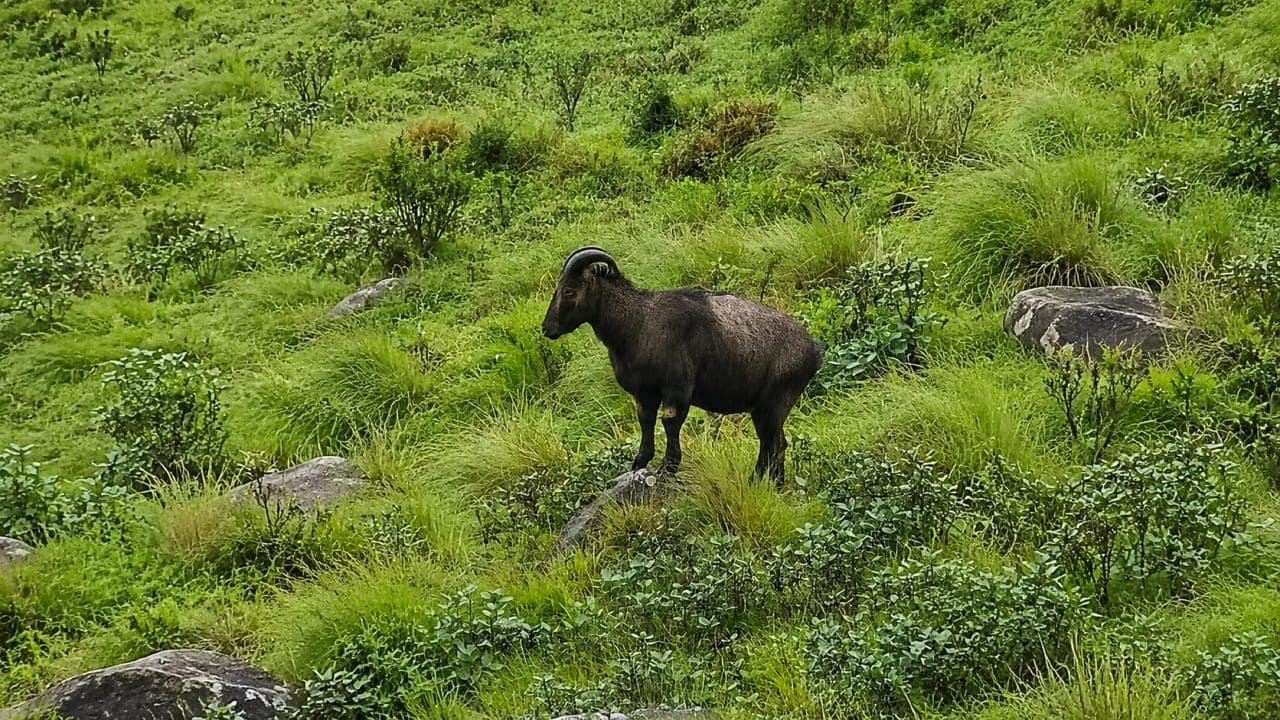
The Nilgiri Tahr
Eravikulam is one of the world's most important habitats for the Nilgiri Tahr, a mountain ungulate endemic to the southern Western Ghats. Kerala Tourism notes that roughly one-third of the world's population is found within this national park. (Kerala Tourism)
They are built perfectly for life on steep mountain slopes.
Strong bodies.
Short coats.
Curved horns.
An extraordinary ability to move across terrain where most of us would probably think twice before taking another step.
Adult males become considerably larger and darker than females and can develop a distinctive silvery patch across their backs, earning mature males the description "saddlebacks." (Kerala Tourism)
The species has faced serious conservation pressures historically, which is one reason Eravikulam became so important.
The area wasn't always a national park.
During the colonial period, the landscape was managed as a game preserve associated with the Kannan Devan Hills plantation region. The Kerala government took control in 1971, declared it a sanctuary in 1975 and upgraded it to Eravikulam National Park in 1978 because of its ecological importance. (Kerala Tourism)
Today, protecting the Nilgiri Tahr remains central to the park's identity.
More Than Just Tahrs
Although the Nilgiri Tahr is the star attraction, Eravikulam supports much more wildlife.
The wider park is home to gaur, sambar deer, Nilgiri langurs, leopards, tigers and wild dogs, along with numerous birds, butterflies and other Western Ghats species. (Kerala Tourism)
Another celebrity here doesn't walk at all.
It blooms.
Neelakurinji.
These famous flowers bloom en masse roughly once every 12 years, covering sections of the hills in extraordinary shades of blue and purple. The next major flowering is expected in 2030. (Kerala Tourism)
So Eravikulam isn't simply a place to spot an animal.
It's an entire high-altitude ecosystem.
And we were about to enter it in the middle of a monsoon.
The Bus Ride That Felt Like Another World
After lunch, we drove towards the national park.
We left our car in the visitor area and walked towards the point where the park buses depart.
Private vehicles aren't simply allowed to drive through the tourism zone. Visitors use authorised transport into Rajamalai and then continue on foot through the permitted visitor area. (Kerala Tourism)
We boarded the bus.
And within minutes...
Everything changed.
The road climbed higher.
Fog thickened around us.
Mist moved between the hills.
Rain covered the windows.
Green mountains appeared for a few seconds and then disappeared behind clouds.
It was beautiful in a way that's difficult to capture properly in photographs.
You could take a hundred pictures and still fail to capture what it felt like sitting inside that bus.
Then came another surprise.
A Waterfall Beside the Bus
As we climbed farther, we suddenly saw water rushing down the mountainside beside the road.
A waterfall.
Because of the monsoon, water seemed to be appearing everywhere in Munnar. Streams crossed slopes that probably looked completely different during drier months.
The driver slowed and stopped briefly so everyone could enjoy the view.
Naturally, phones immediately appeared.
We tried capturing as much as we could before the bus started moving again.
Eravikulam itself contains numerous perennial streams originating in its shola forests, while Lakkom Waterfalls, which originates within the national park landscape, is another well-known waterfall associated with the reserve. (Kerala Tourism)
Whether or not every waterfall we saw had a name didn't really matter at that moment.
It was beautiful.
That was enough.
Wildlife Along the Way
As the bus continued uphill, everyone kept watching outside.
We spotted animals in the distance, including gaur—often casually called Indian bison—and deer-like animals among the grasslands.
Every sighting became a small event inside the bus.
Someone would point.
Everyone else would immediately turn.
Phones would appear.
Then whatever we'd spotted would disappear behind the next bend.
Eventually, the bus reached the visitor drop-off point.
There was a small refreshment area nearby.
From there...
The rest was on foot.
And that's where the real adventure began.
Walking Into Rajamalai
The pathway climbed steadily uphill.
Four of us started together.
My husband.
My mother-in-law.
My father-in-law.
And me.
And, naturally—
it was still raining.
At first, everyone walked together.
Slowly, the climb began becoming more demanding.
The road kept rising.
Rain continued.
Wind picked up.
After some time, my father-in-law decided he'd had enough.
Mission aborted.
He stopped and chose not to continue farther uphill.
The remaining three of us kept going.
Three People, One Mountain and Endless Rain
My husband and I continued walking while my mother-in-law followed at her own pace.
After some time, even she started wondering whether she should turn around.
The climb wasn't impossible, but combined with rain, wind and wet clothes, it certainly wasn't easy.
Still, she continued.
Slowly.
Step by step.
And I'm glad she did.
Because the farther we walked, the more spectacular the landscape became.
Clouds moved across the mountains.
Waterfalls appeared in the distance.
Entire slopes disappeared behind mist.
Raincoats flapped in the wind.
We stopped frequently—not only because we were tired, but because practically every direction deserved a photograph.
Waterfalls Everywhere
At one point, we could see multiple waterfalls streaming down distant mountains.
Thin white lines cut through the dark green slopes.
Then, farther along the path, we encountered another waterfall much closer to us, rushing down beside the road.
It looked wild.
Powerful.
And slightly intimidating.
The monsoon had transformed the mountains into an enormous water system.
But then something else caught our attention.
Something moving on the hillside.
We looked carefully.
And there they were.
We Found the Nilgiri Tahrs
After walking through rain and wind, we finally saw the animals we'd come hoping to find.
Nilgiri Tahrs.
There was a fully grown animal.
And nearby...
Several younger ones.
They weren't right beside us, but they were visible enough for us to watch and photograph.
For a few moments, everything else disappeared.
The rain didn't matter.
The cold didn't matter.
The climb didn't matter.
We had actually found them.
Seeing an endangered animal inside its natural mountain habitat feels very different from seeing one behind a barrier.
These hills belonged to them.
We were simply visitors.
Rajamalai is particularly known as the visitor zone where tourists have a good chance of seeing Nilgiri Tahrs, although—as with all wildlife—sightings can never be guaranteed. (Kerala Tourism)
That sighting alone made the entire climb worthwhile.
Then the Weather Got Even Wilder
We continued walking.
By now, the rain was getting stronger.
So was the wind.
Walking uphill in a raincoat sounds fun when you're describing it later.
While you're actually doing it?
Slightly different story.
The raincoat sticks to you.
Wind pushes against it.
Water finds mysterious ways of entering places that are supposedly waterproof.
The road feels longer.
And yet...
We were having fun.
It was approaching 5:30 PM, and we knew we couldn't continue indefinitely.
So after enjoying the landscape, taking more photographs and recording enough videos to keep our phone galleries busy for months, we finally decided to turn around.
The Walk Back
Going downhill was easier.
Or at least that's what our legs wanted us to believe.
The rain continued while we made our way back towards the bus point.
Eventually, we reached the refreshment area.
And after everything we'd just done, one thing sounded perfect.
Coffee.
Hot coffee.
In cold, rainy Munnar.
What could possibly be better?
We walked towards the counter.
And discovered...
The coffee was finished.
Of course it was.
Sometimes travel has excellent comic timing.
So instead of coffee, we waited for the bus.
When it finally arrived, we climbed inside, found our seats and began the beautiful journey downhill.
Nobody spoke quite as much this time.
We were tired.
But very happy.
Tea, Chocolates and One Last Stop
Once we reached the lower visitor area, we walked back towards our cab.
Before leaving, however, there was still some shopping to do.
We stopped at the shops and picked up a few things.
Tea.
Tea leaves.
Chocolate.
Little pieces of Munnar that could travel home with us.
Then we finally climbed into the car.
This time, nobody asked for another sightseeing stop.
Our hotel sounded very attractive.
And Guess What Was Waiting at the Hotel?
We reached the hotel tired, wet and ready for a warm bath.
If you've read the previous chapter, you probably already know what's coming.
Hot water?
No.
The same problem had returned.
Once again, the immersion rod made its grand entrance.
Water had to be collected.
Brought into the room.
Heated.
Taken back into the bathroom.
And then finally—
A bath.
At this point, the immersion rod had practically become another member of our Kerala travel group.
Not a particularly welcome one.
But definitely a memorable one.
After freshening up, we ordered dinner.
Food arrived.
We ate.
And then nobody needed convincing to go to bed.
Lock in the takeaway
Kerala Travel Stories
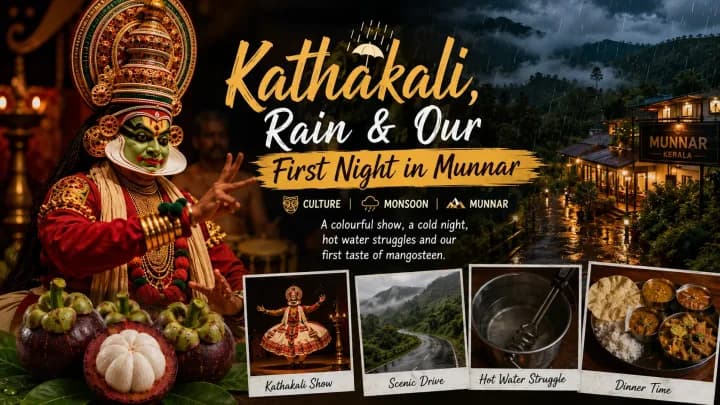
Frequently asked questions
What is Eravikulam National Park?
Eravikulam National Park is a protected area in Kerala's Western Ghats near Munnar. It is famous for its high-altitude grasslands, shola forests, mountain scenery and, most importantly, its population of the endangered Nilgiri tahr.
Is Rajamalai the same as Eravikulam National Park?
Rajamalai is the main tourism zone of Eravikulam National Park and the area most visitors experience when they say they are visiting the park from Munnar.
What is Rajamalai famous for?
Rajamalai is famous for its mist-covered mountains, rolling grasslands, waterfalls, panoramic views and opportunities to spot Nilgiri tahr in their natural habitat.
What is a Nilgiri tahr?
The Nilgiri tahr (Nilgiritragus hylocrius) is an endangered mountain ungulate native to the Western Ghats of southern India. It is especially associated with the high-altitude grasslands of Kerala and Tamil Nadu.
Can you see Nilgiri tahr at Eravikulam National Park?
Yes. Eravikulam protects one of the most important populations of Nilgiri tahr. Sightings cannot be guaranteed because they are wild animals, but Rajamalai is one of the best-known places to observe them.
How do you visit Rajamalai in Eravikulam National Park?
Visitors generally reach the park's designated visitor area and use the authorised park bus for the uphill journey. From the drop-off point, exploration continues on foot along the permitted tourism route; private vehicles aren't allowed into the main visitor zone.
Is the walk at Rajamalai difficult?
The permitted walking section is uphill and can feel tiring, particularly for older visitors or during rain. Wet paths, wind and Munnar's high-altitude weather can make the walk more demanding, so comfortable footwear and rain protection are useful.
Is Eravikulam National Park worth visiting during the monsoon?
The mist, rain-fed waterfalls and intensely green mountains can make the landscape spectacular. However, heavy rain and wind can also make walking more difficult, so visitors should follow current park and weather advisories.
What else did you visit before Eravikulam National Park?
Earlier that day, we explored Munnar's botanical garden, spent time among its tea plantations and stopped at Mattupetty Dam before deciding to dedicate the rest of the afternoon to Rajamalai and Eravikulam National Park.
Was the climb to see the Nilgiri tahr worth it?
For us, absolutely. Walking uphill through increasingly heavy rain and wind wasn't easy, but seeing waterfalls cascading through the mountains and finally spotting an adult Nilgiri tahr with several young ones made the effort worthwhile.