

Listen to this article
Checking audio support
Temples That Defy Logic: Mysteries Hidden in Stone – Part 3
Some mysteries hide in dark chambers.
Some survive as stories whispered from one generation to another.
And then there are mysteries that stand openly in front of us—in stone pillars, disappearing shrines, strange rituals and entire mountains that somehow became temples.
In the first two parts of this series, we travelled through ten extraordinary temples of India. We encountered flames that have burned for generations, pillars that seem to hang above the ground, unopened chambers, unusual natural phenomena, sacred crocodiles and architectural puzzles that continue to fascinate visitors.
But India has far more stories hidden inside its temples.
And perhaps the strangest thing about some of them is that the mystery isn't hidden at all.
You can see it.
You can hear it.
Sometimes, you can even watch it disappear before your eyes.
So our journey isn't over yet.
Here are five more Indian temples where faith, engineering, nature and legend come together in ways that can make you wonder:
How did they do this?
And sometimes—
Why does this happen at all?
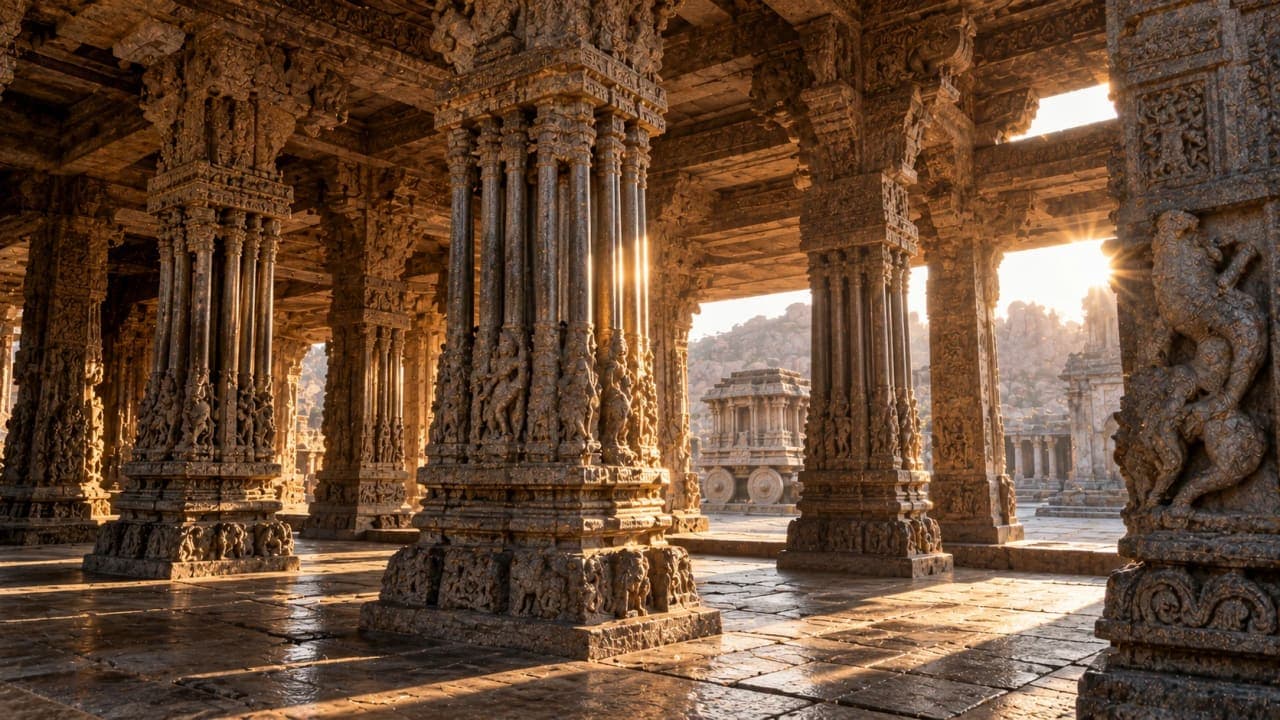
1. Vittala Temple, Hampi – When Stone Begins to Sing
Location: Hampi, Karnataka
Imagine entering a centuries-old temple hall.
There are no speakers.
No hidden instruments.
No musicians waiting behind the pillars.
There is only stone.
And yet, certain pillars have become famous for producing ringing tones when struck.
Welcome to the Vittala Temple of Hampi, one of the architectural masterpieces associated with the Vijayanagara Empire.
The temple complex is famous for many things—the magnificent stone chariot, elaborate carvings, pillared halls and the remains of one of medieval India's greatest cities.
But one feature has fascinated generations of visitors more than almost anything else.
Its so-called musical pillars.
The Orchestra Carved in Stone
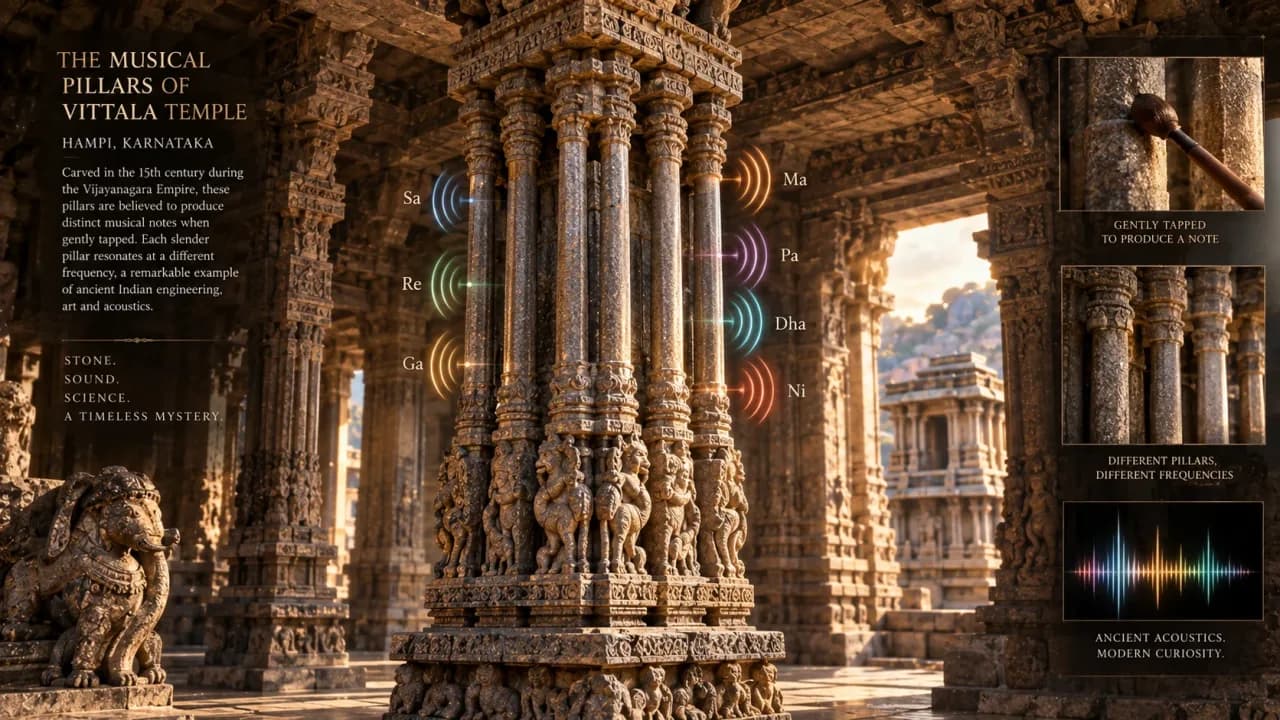
The temple's great hall contains massive composite pillars surrounded by groups of slender stone columns.
Traditionally, these are known as the musical pillars or SaReGaMa pillars.
When some of these stone elements are gently struck, they can produce resonant sounds of different tonal qualities.
Think about that for a moment.
These aren't metal bells.
They aren't hollow wooden instruments.
They are carved stone.
Yet the architecture itself behaves almost like an instrument.
How?
Is There Something Hidden Inside?
Naturally, stories grew around the pillars.
One popular tale says that colonial-era investigators were so puzzled by the phenomenon that some pillars were damaged or cut in an attempt to discover whether something was hidden inside them.
The story is often repeated in descriptions of Hampi, although the dramatic details surrounding such investigations should be treated cautiously unless supported by archaeological documentation.
What is not folklore, however, is the unusual acoustic behaviour of the stone pillars themselves.
Their dimensions, shape, density and arrangement affect the way vibrations travel through them.
In other words, the mystery does not necessarily require a secret metallic object hidden inside the stone.
The stone itself can vibrate.
And Vijayanagara craftsmen appear to have understood stone, proportion and resonance at an extraordinary level.
But Did They Intentionally Tune Them?
This is where the story becomes even more interesting.
The pillars exist within a temple hall decorated with sculptures associated with music, dance and performance.
That makes it tempting to imagine an ancient hall where architecture and music were deliberately connected.
But modern descriptions sometimes exaggerate the phenomenon by claiming that every pillar reproduces an exact modern musical note or a specific instrument.
The reality is more nuanced.
The pillars produce resonant tones.
How precisely those tones correspond to historical musical scales, and exactly how intentionally ancient builders engineered each acoustic response, is a more complicated question.
Perhaps the greatest mystery isn't that stone can make a sound.
Physics can explain vibration.
The remarkable question is:
How deeply did the craftsmen who carved these pillars understand the behaviour of stone?
Centuries later, the pillars still leave visitors listening to architecture rather than merely looking at it.
And perhaps that was always the point.
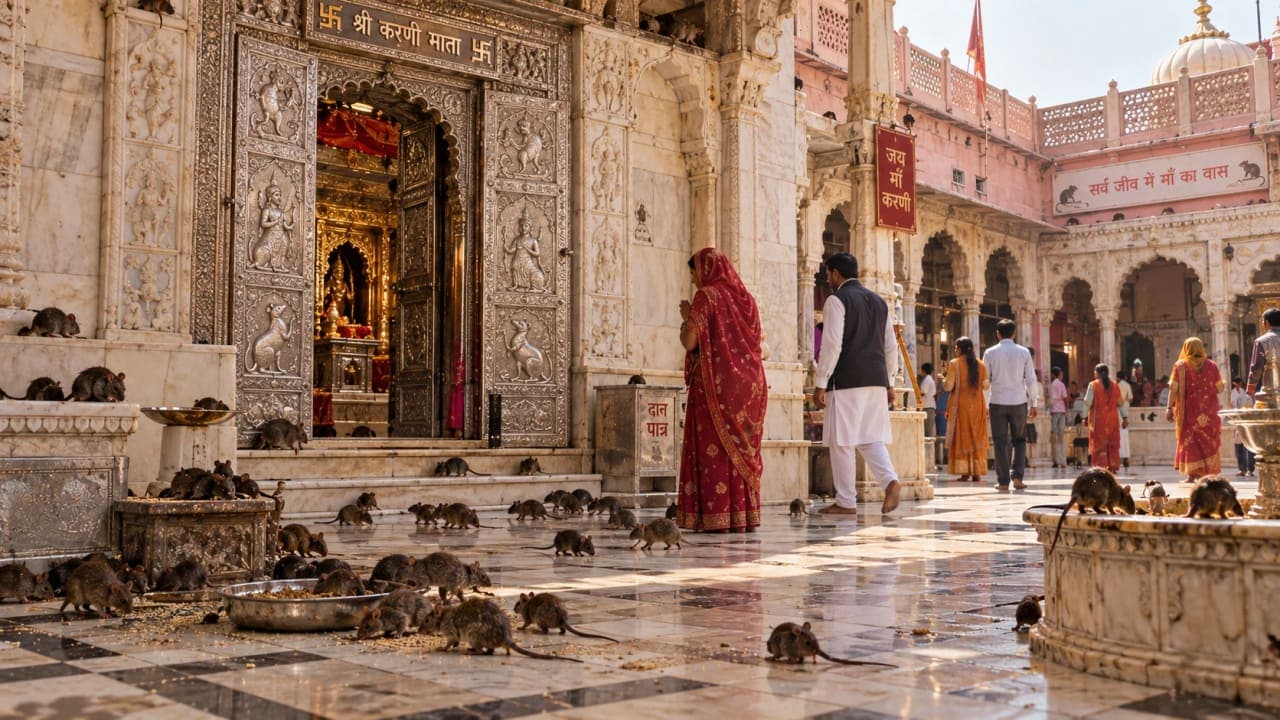
2. Karni Mata Temple – The Temple Where Thousands of Rats Are Sacred
Location: Deshnok, near Bikaner, Rajasthan
Most temples ask visitors to watch where they step.
At Karni Mata Temple, that advice takes on an entirely different meaning.
Walk into the temple complex at Deshnok and you may find tiny creatures rushing between your feet.
One crosses the courtyard.
Another appears near an offering.
Then another.
And another.
Soon you realise they are everywhere.
Rats.
Thousands of them.
But here, they aren't treated as pests.
They are protected.
Fed.
And considered sacred.
Who Was Karni Mata?
Karni Mata occupies an important place in the religious traditions of Rajasthan.
Tradition places her life roughly between the fourteenth and sixteenth centuries, and she became deeply revered among communities of the region.
The present temple is known for its marble architecture, silver doors and, most famously, its resident rats.
Locally, these rats are often called kabas.
Rajasthan Tourism describes the temple as being home to around 20,000 rats.
But why would thousands of rats live inside a temple?
That answer takes us from history into legend.
The Story of Death That Was Refused
One of the best-known traditions associated with Karni Mata tells of the death of a boy connected with her family or community.
According to versions of the legend, Karni Mata appealed to Yama, the god associated with death, asking that the boy be restored.
The story develops differently depending on the tradition being told, but its central idea is extraordinary.
Those under Karni Mata's protection would not pass through the ordinary cycle controlled by Yama.
Instead, members of her community were believed to return in another form before eventually being reborn as humans.
The rats of the temple consequently became connected with this sacred cycle.
To devotees, therefore, these aren't simply rodents living conveniently inside an old building.
Their presence carries religious meaning.
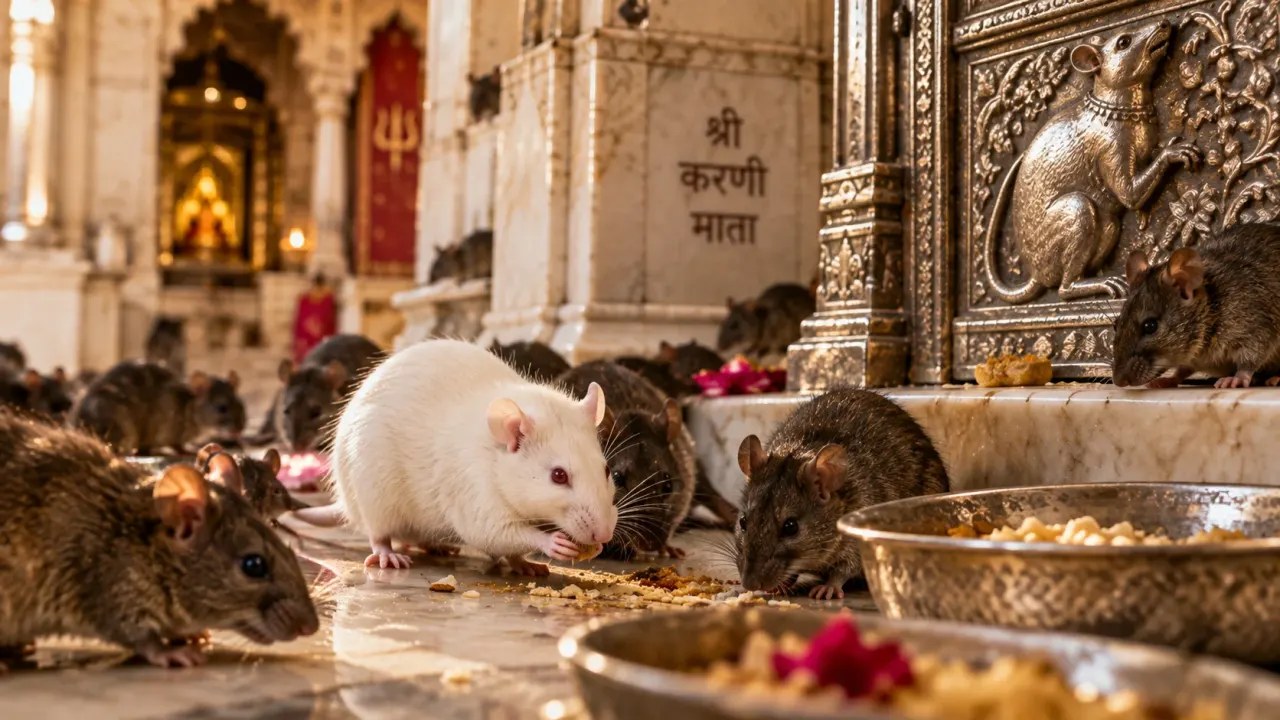
And Then There Are the White Rats
Among thousands of dark-coloured rats, visitors sometimes search for something much rarer.
A white rat.
Seeing one is traditionally regarded as especially auspicious.
That rarity only adds another layer to the experience.
Imagine standing in a marble temple while thousands of tiny animals move freely around you, devotees carefully avoid harming them, and everyone nearby suddenly becomes excited because a white rat has appeared.
Outside this temple, the scene might be considered chaotic.
Inside it, the same scene becomes part of worship.
Mystery or Tradition?
There is no biological mystery in rats forming a large colony where they are protected and regularly provided food, water and shelter.
The remarkable part is cultural.
For generations, humans and these animals have occupied the same sacred space under a completely different set of rules from those normally governing the relationship between people and rats.
Perhaps Karni Mata Temple doesn't defy biology.
Instead, it challenges our expectations.
Because sometimes what appears strange from outside a tradition has an entirely different meaning from within it.
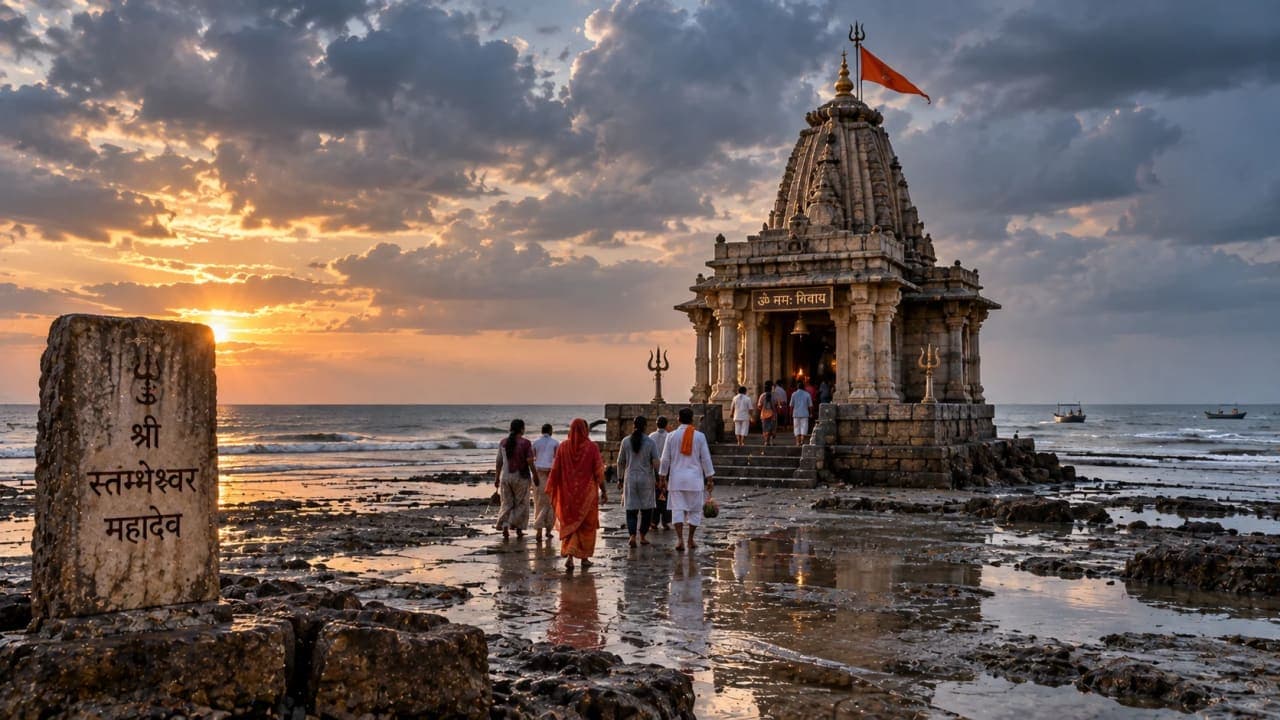
3. Stambheshwar Mahadev – The Shiva Temple the Sea Makes Disappear
Location: Kavi Kamboi, Gujarat
You arrive at a Shiva temple.
You pray.
You walk away.
And sometime later, the temple begins to disappear.
Not behind fog.
Not because of an illusion.
Water slowly moves across the land.
It rises around the shrine.
Higher.
And higher.
Until the sea takes over.
Hours later, the water retreats.
How is it so far?
Vote with other readers
And the temple returns.
This is Stambheshwar Mahadev Temple, one of Gujarat's most unusual Shiva shrines.
A Temple Governed by the Tide
The temple stands at Kavi Kamboi near the Gulf of Khambhat.
Its extraordinary appearance and disappearance is connected to the tidal cycle.
During low tide, devotees can approach the shrine.
As high tide arrives, water rises around it and the shrine becomes submerged.
When the tide recedes, the path opens again.
It looks almost supernatural when seen without context.
But unlike many mysteries in this series, the mechanism behind this one is not mysterious at all.
It is nature.
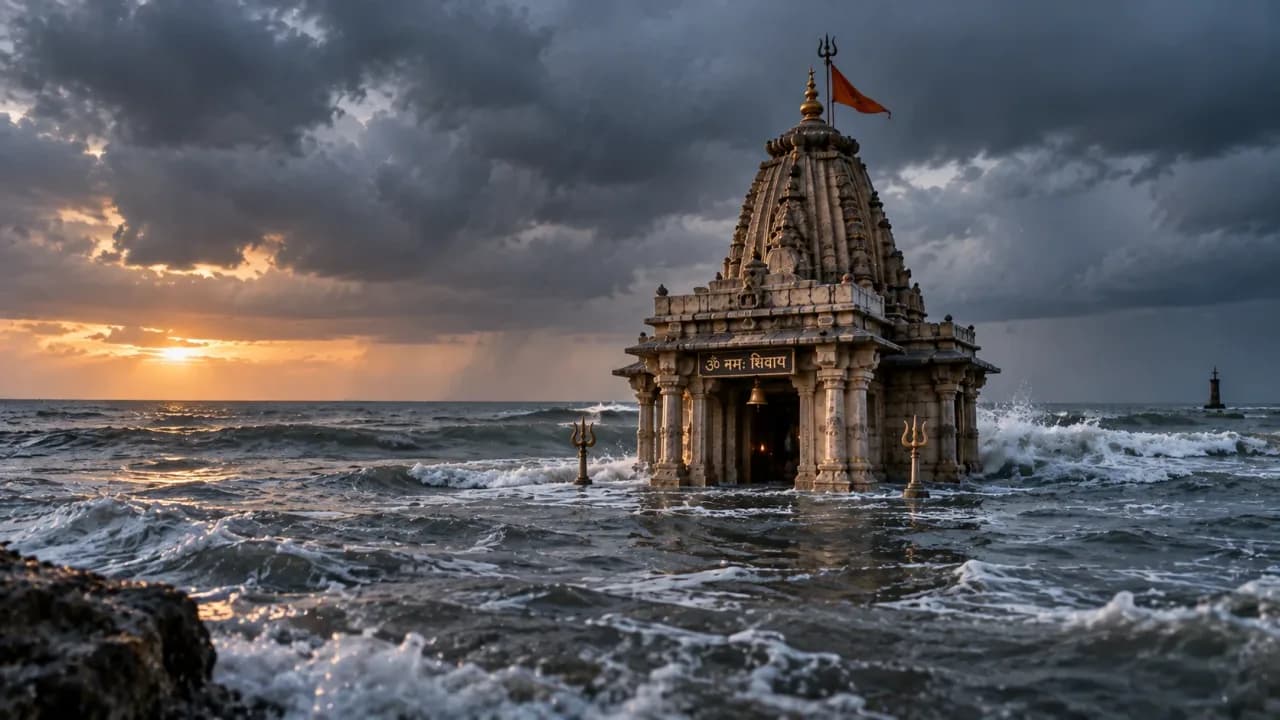
Then Why Build a Temple Here?
That question leads us into mythology.
According to temple tradition, the shrine is associated with Kartikeya, the son of Shiva.
A traditional account links the establishment of the Shiva lingam here with Kartikeya's killing of the demon Tarakasura.
Versions of the story describe Kartikeya seeking spiritual relief after killing Tarakasura, who despite being an adversary was also a devotee of Shiva.
The Shiva lingam therefore becomes connected with repentance, devotion and reconciliation.
Whether the shrine's earliest physical history can be traced as far back as the mythological narrative is another question entirely.
Mythology provides sacred meaning.
Archaeology requires material evidence.
The two should not automatically be treated as the same thing.
The Sea Performs the Ritual
And yet, knowing the scientific explanation doesn't make the sight less beautiful.
In fact, perhaps it makes it more extraordinary.
The Moon's gravitational influence helps drive Earth's tides.
The geography of the Gulf influences how dramatically those tides appear locally.
And a temple happens to stand precisely where that movement becomes part of its daily existence.
For devotees, the recurring submergence can take on a spiritual character—as though nature itself is performing an abhishek of Shiva.
Science explains how the water rises.
Faith explains what that moment means.
Neither needs to erase the other.
But there is one very practical lesson hidden inside this mystery.
If you ever visit Stambheshwar Mahadev, the tide isn't merely something interesting to photograph.
It determines when the shrine can safely be approached.
Here, nature decides the timetable.
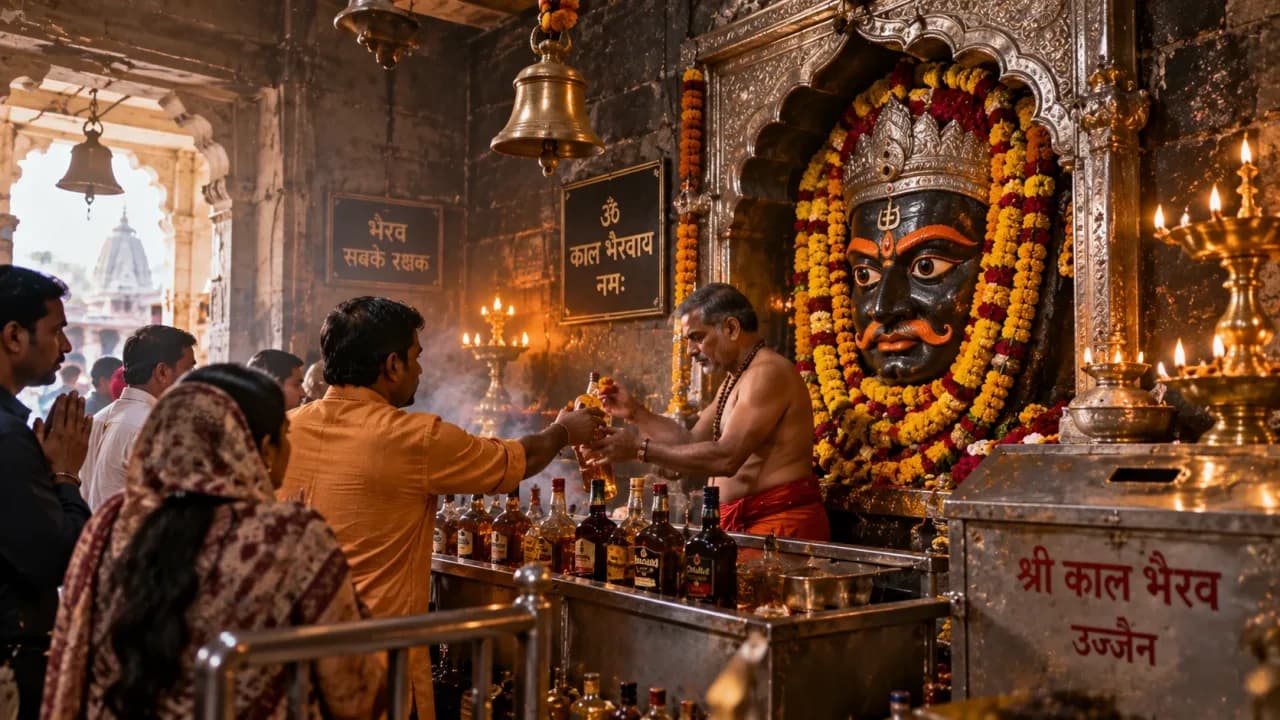
4. Kal Bhairav Temple – Where Liquor Becomes an Offering
Location: Ujjain, Madhya Pradesh
Flowers.
Incense.
Coconut.
Sweets.
These are offerings you might expect to see outside an Indian temple.
But walk toward the Kal Bhairav Temple in Ujjain, and you may notice something else being sold alongside ordinary puja items.
Liquor.
Not secretly.
Not as an act of rebellion.
As an offering.
And what happens during the ritual has fascinated visitors for years.
The Fierce Form of Shiva
Kal Bhairav is a fierce manifestation associated with Shiva.
Bhairava worship has long-standing connections with particular Shaiva traditions, including traditions historically associated with ascetic and Tantric practices.
Ujjain itself is one of India's most important sacred cities.
The official Ujjain district description notes that the temple stands near the Shipra and that Kal Bhairav worship forms part of the city's Shaivite tradition.
It also records something that surprises many first-time visitors:
liquor continues to be offered to the deity as part of the ritual.
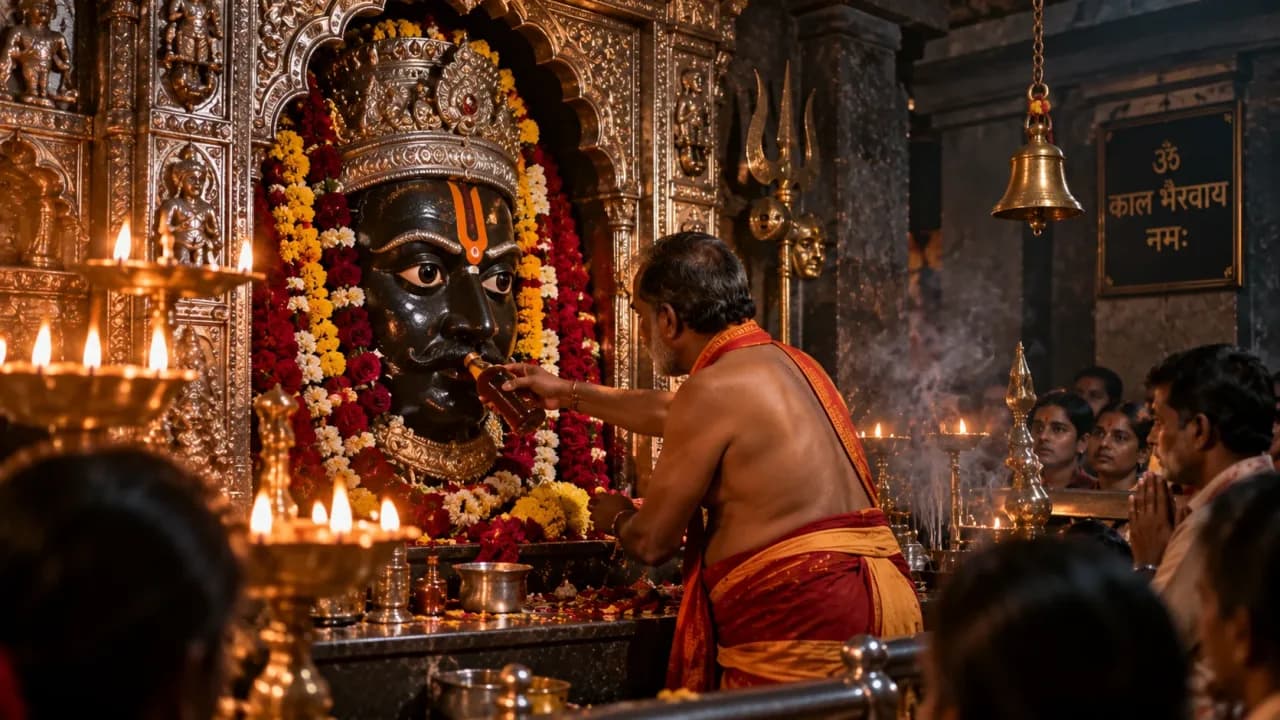
Where Does the Liquor Go?
During the ritual, the priest places liquor near the mouth of the idol.
Visitors describe watching the liquid level fall as it is offered.
And that has produced the obvious question:
Where does it go?
For devotees, there may be no mystery requiring investigation.
The deity accepts the offering.
For a curious observer, however, the disappearing liquid immediately invites physical explanations.
Could the idol contain an internal cavity?
Could the stone be connected to some concealed channel?
Could capillary action, absorption or an unseen drainage arrangement explain what visitors observe?
Numerous explanations have circulated over the years.
But one should be careful here.
A plausible theory isn't automatically a demonstrated explanation.
Without a controlled examination of the idol and its internal structure, confidently declaring a hidden mechanism would simply replace one unverified story with another.
The Bigger Mystery Is the Ritual Itself
The ritual becomes easier to understand when viewed within the wider history of Bhairava worship.
Not every Hindu tradition uses identical offerings.
Different deities, regions and ritual traditions can have very different practices.
What seems unexpected through the lens of mainstream temple customs can have a long history within another religious tradition.
And perhaps that's what makes Kal Bhairav Temple so fascinating.
The mystery isn't only:
Where does the liquid go?
It is also:
How do ancient ritual traditions survive for centuries even as the world around them changes completely?
In Ujjain, the answer is visible every day.
Devotees still arrive.
The offering is still made.
And the questions continue.
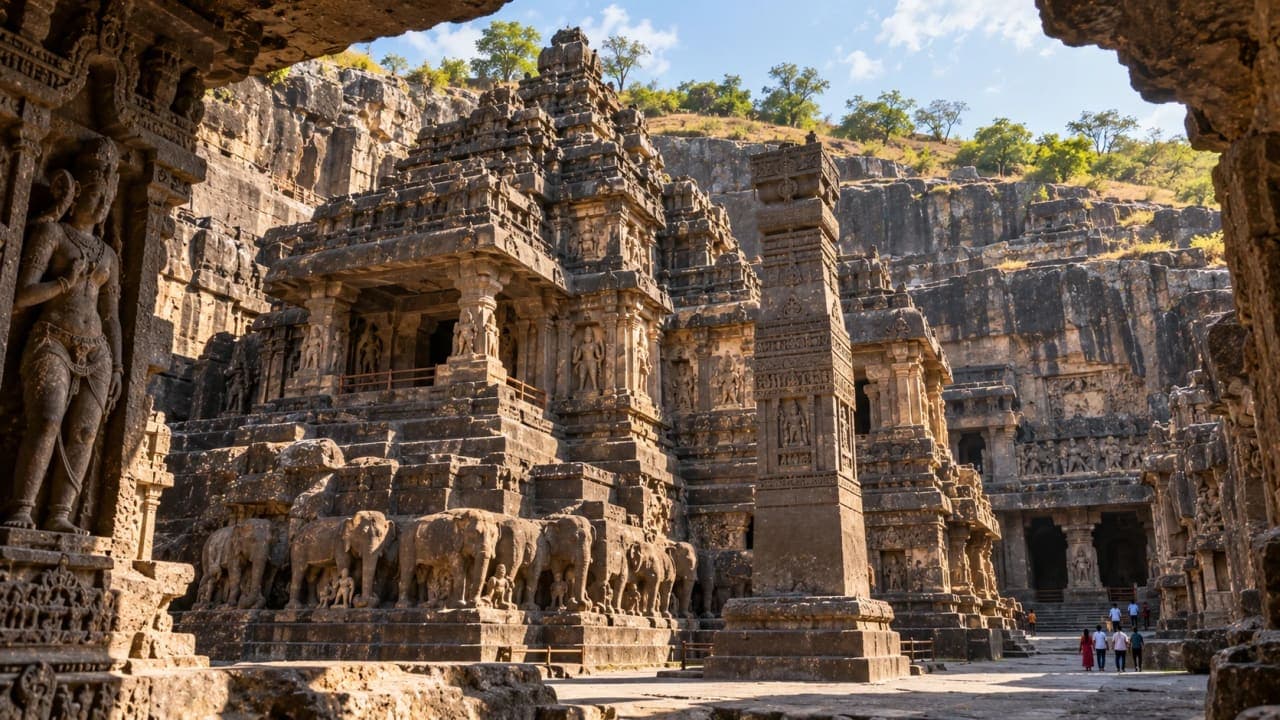
5. Kailasa Temple, Ellora – The Temple That Wasn't Built
Location: Ellora, Maharashtra
For the final temple, forget almost everything you normally imagine about construction.
There were no blocks brought to the site and stacked upward.
No brick walls gradually rising from foundations.
No enormous pieces assembled to create the finished temple.
Instead, craftsmen faced a mass of rock.
And began removing it.
What remained became a temple.
This is Kailasa Temple, Cave 16 of the Ellora Caves.
And it may be one of the most astonishing examples of rock-cut architecture anywhere in the world.
Building by Removing
That sentence sounds contradictory.
How can you build something by taking material away?
But that is precisely what makes Kailasa extraordinary.
The temple was excavated from basalt rock.
Rather than constructing the monument conventionally, craftsmen removed enormous quantities of material until architectural spaces, pillars, courtyards, sculptures and the monumental temple form emerged from the original rock mass.
UNESCO calls Kailasa the largest monolithic temple at Ellora and describes the excavation involved in its creation as an extraordinary technological achievement.
Think about the planning problem.
With ordinary masonry, if a stone is incorrectly placed, it may sometimes be removed.
If a wall needs alteration, parts may be rebuilt.
But when you're carving architecture directly from living rock, a major mistake can be irreversible.
Remove too much—
and you cannot put the mountain back.
How Did They Plan Something This Complicated?
This is where Kailasa becomes almost difficult to comprehend.
The craftsmen had to understand proportion before much of the final monument existed.
They had to anticipate where walls would remain.
Where columns would emerge.
Where sculptures would be carved.
Where open spaces would appear.
And how enough rock could be removed without destroying the structure they were trying to reveal.
This wasn't merely sculpture.
It was architecture created through subtraction.
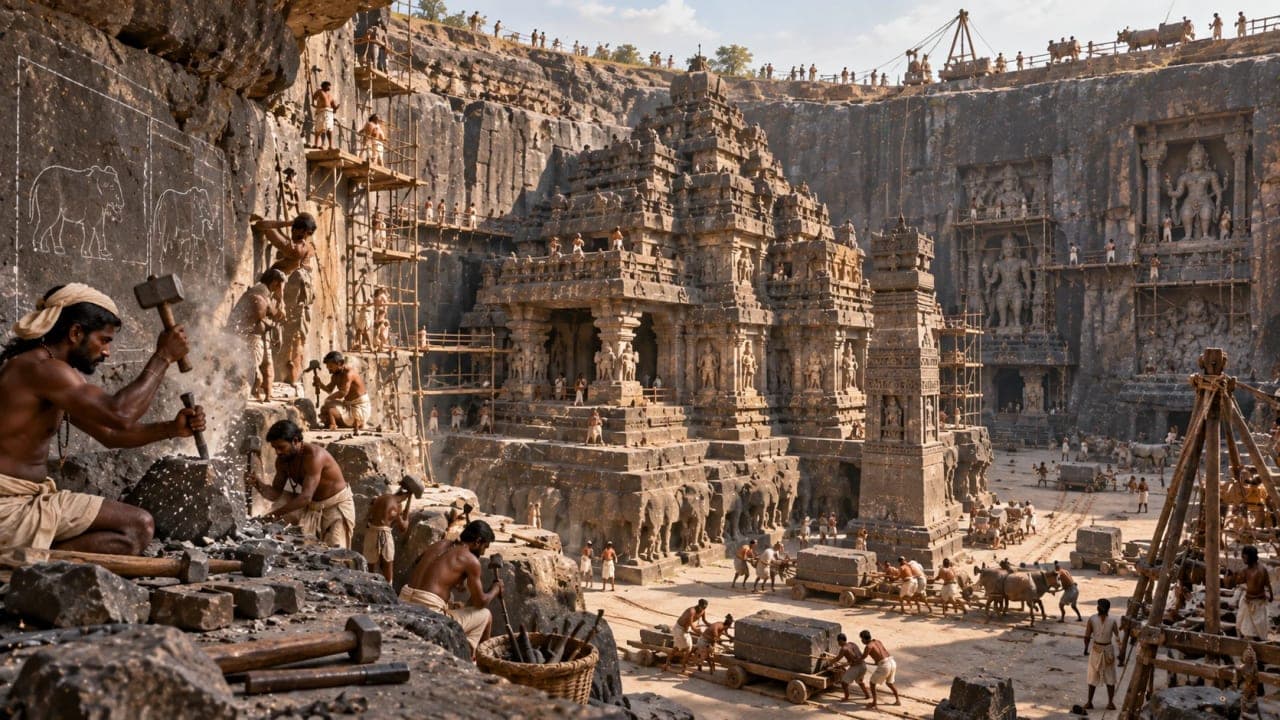
Was It Carved From the Top Down?
The monument is widely understood as having been excavated substantially from the top downward, an approach that makes practical sense for such an enormous rock-cut project.
But this simple statement sometimes turns into exaggerated internet stories.
You may encounter claims that the entire temple was completed in an impossibly short period or that ancient people could not have constructed it without lost technology.
Those claims deserve caution.
Large monuments were rarely the work of a single person swinging a hammer and chisel.
They involved organised labour, specialist craftsmen, planners, sculptors and generations of accumulated knowledge.
The fact that we cannot reconstruct every individual decision made by its builders does not mean those builders possessed supernatural technology.
Their achievement is impressive enough without exaggeration.
A Mountain Turned Into Kailasa
The temple is dedicated to Shiva, and its architectural conception evokes Mount Kailasa, Shiva's mythical abode.
That gives the monument an almost poetic dimension.
The craftsmen didn't simply place a temple beside a mountain.
They transformed part of the mountain itself into sacred architecture.
Elephants appear to support the monumental composition.
Mythological scenes cover the stone.
Massive pillars rise from the same rock from which the surrounding spaces were excavated.
And one of the celebrated sculptural compositions depicts Ravana attempting to shake Mount Kailasa.
Stone becomes architecture.
Architecture becomes mythology.
And mythology becomes landscape.
Perhaps that is the real secret of Kailasa Temple.
Not some lost machine.
Not an impossible civilisation.
But human planning, craftsmanship and patience operating on a scale that is difficult for us to imagine today.

So, Do These Temples Really Defy Logic?
After three parts of this journey, perhaps we need to change the question.
Maybe these temples don't actually defy logic.
Maybe they challenge the limits of what we expect.
A stone pillar producing a musical resonance has physics behind it.
Thousands of rats living safely inside Karni Mata Temple can be understood through ecology, protection and regular feeding.
Stambheshwar Mahadev disappears because of tides.
Kal Bhairav's unusual offering belongs to a particular religious tradition.
And Kailasa Temple was created through extraordinary rock-cut engineering rather than magic.
Knowing these things doesn't make the temples less fascinating.
It makes them more fascinating.
Because behind many so-called mysteries lies something just as extraordinary as a miracle:
human knowledge.
Knowledge of stone.
Knowledge of sound.
Knowledge of landscape.
Knowledge of ritual.
Knowledge passed from one generation to another.
But history rarely gives us every answer.
Some techniques disappear.
Some stories change.
Some explanations become mixed with folklore.
And sometimes the people who created something extraordinary leave behind the monument—but not a manual explaining exactly how they did it.
That empty space is where mystery survives.
Faith, Science and the Space Between Them
There is also something important that all fifteen temples in this series teach us.
Science and faith aren't always trying to answer the same question.
Science might explain why a tide rises around a Shiva temple.
Faith asks what that moment means to the person standing there with folded hands.
Physics can explain how stone vibrates.
History can study the people who carved it.
But neither can completely describe what a musician, pilgrim or sculptor centuries ago felt while standing in that hall.
That belongs to another kind of human experience.
Perhaps this is why India's ancient temples continue to fascinate us.
They aren't merely buildings.
They are archives.
Every pillar carries craftsmanship.
Every ritual carries memory.
Every sculpture carries a story.
And every unanswered question invites another generation to look closer.
Lock in the takeaway
Spiritual Travel Stories
Frequently asked questions
What are some of the most mysterious temples in India?
India has many temples associated with unusual architecture, natural phenomena and centuries-old traditions. Examples include Vittala Temple in Hampi, Karni Mata Temple in Rajasthan, Stambheshwar Mahadev in Gujarat and Kaal Bhairav Temple in Ujjain.
Why are the pillars of Vittala Temple called musical pillars?
The stone pillars of Vittala Temple in Hampi are famous for their resonant qualities. Different sections can produce distinctive tones when struck. Today, visitors should not strike the pillars, as they are protected historic structures.
Why are there so many rats at Karni Mata Temple?
The rats at Karni Mata Temple are considered sacred and are locally known as kabbas. Religious tradition connects them with Karni Mata and her followers, and devotees treat them with respect.
Does Stambheshwar Mahadev Temple really disappear under the sea?
The temple is located along the coast of Gujarat and is affected by the natural tidal cycle. During high tide, seawater surrounds and can submerge the shrine, while during low tide it becomes accessible again.
Why is liquor offered at Kaal Bhairav Temple in Ujjain?
Liquor is traditionally offered to Kaal Bhairav as part of the temple’s established ritual practice. The custom is connected with traditions surrounding Bhairava worship and has become one of the temple’s best-known features.
Are the mysteries associated with these temples scientifically proven?
Not all of them should be treated the same way. Some involve observable natural phenomena or remarkable architecture, while others come from religious traditions, legends and popular stories. Historical evidence for individual claims varies considerably.
Can tourists visit these mysterious temples?
Yes, these are places of worship or heritage sites that can generally be visited, although timings, rituals and visitor restrictions differ. Travellers should respect local customs and any archaeological conservation rules.
Is this article connected to the earlier Temples That Defy Logic stories?
Yes. This is Part 3 of the Temples That Defy Logic: Mysteries Hidden in Stone series, continuing the journey through unusual temples, traditions, legends, architectural achievements and natural phenomena found across India.