Listen to this article
Checking audio support
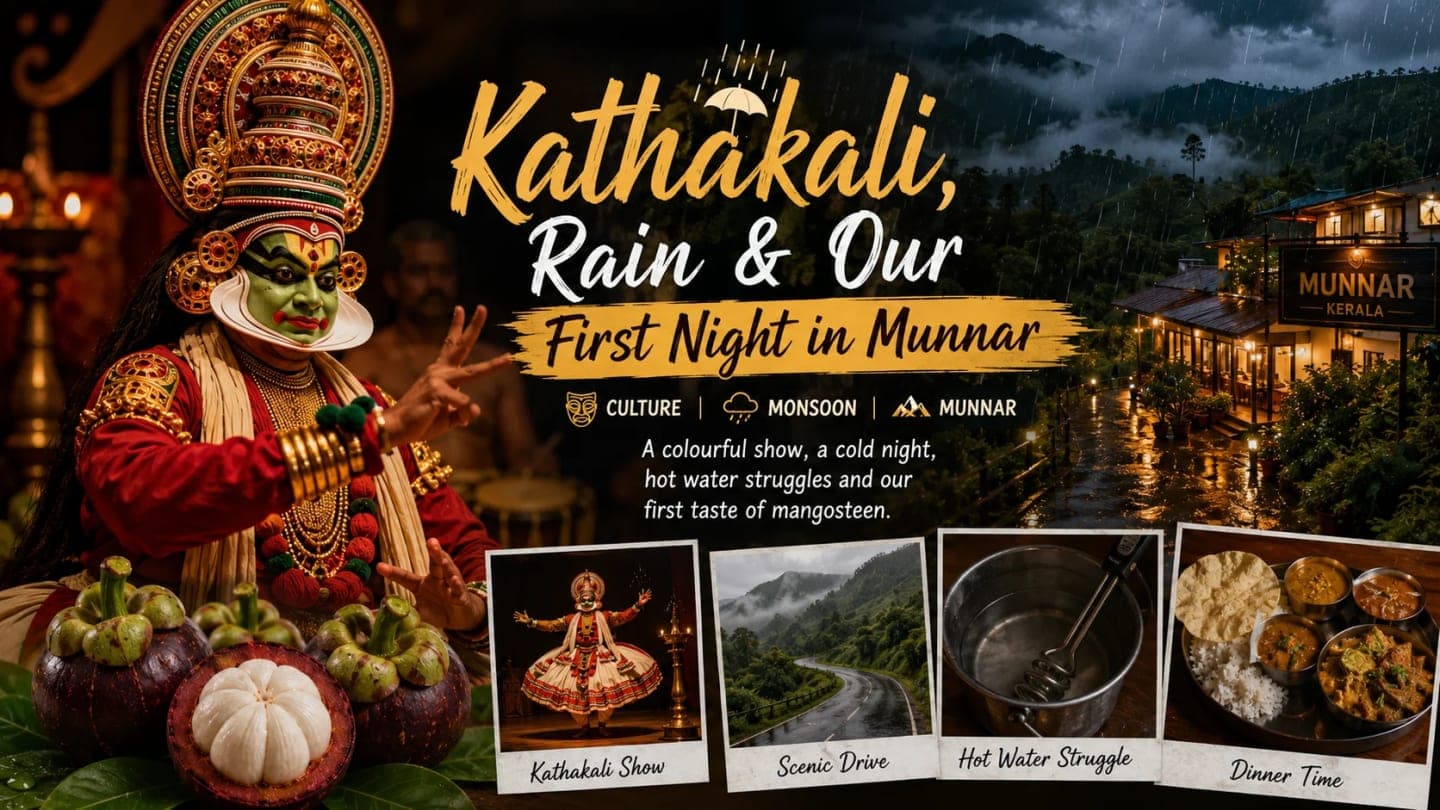
Kathakali, Rain & Our First Night in Munnar
Our jeep safari finally came to an end after what had turned into one of the most eventful parts of our Kerala journey. Ripple Waterfalls, Ponmudi Hanging Bridge, the dam, Kundala Lake, Nadukani, rain, endless photographs and even our first encounter with mangosteen—we had managed to fit quite a lot into a single day.
By the time we returned, we were tired, but apparently Kerala wasn't done with us yet.
Our jeep driver dropped us close to the place where a Kathakali show was about to begin. We hadn't even checked into our hotel yet. Our luggage was still with our cab wale bhaiya, and technically, after such a long day, going directly to the hotel would have been the sensible thing to do.
But we were in Kerala.
And there was a Kathakali performance starting right in front of us.
There was no way we were going to miss it.
From the Jeep Straight to Kathakali
We quickly bought our tickets and entered the performance hall.
The first thing I noticed wasn't the stage.
It was the temperature.
The hall was cold.
And when I say cold, I mean extremely cold.
We had already spent much of the day travelling through Munnar's rainy weather, and now we were sitting inside a dark, chilly auditorium. But once the lights dimmed and the performance began, our attention shifted completely towards the stage.
Smoke filled parts of the performance area.
Bright colours appeared under the lights.
Elaborately dressed performers entered the stage.
And suddenly, everything looked completely different from the Kerala we'd been exploring outside.
Until now, much of our trip had been about nature—backwaters, forests, waterfalls, mountains, tea gardens and rain.
This was Kerala telling us its story through art.
What Exactly Is Kathakali?
Kathakali is one of Kerala's most recognisable classical performing traditions. The name is generally understood as a combination of the Malayalam words katha, meaning story, and kali, meaning play or performance.
In other words—
Kathakali is storytelling through performance.
But calling it simply a "dance" doesn't quite explain what happens on stage.
Kathakali combines dance, drama, acting, music, elaborate costumes, facial expressions, hand gestures and rhythmic movement to tell stories, traditionally drawing heavily from Indian epics and Puranic literature.
The Ramayana and Mahabharata, along with stories concerning Krishna, Shiva and other figures from Hindu tradition, have provided material for generations of Kathakali performances.
The form developed in Kerala several centuries ago, with important influences from older ritual, martial and theatrical traditions of the region.
What eventually emerged was something extraordinarily visual.
And once you watch it live, you understand why.
The Face Tells the Story
One of the most fascinating parts of Kathakali is that performers don't depend on ordinary spoken dialogue to tell the audience what is happening.
Their faces become part of the language.
Eyes move dramatically.
Eyebrows rise and fall.
Cheeks change.
The mouth expresses anger, fear, amusement or surprise.
Even tiny movements can communicate emotion.
Kathakali performers traditionally undergo years of training to develop control over their bodies and facial muscles.
Sitting in the audience, we could see how exaggerated some expressions looked.
But that's intentional.
The performer needs to communicate an emotion clearly enough for an entire hall to understand it.
A glance isn't simply a glance.
An angry face isn't simply anger.
Everything is amplified into storytelling.
And Then There Are the Hands
Another important element is mudras, or codified hand gestures.
Different hand positions can represent characters, objects, actions and ideas. Combined with facial expressions and body movements, these gestures allow performers to communicate without relying on conventional dialogue.
To someone seeing Kathakali for the first time, it can be difficult to understand the precise meaning of every mudra.
We certainly couldn't.
But interestingly, you don't necessarily need to understand every gesture to enjoy the performance.
Music, expression, movement and the interaction between performers still tell you whether a scene is peaceful, dramatic, humorous or confrontational.
That makes Kathakali surprisingly engaging even for first-time viewers.
Those Colours Aren't Just Decoration
The costumes were probably the first thing that caught our attention when the performers appeared.
Everything was elaborate.
Huge skirts.
Heavy jewellery.
Large headgear.
Detailed facial makeup.
Strong colours.
Nothing about a traditional Kathakali costume is subtle.
But the colours aren't chosen simply because they look beautiful under stage lights.
Traditional Kathakali makeup uses visual codes to help communicate the nature of a character.
Green, known as pacha, is traditionally associated with noble and heroic characters.
Different combinations of red, black, yellow and other colours can indicate aggressive, demonic, divine, female or other character types depending on the traditional classification being represented.
So before a character has even done anything, an audience familiar with Kathakali can already understand something about who has entered the stage.
It's almost like costume design, character introduction and storytelling happening simultaneously.
Music, Rhythm and Movement
Behind the visual drama is equally powerful music.
Traditional Kathakali performances are accompanied by singers and percussion instruments, particularly drums such as the chenda and maddalam, along with cymbals and other accompanying instruments.
The singers narrate or sing the text while the actors interpret it through movement and expression.
This creates an interesting separation.
One person may be providing the voice.
Another person is becoming the character.
The drums then build tension around them.
During dramatic moments, the combination becomes incredibly powerful.
Even without knowing every detail of the story being performed, you can feel when something important is happening.
From Temple-Night Performances to Tourist Shows
Traditional Kathakali is very different from the shorter performance most tourists encounter in places such as Munnar, Thekkady and Kochi.
Historically, full Kathakali performances could last for many hours, sometimes continuing through the night.
Modern cultural centres understandably can't ask every traveller to cancel dinner and remain seated until sunrise.
So tourist-oriented shows usually present a shortened introduction to the art form.
Depending on the venue, the programme may begin with demonstrations of facial expressions and mudras before moving into a selected dramatic sequence.
This actually works quite well for someone watching Kathakali for the first time.
You get to see how the language of the performance works before watching the artists use it in a story.
How is it so far?
Vote with other readers
For us, it was enough to appreciate just how much discipline goes into what appears on stage.
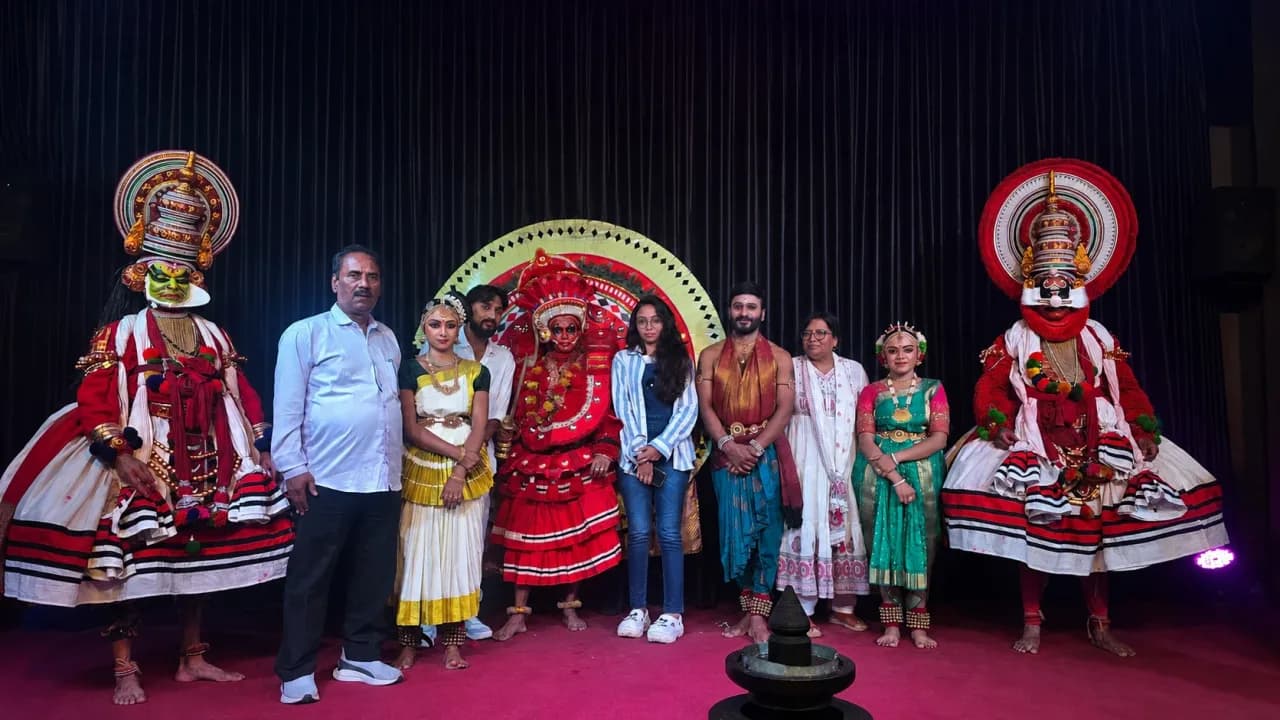
Smoke, Colours and a Completely Different Kerala
What I remember most from our show is the atmosphere.
The dark hall.
The cold air.
Smoke moving across the stage.
Bright costumes suddenly appearing beneath the lights.
Strong facial expressions.
Music.
Rhythmic movement.
It was dramatic and colourful without feeling like anything we'd watched before.
Just the previous evening we'd seen Kalaripayattu, Kerala's martial tradition, where fire, weapons, physical strength and speed dominated the performance.
Now we were watching Kathakali, where expression, storytelling, costume and controlled movement were the focus.
Together, the two performances showed us two completely different sides of Kerala's cultural heritage.
When the Kathakali show finally ended, however, our bodies reminded us about something.
We had been travelling all day.
We were exhausted.
And we still hadn't checked into our hotel.
Finally, Our Hotel
We met our cab wale bhaiya again and finally started towards our hotel.
The road leading there was beautiful.
Even though evening was setting in, we could still see hills, greenery and mist surrounding us. Rain had intensified after we came out of the Kathakali show, and the temperature had dropped further.
By the time we reached the hotel, nobody wanted another activity.
No viewpoint.
No waterfall.
No photograph.
Nothing.
We just wanted our rooms.
We completed the check-in formalities, collected our keys and went inside.
The plan was very simple:
Freshen up. Take a hot bath. Eat dinner. Sleep.
After spending an entire day in Munnar's cold monsoon weather, a hot bath sounded less like luxury and more like a necessity.
Unfortunately...
The hotel had other plans.
"Hot Water Is Available From 6 AM to 10 AM"
We asked about hot water and were informed that it was available only between approximately 6 AM and 10 AM.
That wasn't particularly useful at that moment.
According to the hotel staff, there was a limitation with their hot-water arrangement and fuel/gas availability in the area.
Whatever the reason, we had one immediate problem.
We were cold.
It was raining outside.
We had been travelling since morning.
And nobody wanted to take a cold shower in Munnar that evening.
So we spoke to the hotel staff and explained that we genuinely needed hot water.
Thankfully, they tried to help.
Their solution?
An immersion rod.
The Immersion Rod Adventure Nobody Asked For
Technically, the immersion rod solved the problem.
Practically?
It wasn't exactly comfortable.
We had to bring water out from the bathroom, heat it carefully using the immersion rod, wait for it to become warm enough and then carry the water back into the bathroom.
After spending an entire day climbing, walking and travelling, this was definitely not the relaxing hot shower we'd imagined.
But travel isn't always perfect.
Sometimes you get a luxury room overlooking mountains.
Sometimes you get an immersion rod and a bucket.
Both eventually become stories.
We somehow managed.
Was it a great bath?
No.
Was it technically a bath?
Yes.
At that point, that was enough.
Dinner Was Whatever the Kitchen Had Tonight
While we were dealing with our hot-water situation, the hotel staff came to take our dinner order.
Instead of a full restaurant menu, they told us what dishes were available that evening and asked us to choose from those options.
Again, after the day we'd had, nobody was interested in being overly selective.
We chose our food.
Freshened up.
Changed into comfortable clothes.
And waited for dinner.
When the food finally arrived, we ate peacefully.
The rain continued outside.
The temperature kept dropping.
And for the first time since morning, we were sitting somewhere without needing to rush towards another destination.
It felt good.
Wait... We Forgot the Mangosteen!
Dinner was over.
Everyone was tired.
Beds were calling.
Then we suddenly remembered something.
The mangosteen.
We had bought it earlier at Nadukani, carried it all the way back with us and somehow forgotten to actually eat it.
There was no chance we were carrying the "Queen of Fruits" around Kerala for another day without tasting it.
So before sleeping, we finally opened it.
The thick purple rind revealed soft white segments inside.
And then came the first bite.
Sweet.
Juicy.
Slightly tangy.
Refreshing.
After such a long day, sitting inside our Munnar hotel room tasting a completely new fruit felt like a strangely perfect ending.
Nothing dramatic.
No waterfall.
No safari.
No performance.
Just four tired travellers sharing a fruit they'd discovered earlier that afternoon.
Sometimes those tiny moments stay with you just as much as the big attractions.
One Day, So Many Different Stories
When we thought about everything we'd done since morning, it almost didn't feel like one day.
We had left Thekkady.
Walked through a spice garden in the rain.
Learned about medicinal plants and Ayurveda.
Stopped beside a giant black Ganesha statue.
Passed Eagle's Flight.
Taken a jeep safari.
Broken our camera stand.
Walked through the rain towards Ripple Waterfalls.
Bought fridge magnets.
Crossed Ponmudi Hanging Bridge.
Explored the reservoir landscape.
Visited Kundala Lake.
Stopped at Nadukani.
Discovered mangosteen.
Watched Kathakali.
Reached our hotel in pouring rain.
Fought for hot water.
Battled an immersion rod.
Had dinner.
And finally tasted the fruit we'd been carrying around all evening.
No wonder we were exhausted.
We switched off the lights knowing that sleep wouldn't take very long to arrive.
Outside, Munnar remained cold, wet and covered in rain.
Inside, we were finally warm enough to rest.
And that rest was important.
Because the next morning wasn't going to be slow.
Another long—and very exciting—day in Munnar was waiting for us.
Lock in the takeaway
Kerala Travel Stories

Frequently asked questions
What is Kathakali?
Kathakali is a classical performing tradition from Kerala that combines acting, dance, music, facial expressions, hand gestures, elaborate makeup and colourful costumes to tell stories.
What does the word Kathakali mean?
The name is generally understood as a combination of katha, meaning "story," and kali, meaning "play" or "performance." Kathakali can therefore be understood as storytelling through performance.
What stories are performed in Kathakali?
Traditional Kathakali performances often draw from Indian epics and Puranic stories, including episodes from the Ramayana and Mahabharata and stories involving Krishna, Shiva and other figures.
What is special about Kathakali makeup?
Kathakali makeup isn't merely decorative. Colours and facial designs traditionally help identify different types of characters. Green, or pacha, for example, is commonly associated with noble and heroic characters.
What are mudras in Kathakali?
Mudras are codified hand gestures used by performers to communicate characters, objects, actions and ideas. They work together with facial expressions and body movements to tell the story.
How long does a Kathakali show last?
Traditional performances could continue for many hours, sometimes through the night. Tourist-oriented cultural shows in destinations such as Munnar are usually much shorter and may include demonstrations of facial expressions and mudras followed by a dramatic sequence.
Is a Kathakali show worth watching in Munnar?
For us, definitely. The costumes, colours, music, expressions and stage atmosphere made it completely different from the other experiences we'd had in Kerala and offered a fascinating introduction to the state's cultural heritage.
Is Munnar cold during the monsoon?
Munnar's elevation generally makes it cooler than Kerala's coastal areas, and rain, wind and cloudy conditions can make evenings feel considerably colder. Carrying a light jacket and rain protection is useful during a monsoon visit.
What was your first night in Munnar like?
After the Kathakali show, we reached our hotel tired and cold. Limited hot-water availability led to an inconvenient encounter with an immersion rod, but after dinner and finally tasting the mangosteen we'd bought earlier, we were ready for a much-needed night's sleep.
What comes next in your Kerala travel series?
Our next day in Munnar was going to be long and packed with new experiences. After a much-needed night's rest, we were ready to wake up and continue exploring another side of this beautiful hill destination.